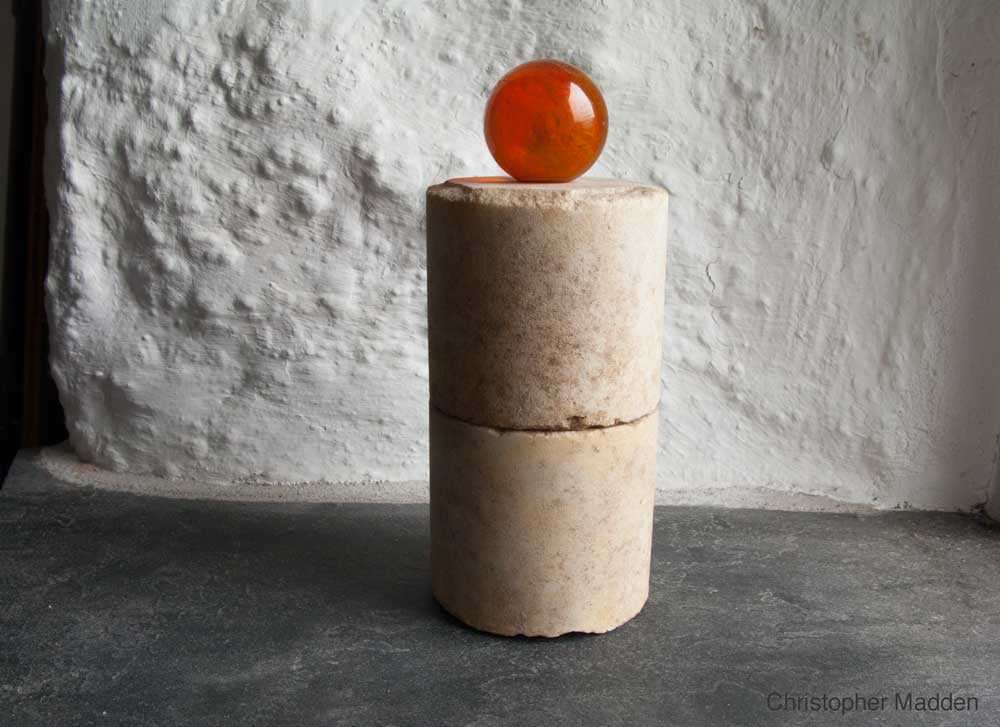
Sculpture involving light through a translucent sphere
199. 10x10x20cm
An abstract sculpture exploring the effects of light using a translucent resin sphere on the top of a marble column. In the photograph the sculpture is positioned on a slate base against a rough painted granite wall to give the work a robust organic feel.
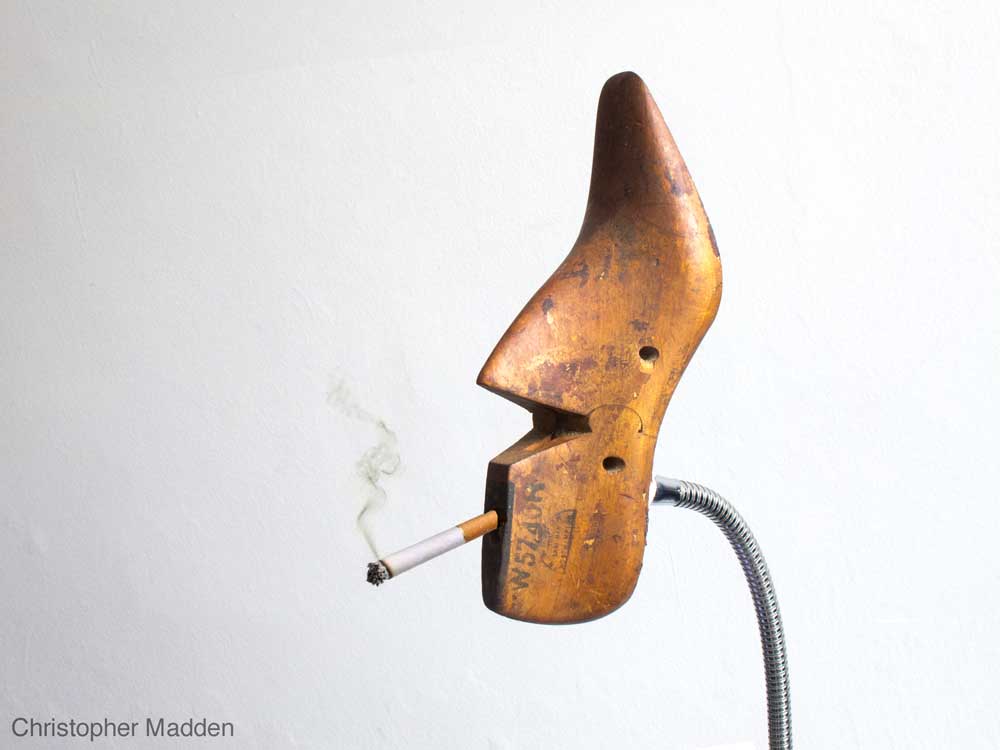
A surreal or dada found object sculpture made from a cobbler’s shoe last with a cigarette inserted into the circular hole in the last that is designed to accommodate a handle. The last is mounted on a lamp stand.
The sculpture utilises the human sensory condition known as pareidolia, the interpretation of shapes as human faces, to create a surreal head. Pareidolia is essential for the interpretation of a lot of art, especially art in which faces are merely suggested by, say, a few strokes of a paintbrush. In some art pareidolia is actually a curse though – think of the number of abstract images that are ruined when you see an unintentional face in them. The sculpture’s title, Last Cigarette, utilises the human tendency to reinterpret words to create puns – in this case the word ‘last’ referring to the wooden cobbler’s last, meaning that the cigarette is the last’s last cigarette.
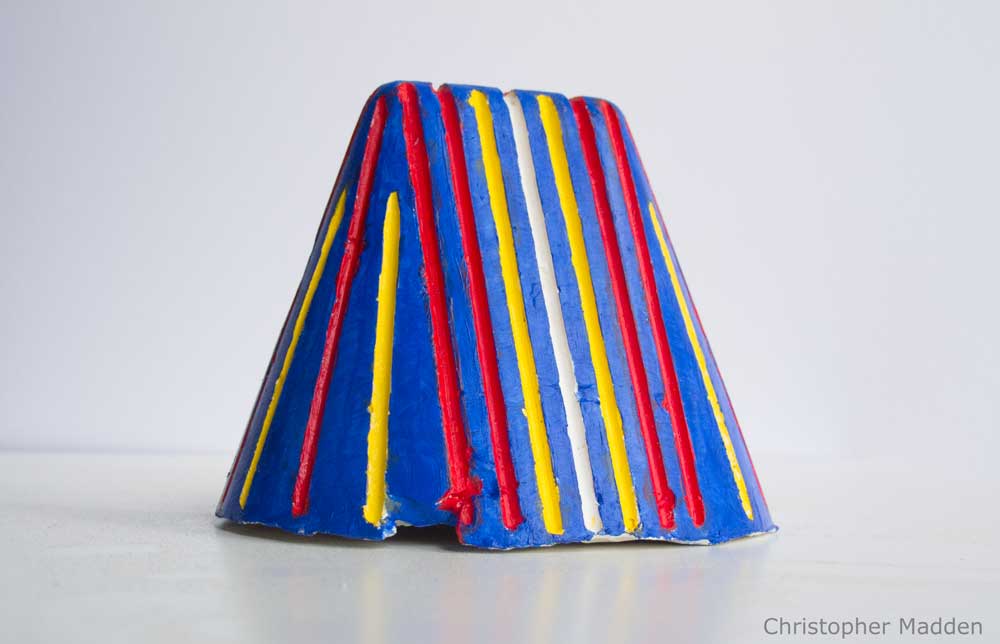
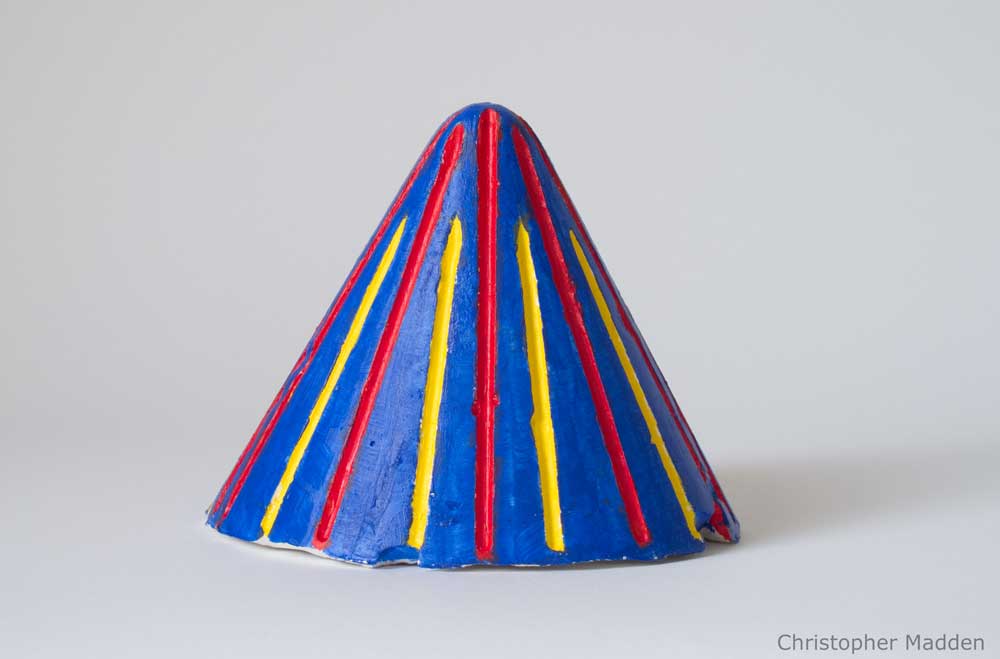
A small abstract contemporary sculpture created by casting the interior of a coffee filter cone. The work is deliberately created in a slightly crude style (notice the imperfections in the base).
The sculpture is painted in bright colourful primary colours, with the main surface of the sculpture painted blue while. he grooves in the sculpture (created by the ridges in the coffee filter cone) are in red or yellow (with a couple of white ones too).
The sculpture has an overall positive feel to it, caused partly by the bright colours and partly by the simple conical shape with its grooves.
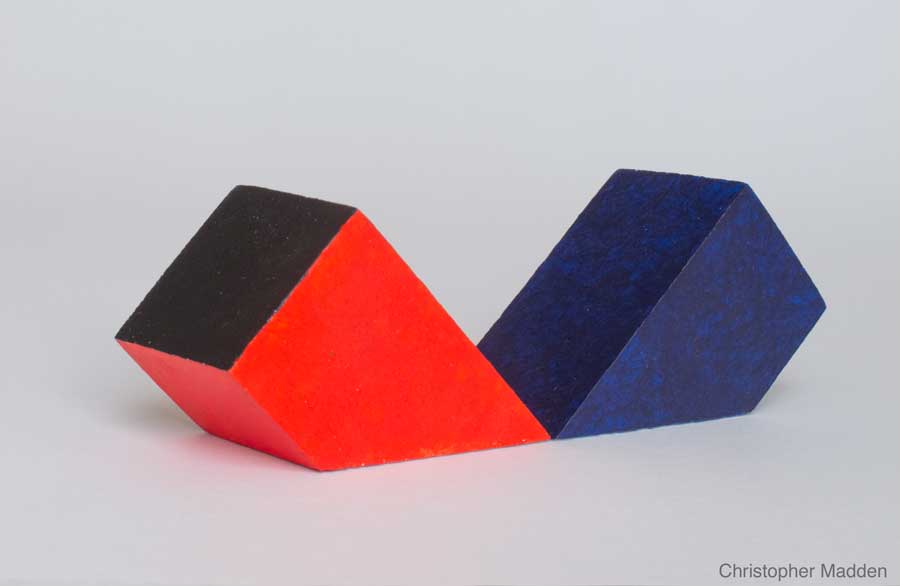
It’s hard to tell how big this sculpture is from this photograph.
It could be a couple of metres tall. In fact it’s closer to five centimetres, as the piece is created from lengths of 2×2 wood (two inches by two inches). The work has a strange relationship with scale. It’s small, but it could be big.
At it’s actual size this sculpture looks as though it’s happy at the size that it is, while somehow containing the spirit of a larger sculpture within itself. In some ways it gives the impression of being a large object that is somehow being perceived as being small, as though viewed through the wrong end of a telescope.
As I mentioned, this work is composed of two pieces of two by two wood. This is a common size of wood sold in long lengths in timber yards for use in general construction projects. This sculpture came about when I picked up two short offcuts of wood from a different project, that each had been cut at 45 degrees at one end, and placed them on a work surface on their angled faces. They instantly acquired a dynamic and vital presence. Due to the manner in which they rested at an angle each piece looked as though it was embedded in the surface with part of its form submerged.
One of the things I like about this work is that it is made from extremely simple components – two pieces of wood from a builders’ merchants and a bit of red and blue acrylic paint. Yet it doesn’t look like a work created in the spirit of found objects or ‘detritus art’ in which the work is often deliberately engineered to emphasise its origins in the flotsam and jetsam of contemporary consumer culture (Artists such as Philidda Barlow, whose work I like greatly, and Abraham Cruzvillegas come to mind as good exponents of this genre). The bright red and blue primary colours of the sculpture help, as found object sculpture is often the colour of rubbish. In fact this sculpture could almost be mistaken for a tiny example of the highly engineered works that are quite common in modernist sculpture.
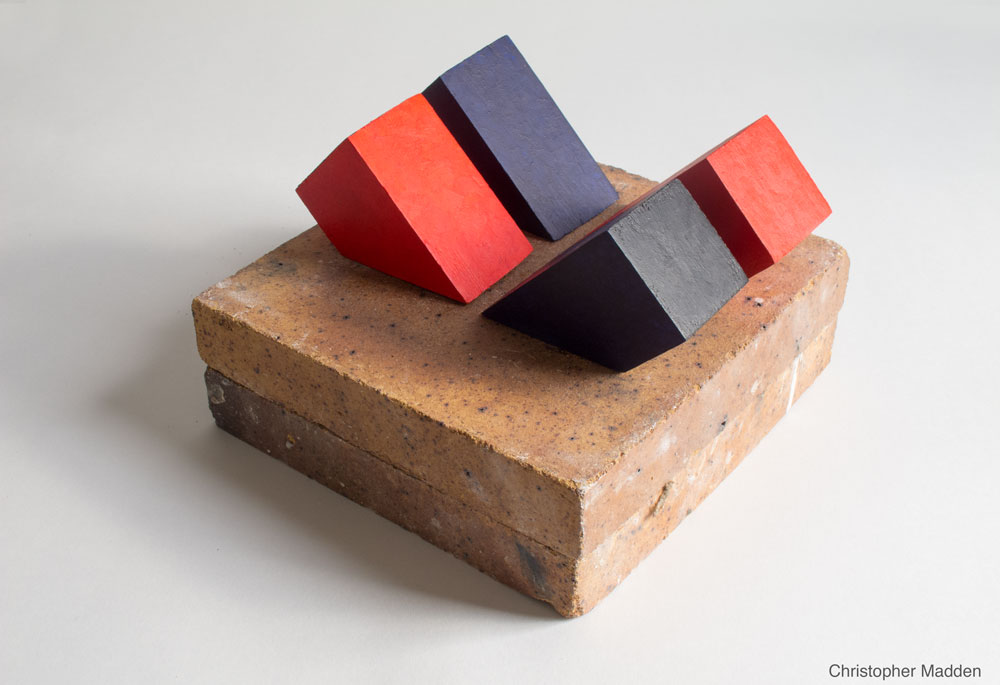
Wood, ceramic, acrylic paint Height 12cm August 2017
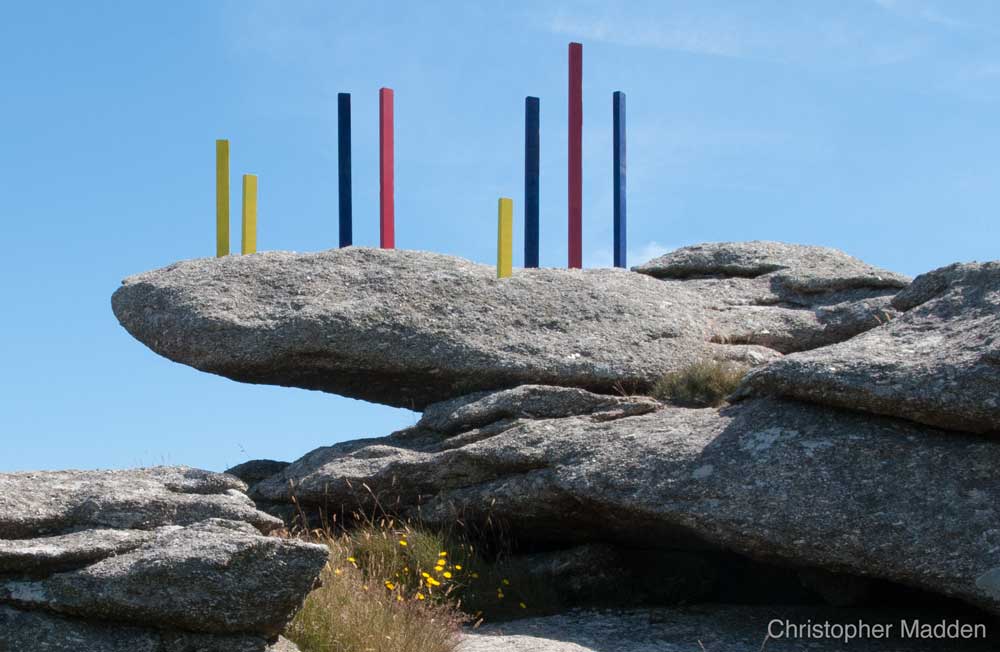
A sculpture composed of four identically shaped, differently coloured blocks of wood mounted on two ceramic tiles. The wood blocks are set at an angle to the vertical to give the impression that they may be partly concealed within the base on which they stand. The work is deliberately made from mundane material at a small scale which gives the work a surprising intimacy.
The piece is composed of scrap material that has been recycled or upcycled to create the artwork. It is no doubt influenced by the Arte Povera movement which used discarded artefacts to construct artworks. It is also influenced by the current awareness of environmental issues and the problems posed by consumer waste.
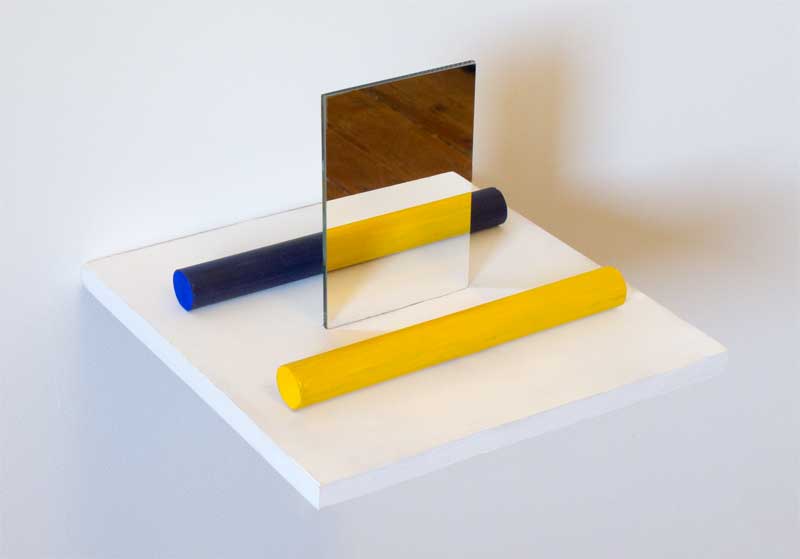
Colour Discontinuity 3 – the illusion of continuity
Front surface mirror, wood, acrylic. March 2017 20x20x14cm
A colored rod reflected in a mirror, positioned so that the reflection of the rod coincides with another rod of a different color on the other side of the mirror, creating an ambiguous optical effect.
A study of ambiguous visual stimuli to question the nature of perception and the interpretation of reality through the visual illusion of continuity.
The work is quite small and is intended to be viewed close up. Because of this the mirror used is a front surfce mirror (or first surface mirror), which is a mirror that is coated on the front rather than the back. As a result there are no ghost reflections caused by the thickness of the glass.
I’ve worked with mirrors since I was a teenager in the late 1960s, when I ground the parabolic mirror for an astronomical telescope that I’d constructed. I got it coated by Grubb Parsons, a telescope manufacturing company that constructed seriously large telescopes including the Isaac Newton telescope and the William Herschel telescope. I used that mirror in one of my early mirror art experiments in about 1970.
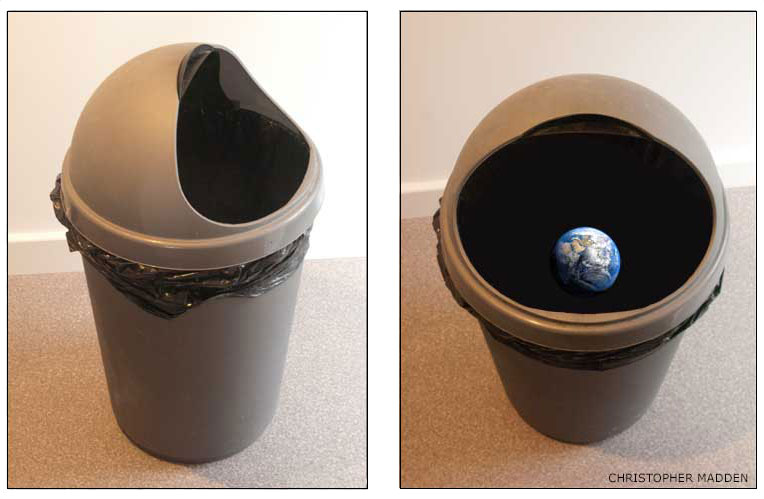
Environmental contemporary art – the Earth in a kitchen waste bin.
Kitchen waste bin, digital display. January 2017, Cornwall.
This is an example of my work on environmental issues such as global warming and climate change. This sculpture addresses the issues of over-consumption, environmental degradation and waste. I have been creating work about the state of the natural world and the environment since the 1970s.
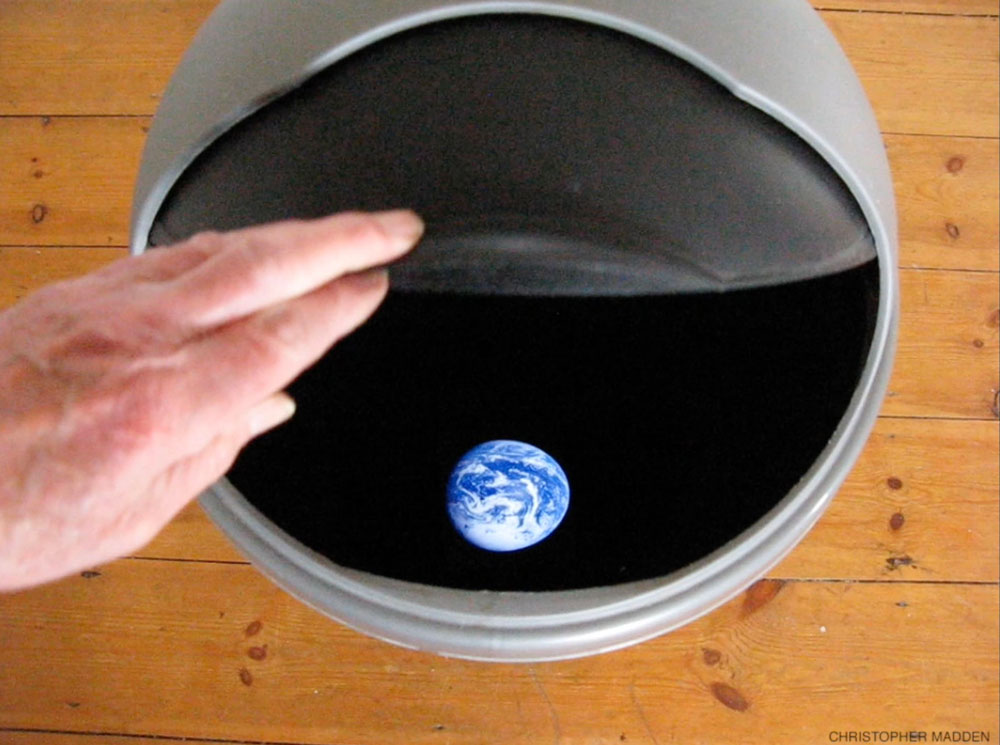
From most angles (as in the image on the left, above) the bin looks like any conventional kitchen bin: however when viewed from the front (the image on the right, above) the opening in the bin is transformed into a portal to the cosmos, with the Earth suspended in the darkness of outer space.
The inside of the bin is pitch black due to the use of extremely matt black paint, while the Earth shines as a back-lit image.
The work carries the environmental message that the human race is treating the earth with contempt and that we are effectively placing the planet itself in the rubbish bin.
The work is a development of a concept that I had in about the year 2000, when I produced several environment-themed drawings of the earth falling into a wastepaper basket. The sculptural potential of using a real rubbish bin to create an illusion of outer space is a more recent development.
A version of this work was shown in my solo show at Tremenheere Sculpture Gardens, Cornwall in 2022 and was shortlisted for the Royal Academy Summer Exhibition in the same year.
Below is a video of the work showing the dramatic optical illusion effect of the work which can only be appreciated in three dimensions of on video.
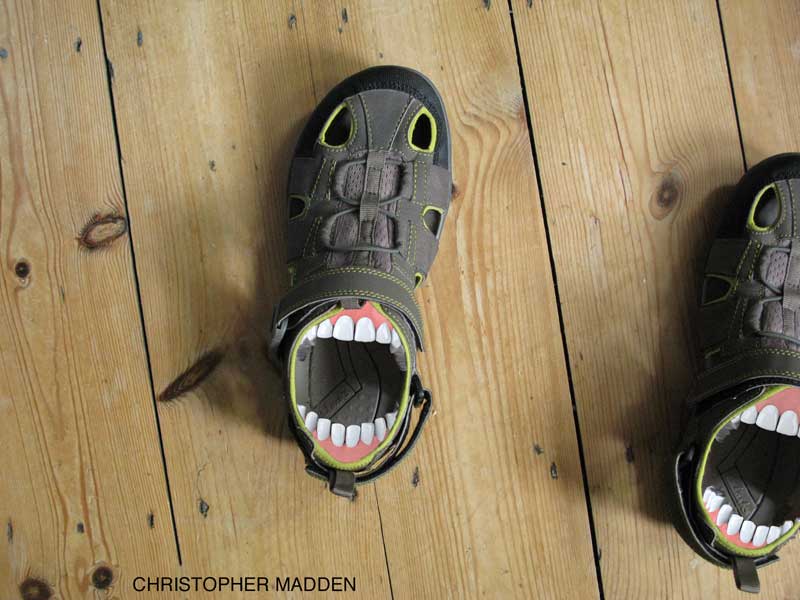
A study for a surreal work composed of a pair of shoes with mouths and teeth. The teeth in this study were added digitally. These particular shoes were chosen partly because the holes at the toe end of the shoes give the impression of eyes. An unsettling aspect of this concept is that it is normal for a person to put their feet into shoes – however these shoes look as though they would devour anything that was placed in their ‘mouths’. They are almost lying in wait for feet to be placed inside them. This work may be interpreted as being a metaphor for the manner in which consumerism devours people (especially via the connsumerism of clothing and fashion). I thought of the concept of carnivorous shoes that devour their wearer many years ago and drew it as a sketch. It’s currently misplaced in my studio so I’m not sure of the year.
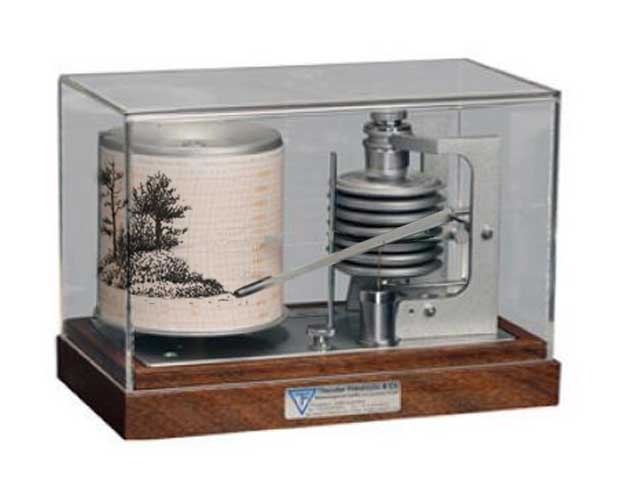
Study for a proposed sculpture. Photograph of a barograph, digital manipulation. January 2017
A photograph of a barograph digitally altered so that the arm of the barograph appears to be creating a fine pen and ink drawing of a landscape. A barograph normally draws a graph recording air pressure over the course of time on a sheet of graph paper attached to a rotating drum. This barograph is in the spirit of surrealism and dada – it is a scientific instrument appropriated for the purposes of art (In C P Snow’s two cultures thesis this would possibly count as cultural appropriation).
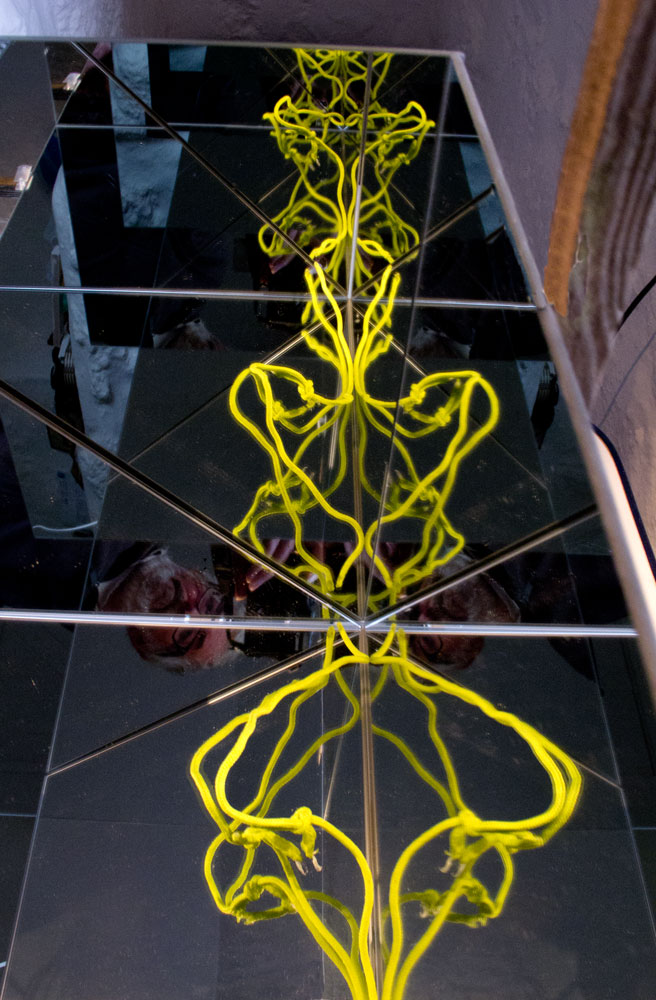
Mirrors, cord and light source: January 2017. W=30cm H=30cm
A study for a work composed of mirrors that are configured so that they create reflections round a symmetrical axis and also create reflections in infinite regression. The reflected object in this work is a single short length of coloured cord (about 40cm long), made to appear much longer by the multiple reflections in the mirrors. The cord is brightly coloured and is lit by a directional light source which gives the cord the effect of being a pulsating energy stream in a containment vessel, perhaps in a high energy physics laboratory. This work brings together my interests in art and science, especially the science of optics and perception.
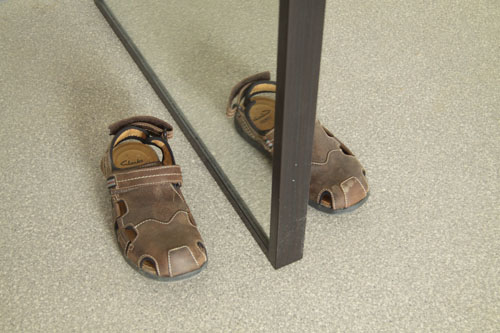
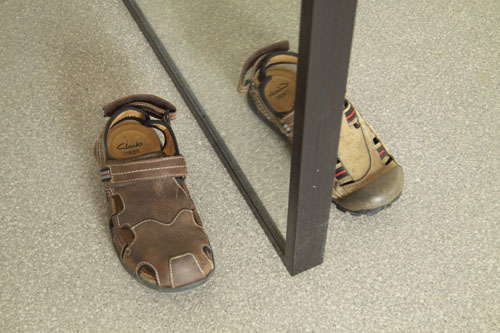
A pair of shoes reflected in a mirror, with the shoes positioned so that the reflection of the shoe in the mirror coincides exactly with the other shoe on the opposite side of the mirror, thus optically merging the real shoe with the reflection of the other shoe. Like a lot of my works that involves optical illusion and perception this one explores the line between reality and our interpretation of what we perceive. It also links art with humour – humour being an interesting psychological interpretation of the world.
Perception and deception. Odd shoes reflected in a mirror
Shoes, mirror. January 2013
Part of a series of works involving the reflection of shoes in a mirror, with the shoes positioned so that the reflection of each shoe in the mirror coincides exactly with the other shoe on the opposite side of the mirror. In this work the shoes involved are not a pair. This creates a double dissonance in the viewer. Firstly the viewer has to interpret the fact that the reflected part of the shoe is not part of the other shoe, and secondly the viewer has to interpret the fact that the two shoes are different (with the degree of difference varying depending on the position of the viewer and thus the amount of the shoe that is behind the mirror that is visible). Like a lot of my works that involve mirrors, reflections, perception and optical illusions this one explores the line between reality and our interpretation of what we perceive. Hopefully it includes an element of humour too.
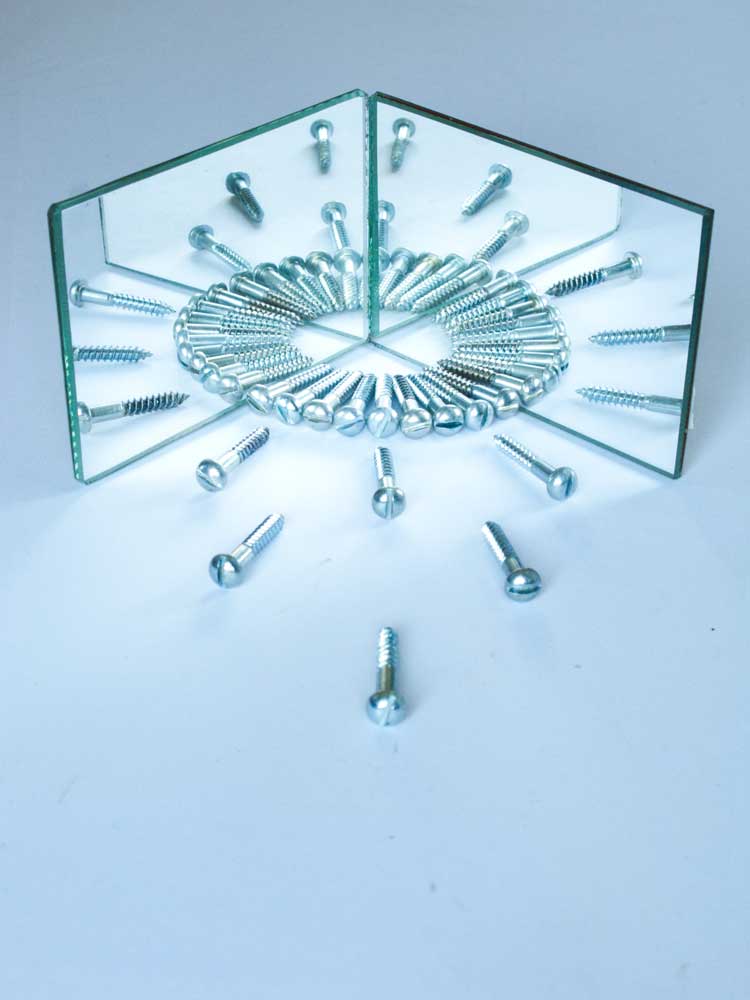
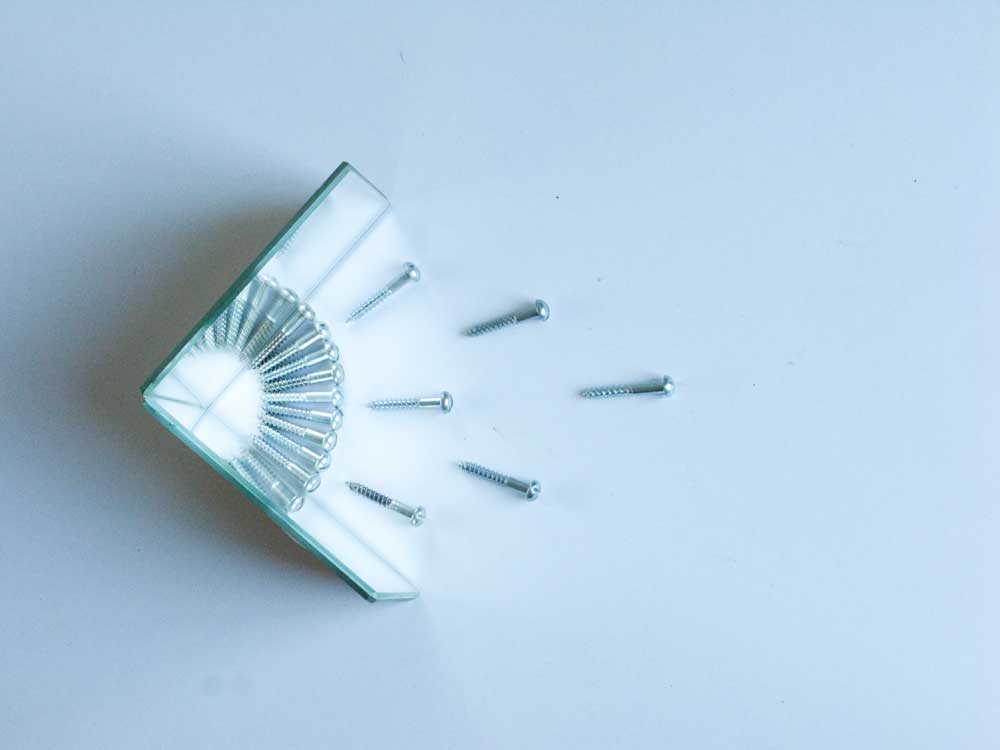
A study of reflections using mundane everyday objects to create interesting multiple reflections. Here ordinary hardware screws are arranged to form a dynamic expansive configuration. Screws lend themselves to this study partly because of their physically dynamic shape – large at one end and then tapering away at the other – and partly because of their intended purpose, which is to hold things in place – the exact opposite of dynamic expansiveness – which brings a slight touch of paradox to the work. If anyone looking at the image feels that I ought to have lined up the screw heads, it’s a deliberate act not to have aligned them, even though in real life I am an obsessive screw head aligner.
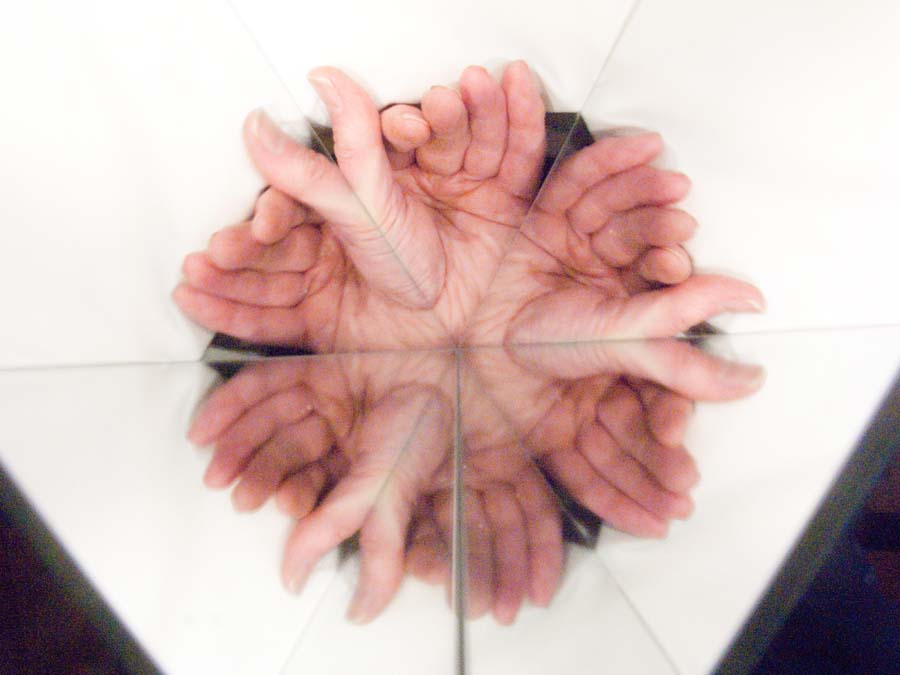
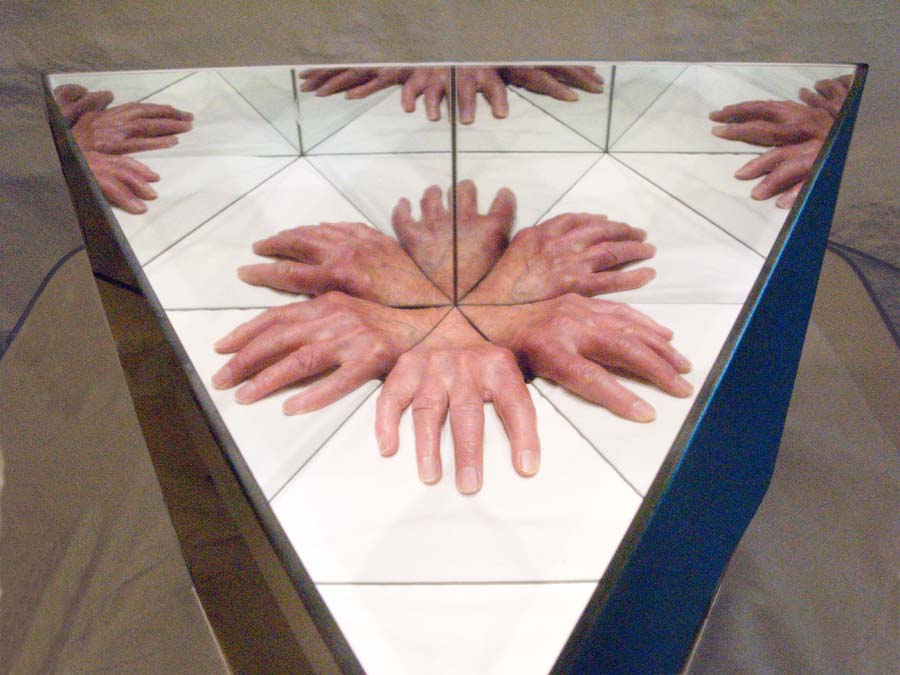
Metamorphosis: reflection of a hand into an alien creature
Mirrors and hand. October 2016
Three mirrors forming the vertical sides of a triangular box turn a hand into an alien creature by multiple reflections. The hand is intruding into the box through an opening in the corner. The artwork is an exploration of how a familiar object (a hand) can be transformed into something completely alien purely by the use of simple mirrors. A study of the familiar becoming unfamiliar via a mundane agency. When the fingers of the hand move the effect is surprisingly disturbing (I’ll make a video of it when I can).
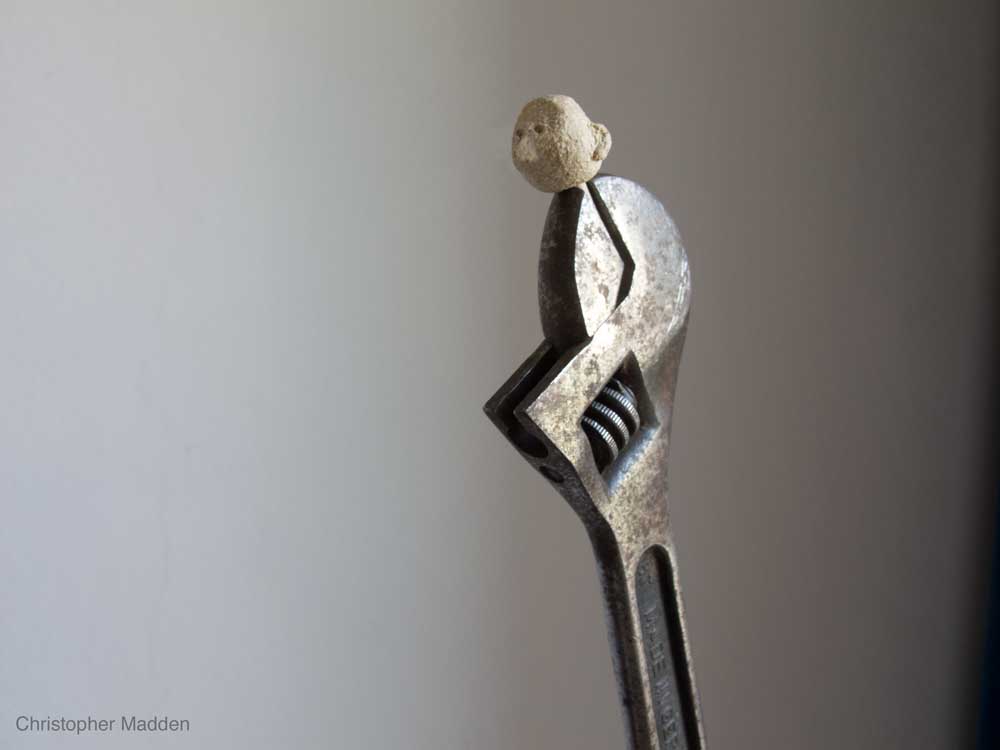
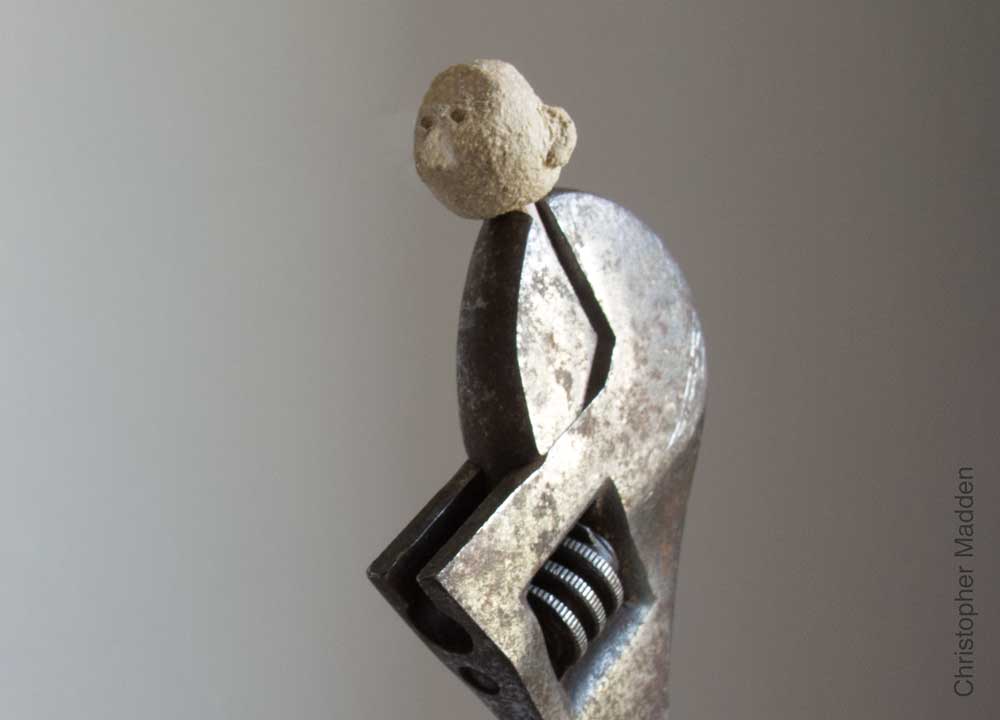
The ceramic head in this sculpture is held in the jaws of the spanner by a thin wooden rod that forms the head’s neck. It is uncertain whether the head is trapped in the jaws of the spanner or whether the head and the spanner form a single entity, with the spanner as the body (The shape of the spanner suggests a seated or crouching body). It could be interpreted that the head in the sculpture represents the thinking part of the person, while the spanner represents the physical body of the person, the thinking part thus being clamped (possibly against its will) to the physical part. This could have metaphysical connotations or connotations invoking the expression “born in the wrong body”. This tension of ambiguity of meaning is one of the things I like about the piece. Workshop tools and handyman tools such as spanners, hammers and pliers are a recurring feature of my small scale sculptural work.
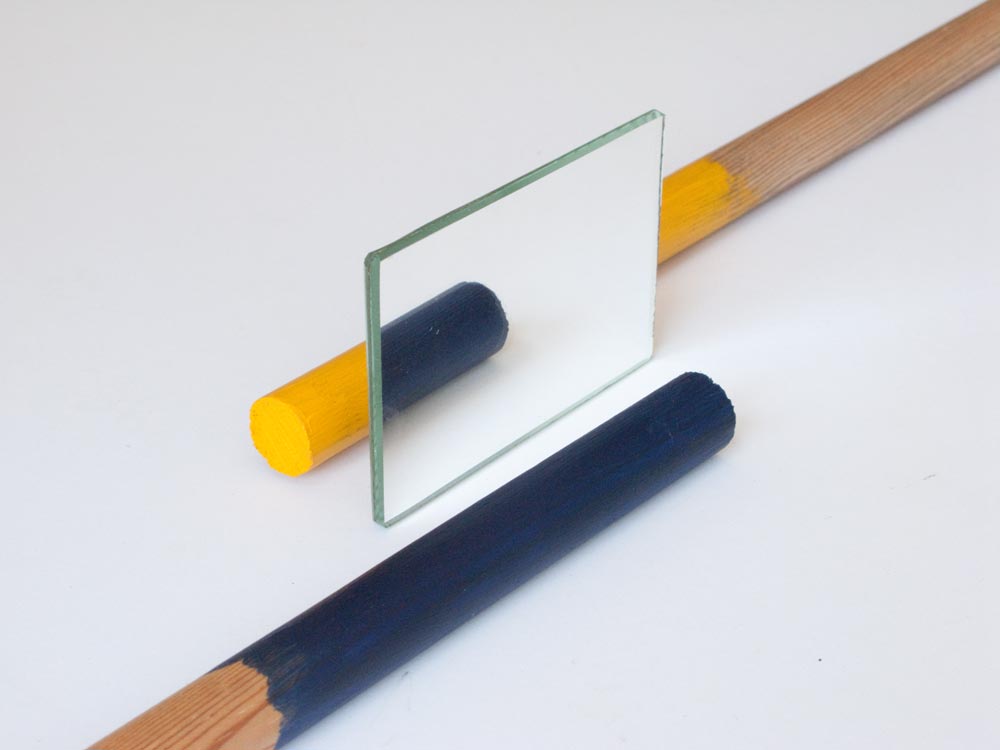
Colour Discontinuity 2. Optical illusion in mirror.
Mirror, coloured wooden rods. March 2017
A coloured rod reflected in a mirror, positioned so that the reflection in the mirror coincides with another rod of a different color on the other side of the mirror, creating an ambiguous optical effect.
A study in the perception and interpretation of ambiguous visual stimuli annd illusions. The study of reflections and their interpretation (especially illusions)is a common theme of my work. I have been fascinated by mirrors for most of my adult life, starting as a teenager in the late 1960s when I ground the parabolic mirror of an astronomical telescope that I constructed (It was an eight and a half inch mirror).
Colour Discontinuity 1. Coloured rods reflected in a mirror
Mirror, wooden rods, acrylic paint. July 2015
A coloured rod reflected in a mirror so that the reflection in the mirror coincides with a differently coloured rod on the other side of the mirror, creating a form of ambiguous optical illusion.
A study in perception, illusion and the interpretation of ambiguous visual stimuli. I’ve been interested in mirrors and reflections since I was a teenager in the late 1960s. My first mirror based work was done at that time. It started a science based endeavour rather than an artistic one – involving the construction of an astronomical telescope, including the grinding of its primary parabolic mirror.
Humour in contemporary art. Defaced/refaced statue.
Classical statue, marker pen. June 2015.
A humorous work consisting of a headless classical statue with a cartoon-like face drawn onto the oval form of the neck. Part of the humor of this piece is the juxtaposition of opposites – the elegant and timeless form of the classical statue in contrast to the crudeness and immediacy of the contemporary cartoon head. The piece also contains dark humour and an unsettling quality due to the fact that the drawn two-dimensional head is occupying the surface created by the decapitation of the statue’s three-dimensional head. The drawn-on face also has the appearance of graffiti, so it could be said that the act of giving the statue a face is in fact defacing the statue. The word deface literally means to remove the face (as occurred with iconoclasm and the vandalisation of statues in the past), so the fact that the act of adding a face to a statue can be interpreted as defacing the statue is ironic. Humour is an important element in a lot of my contemporary art work. As well as being an artist I’m also a cartoonist, with my cartoons having been publishered widely in publications such as the Guardian, the Daily Telegraph, the Sunday Times and the Irish Sunday Independent newspapers, and magazines such as Private Eye, the Spectator, Prospect, the Critic and more.
The Oppressor Impaled by the Oppressed. Hammer and nails sculpture
Hammer, nails, plank. June 2015.
A sculpture composed of a hammer nailed to a plank of wood. The hammer is being empaled by the objects that it normally hits. This can be interpreted as a metaphor for oppression and rebellion, and it’s also a study in irony. How did the nails come to be impaling the hammer? Were the nails hammered into place by another hammer? In this case the nails may not be the downtrodden oppressed rising up to overthrow their oppressor using their own power, but are possibly the followers of another power (another hammer?) that may turn out to be as oppressive as the hammer they’ve empaled.
Other versions of this piece have the hammer on a horizontal surface, such as on the top of a plinth, while further iterations use different numbers of nails. The vertical version shown here is in some ways disturbing because the vertical configuration gives more of an impression of the hammer being violently empaled rather than simply nailed down to the spot. It is also disturbingly suggestive of a crucifixion in Christian iconography.
These photos show one of my early artistic experiments using mirrors when I was a sixteen years old still at school. My apologises for the quality of the images – they are quite old and I developed the negatives and printed them myself.
I think if I were to give this work a name now I’d probably call it Sky Bridge or something similar, because it links the earth to the sky. The name Sky Mirror also comes to mind, but Anish Kapoor’s already used that.
The concept behind the mirror actually bears several similarities to Anish Kapoor’s Sky Mirror, in that it’s a concave mirror that reflects the sky, although Kapoor’s Sky Mirror is thirty times the size and cost about a million pounds more. I think I probably paid for this one from the money from my paper round. Anish Kapoor wasn’t yet a student at Hornsey College of Art at the time of these photos.
The mirror is an eight and a half inch parabolic mirror which I ground for a Newtonian reflecting telescope that I constructed as a teenager in 1969. My ambition for a career at that time was to become an astronomer, not an artist.
As you can see from the first two photos, I’ve positioned the mirror in front of a rubbish bin (of a type that was used in the late 1960s) in the least aesthetically pleasing part of my parents’ garden.
The second photo, below, (which is massively underexposed in order to show the mirror, which would otherwise be just a disk of burnt-out white), shows the mirror propped up against the rubbish bin. You can see the sun and the sky reflected in the mirror. This is perhaps meant to show the contrast between the beauty and purity of the sky in contrast to some of the rubbish created by human endeavour (or to be more specific, my parents). It’s probably also meant to show that ultimately everything is connected, the beautiful and the ugly, the transcendent and the mundane.
The photo below shows the mirror on the ground amongst some trees. This is probably meant to show the link between the earth, the natural world and the sky, and by extension the cosmos.
Me grinding the mirror in my parents’ back garden in 1969.My brother, Pete, grinding the mirror