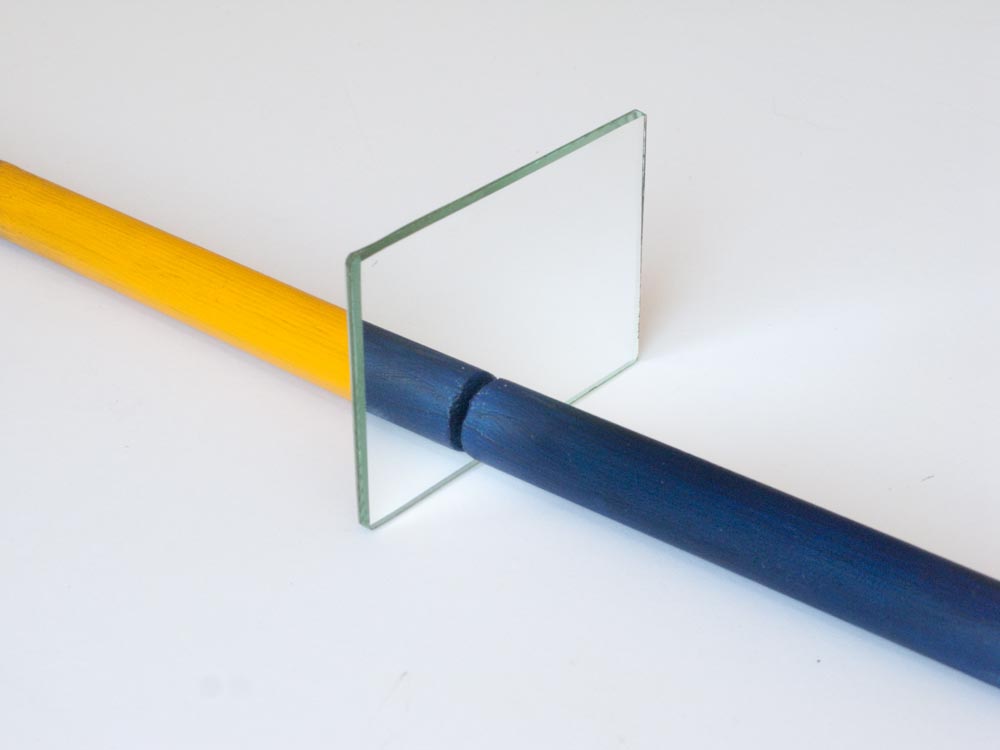
Colour Discontinuity 1. Coloured rods reflected in a mirror
Mirror, wooden rods, acrylic paint. July 2015
A coloured rod reflected in a mirror so that the reflection in the mirror coincides with a differently coloured rod on the other side of the mirror, creating a form of ambiguous optical illusion.
A study in perception, illusion and the interpretation of ambiguous visual stimuli. I’ve been interested in mirrors and reflections since I was a teenager in the late 1960s. My first mirror based work was done at that time. It started a science based endeavour rather than an artistic one – involving the construction of an astronomical telescope, including the grinding of its primary parabolic mirror.
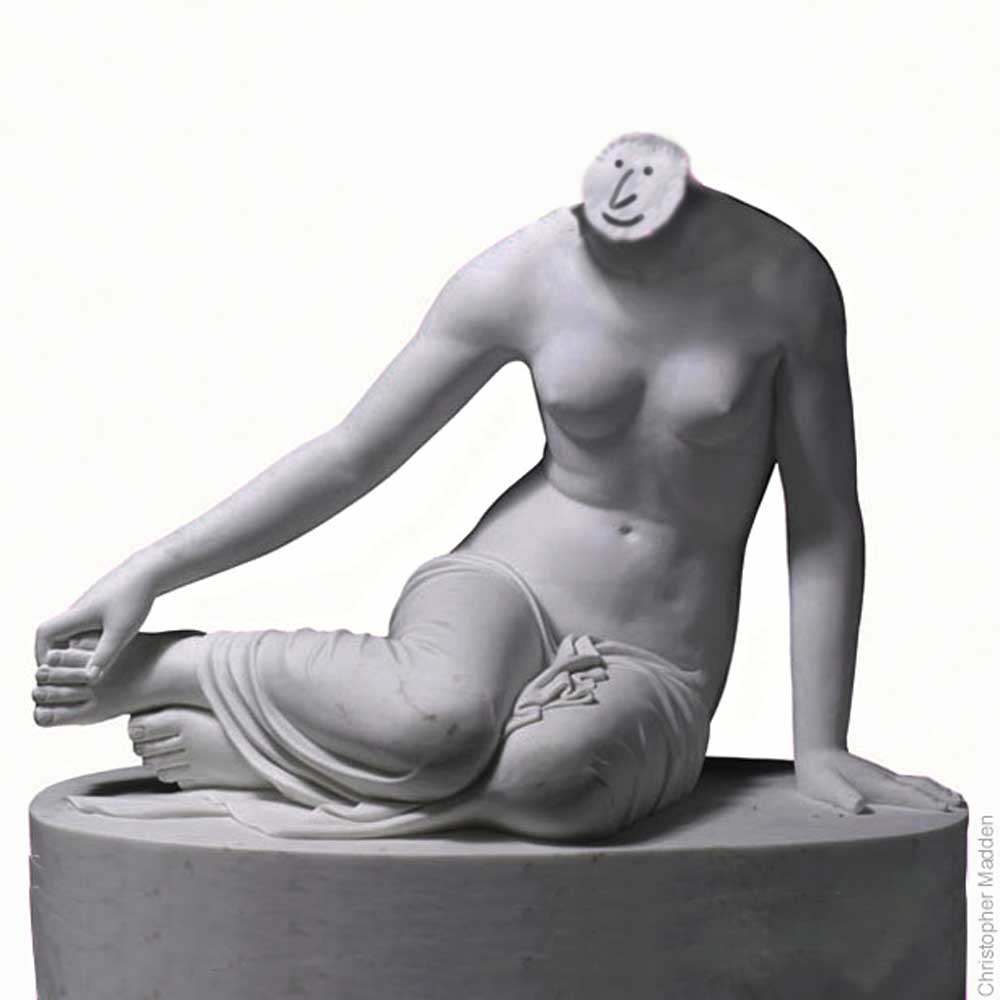
Humour in contemporary art. Defaced/refaced statue.
Classical statue, marker pen. June 2015.
A humorous work consisting of a headless classical statue with a cartoon-like face drawn onto the oval form of the neck. Part of the humor of this piece is the juxtaposition of opposites – the elegant and timeless form of the classical statue in contrast to the crudeness and immediacy of the contemporary cartoon head. The piece also contains dark humour and an unsettling quality due to the fact that the drawn two-dimensional head is occupying the surface created by the decapitation of the statue’s three-dimensional head. The drawn-on face also has the appearance of graffiti, so it could be said that the act of giving the statue a face is in fact defacing the statue. The word deface literally means to remove the face (as occurred with iconoclasm and the vandalisation of statues in the past), so the fact that the act of adding a face to a statue can be interpreted as defacing the statue is ironic. Humour is an important element in a lot of my contemporary art work. As well as being an artist I’m also a cartoonist, with my cartoons having been publishered widely in publications such as the Guardian, the Daily Telegraph, the Sunday Times and the Irish Sunday Independent newspapers, and magazines such as Private Eye, the Spectator, Prospect, the Critic and more.
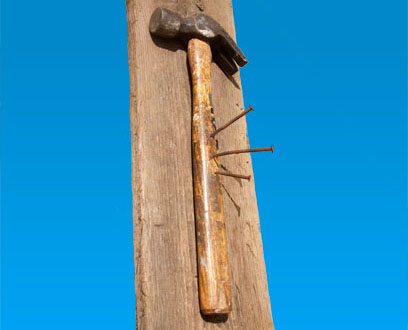
The Oppressor Impaled by the Oppressed. Hammer and nails sculpture
Hammer, nails, plank. June 2015.
A sculpture composed of a hammer nailed to a plank of wood. The hammer is being empaled by the objects that it normally hits. This can be interpreted as a metaphor for oppression and rebellion, and it’s also a study in irony. How did the nails come to be impaling the hammer? Were the nails hammered into place by another hammer? In this case the nails may not be the downtrodden oppressed rising up to overthrow their oppressor using their own power, but are possibly the followers of another power (another hammer?) that may turn out to be as oppressive as the hammer they’ve empaled.
Other versions of this piece have the hammer on a horizontal surface, such as on the top of a plinth, while further iterations use different numbers of nails. The vertical version shown here is in some ways disturbing because the vertical configuration gives more of an impression of the hammer being violently empaled rather than simply nailed down to the spot. It is also disturbingly suggestive of a crucifixion in Christian iconography.
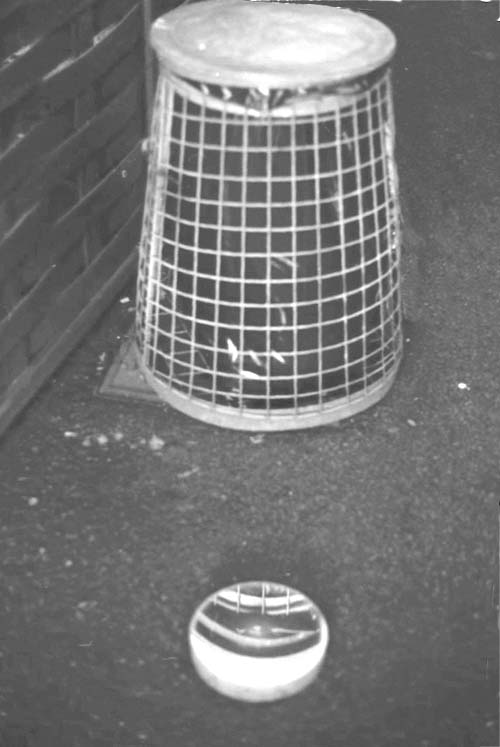
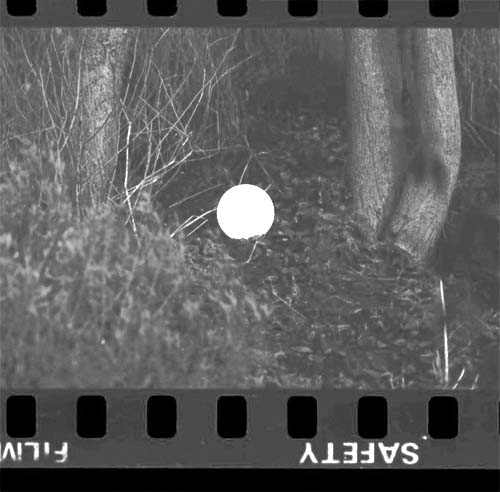
These photos show one of my early artistic experiments using mirrors when I was a sixteen years old still at school. My apologises for the quality of the images – they are quite old and I developed the negatives and printed them myself.
I think if I were to give this work a name now I’d probably call it Sky Bridge or something similar, because it links the earth to the sky. The name Sky Mirror also comes to mind, but Anish Kapoor’s already used that.
The concept behind the mirror actually bears several similarities to Anish Kapoor’s Sky Mirror, in that it’s a concave mirror that reflects the sky, although Kapoor’s Sky Mirror is thirty times the size and cost about a million pounds more. I think I probably paid for this one from the money from my paper round. Anish Kapoor wasn’t yet a student at Hornsey College of Art at the time of these photos.
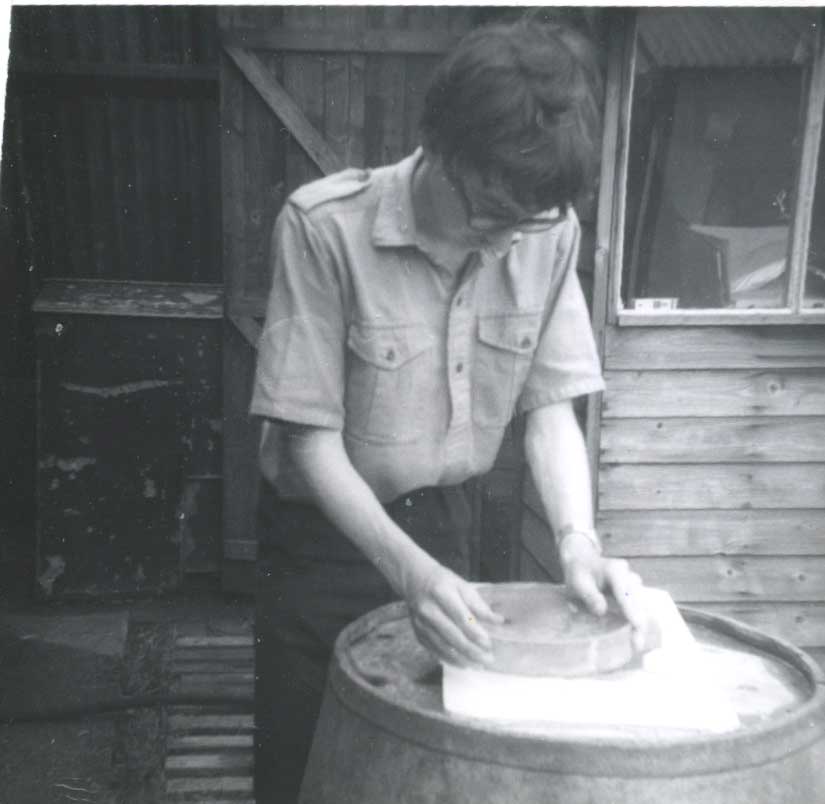
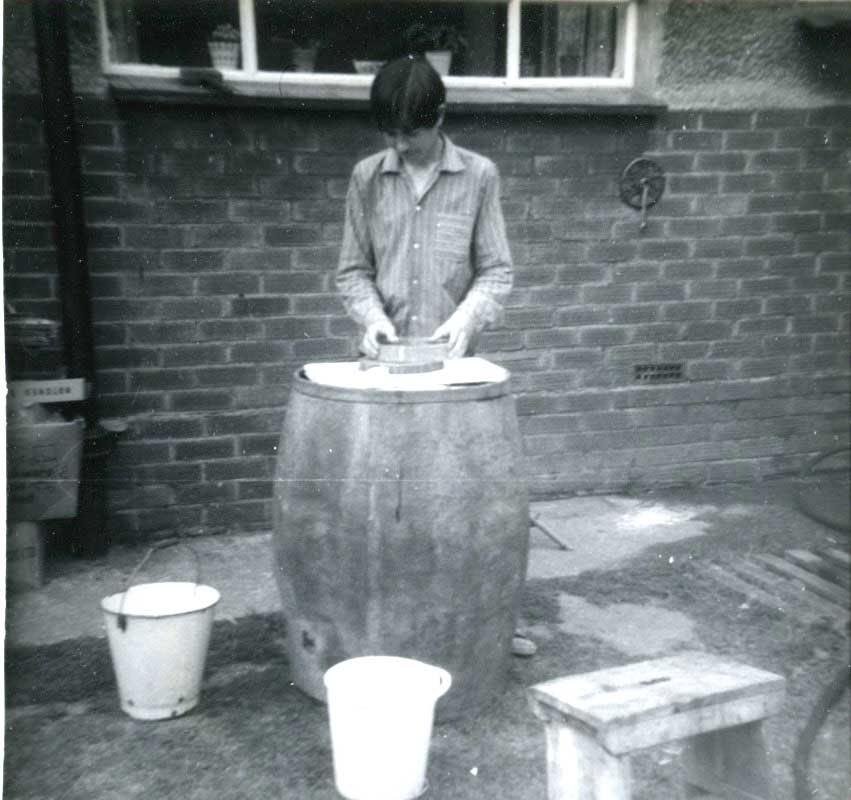
The mirror is an eight and a half inch parabolic mirror which I ground for a Newtonian reflecting telescope that I constructed as a teenager in 1969. My ambition for a career at that time was to become an astronomer, not an artist.
As you can see from the first two photos, I’ve positioned the mirror in front of a rubbish bin (of a type that was used in the late 1960s) in the least aesthetically pleasing part of my parents’ garden.
The second photo, below, (which is massively underexposed in order to show the mirror, which would otherwise be just a disk of burnt-out white), shows the mirror propped up against the rubbish bin. You can see the sun and the sky reflected in the mirror. This is perhaps meant to show the contrast between the beauty and purity of the sky in contrast to some of the rubbish created by human endeavour (or to be more specific, my parents). It’s probably also meant to show that ultimately everything is connected, the beautiful and the ugly, the transcendent and the mundane.
The photo below shows the mirror on the ground amongst some trees. This is probably meant to show the link between the earth, the natural world and the sky, and by extension the cosmos.
Me grinding the mirror in my parents’ back garden in 1969.My brother, Pete, grinding the mirror