• Mirror art – reflected spheres

    contemporary mirror art multiple reflections

    Ring of Spheres – a study in the hierarchy of forms

    Mirrors, wood, papier mâché 15x28x30cm February 2022

    Two mirrors set at an angle to each other with a hemispherical object placed between them.

    The reflection of the hemisphere in the mirror on which its base rests creates the effect of a complete sphere, while the second mirror generates multiple reflections to give the effect of a ring of spheres. The number of spheres can be changed by varying the angle between the mirrors.

    It’s interesting to notice that when you look at this work you see reflected spheres although in reality you’re seeing reflected hemispheres. The sphere is visually, conceptually and metaphorically a more dominating form than the hemisphere, and thus its apparent presence in this work swamps the actual reality of there only being a hemisphere present.

    This work taps into my interest in the generation of forms from more basic forms, with simple forms being the building blocks of more complex entities and objects (see also my abstract moving image work). In this case the hemisphere can be interpreted as being an incomplete form which transforms into a complete sphere which in turn creates more spheres.

    The sphere can be thought of as a symbol of perfection or completeness, while a hemisphere is axiomatically incomplete (as its name implies).

  • Assemblage from discarded objects

    Contemporary art assemblage from upcycled objects

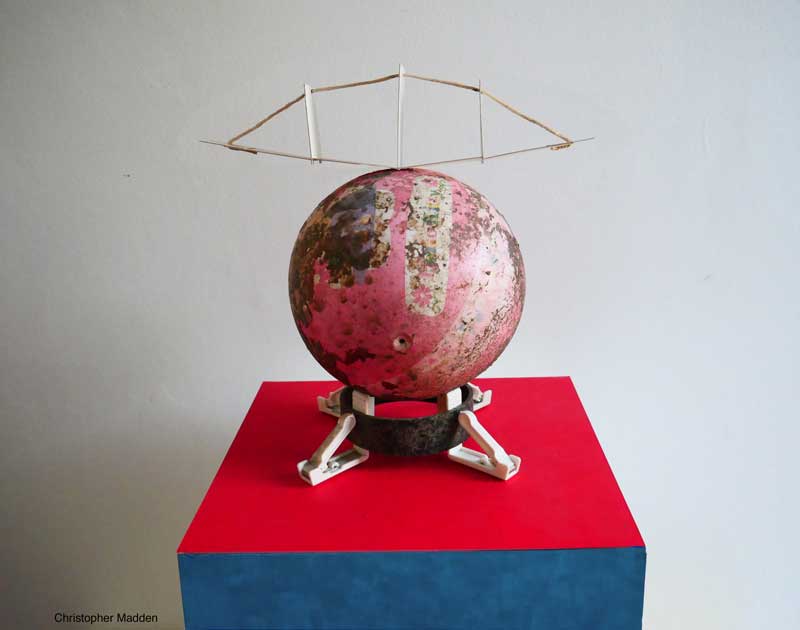
    Assemblage of discarded objects

    Ball and other detritus. September 2021

    A sculpture or assemblage constructed from old objects such as a discarded ball, clips for holding paper on a drawing board and a discarded homemade ‘constructivist’ toy.
    An example of up-cycling in art, with associations to art movements such as arte povera and environmental art.

  • Assemblage composed of G-clamps

    Contemporary art assemblage from construction tools

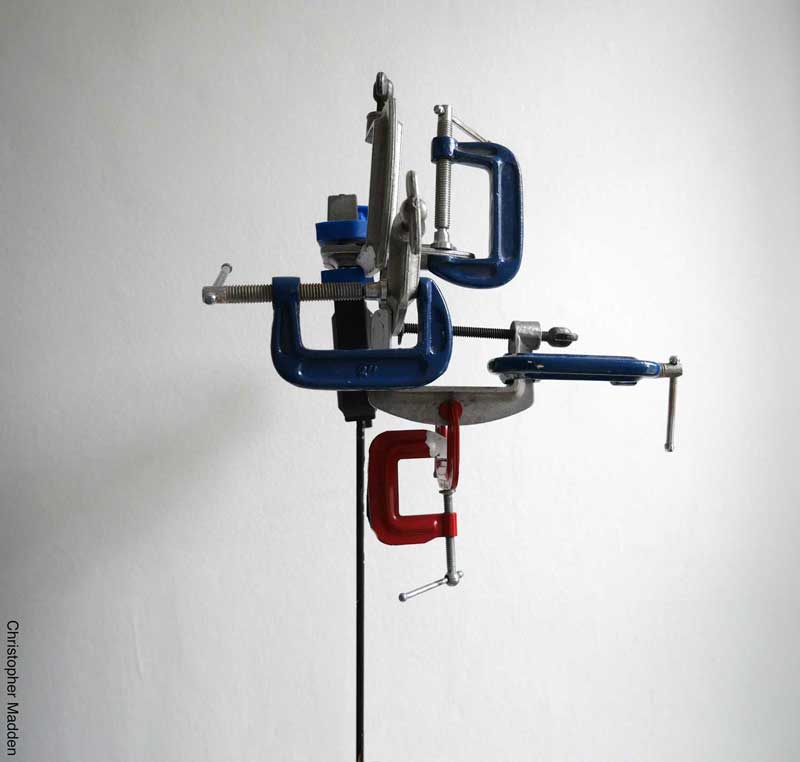
    Assemblage of G-clamps

    G-clamps and speed clamp. September 2021

    A sculpture constructed from G-clamps attached to a speed clamp.
    Normally clamps are used in order to hold other objects together (such as glued pieces of wood while the glue dries). Here the clamps are holding each other together. The assemblage can be interpreted as a metaphor for human society holding itseld together by using its own inherent qualities and strengths.

    An version of this concept shows the clamps at an angle – possibly a metaphor for the precariousness of the cohesion of human society.

  • Angled mirror art

    Contemporary art reflections with angled mirrors

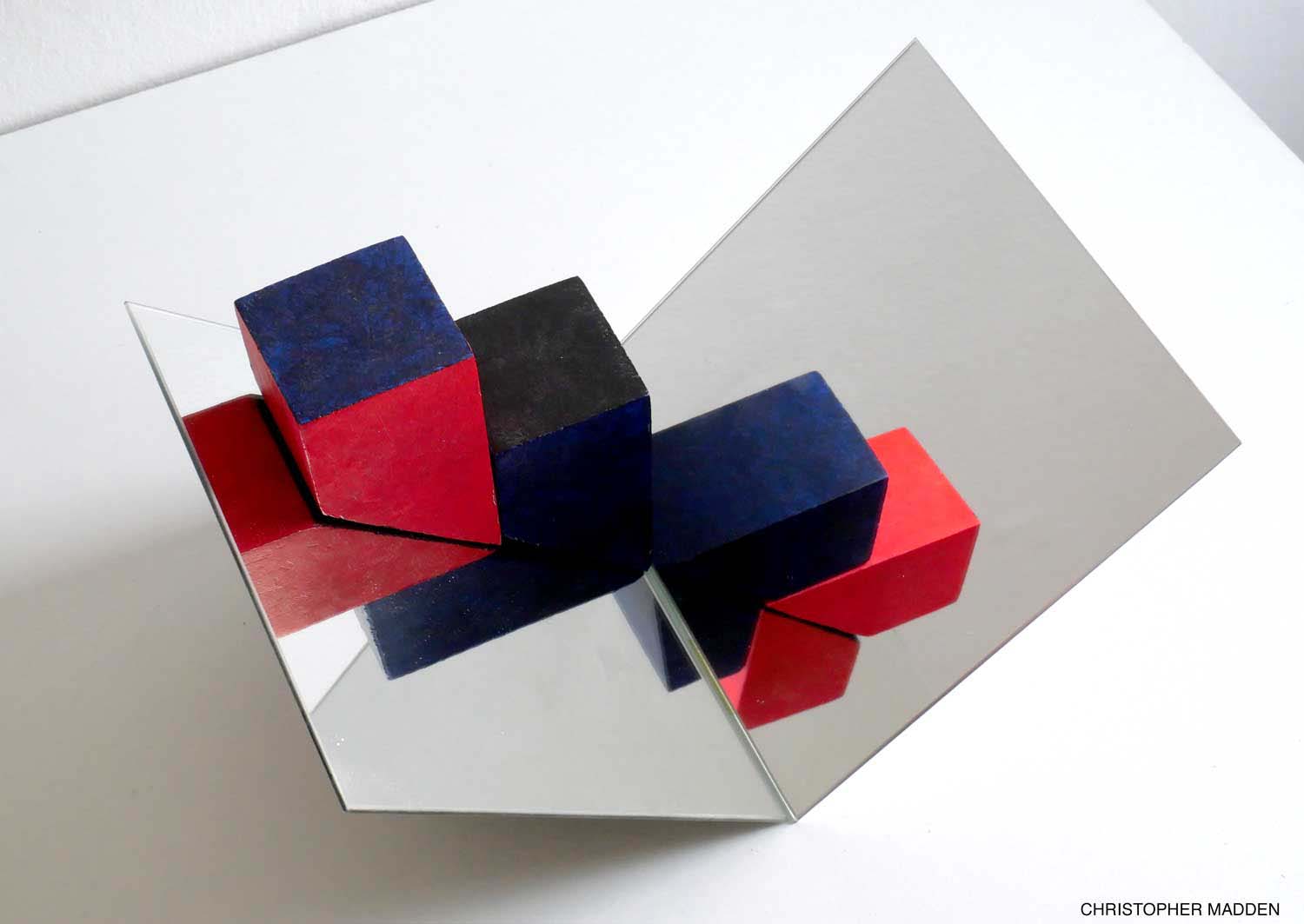
    Angled mirror piece

    Wood, acrylic, mirrors. 18x23x18cm. June 2021

    A sculpture formed of two painted wood blocks placed between two mirrors at angles to each other.

    Unlike with most mirrors, which are vertical, the mirrors in this work are at 45 degrees to the horizontal, producing a reflection that includes the vertical axis rather than just the usual horizontal one.
    I think that reflections on the verticle axis are inherently more interesting than those on the horizontal axis because they invert the image top to bottom rather than just flipping it right to left – a right to left reflection simply puts the right side to the left, with the only striking evidence of anything being unusual is when writing becomes back-to-front. Vertically reflected images however turn the whole world upsidedown.

  • Contemporary art crucifix

    Contemporary art sculpture – cross

    Cross

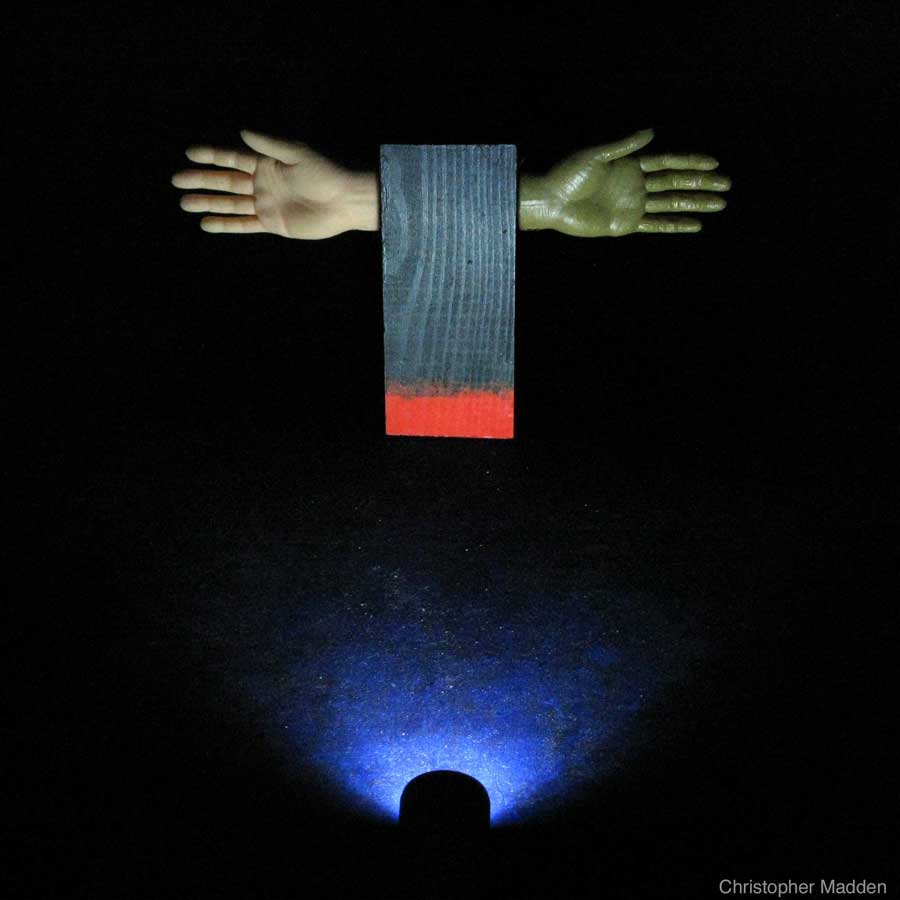
    Wood, plastic, acrylic, torch, 18x18x11cm. November 2020

    This sculpture suggests a contemporary art Christian crucifix.

    A sculpture formed from a wood block, plastic hands and a small hand torch.
    The work is composed of very simple components (the wood block is a piece of 2×2). In this version the cross is dramatically lit by a pocket torch.
    The work bears a resemblence to a Christian crucifix, although this is actually an emergent property of the work rather than a primary aim. The initial concept behind the sculpture is of hands that also resemble wings attached to a geometrically simple form (In this case a rectangular block, in other cases spheres).
    The position of the hands give an impressing of offering embrace, while also giving the impression of being elevating (when the hands are seen as wings). These are properties that enhance the work’s identification to the ideals of Christianity. The feeling of elevation in the work is enhanced by the fact that the cross seems to be suspended in the air. It is actually firmly rooted on a dark blue, flat horizontal surface, with the atmosphere of elevation being provided by the simple dramatic light of the hand torch.
    You may also notice that one hand is black while the other is white, which may be seen as a symbol of inclusivity and universal human togetherness.

  • Contemporary body part art

    Contemporary art fetish body part

    Finger
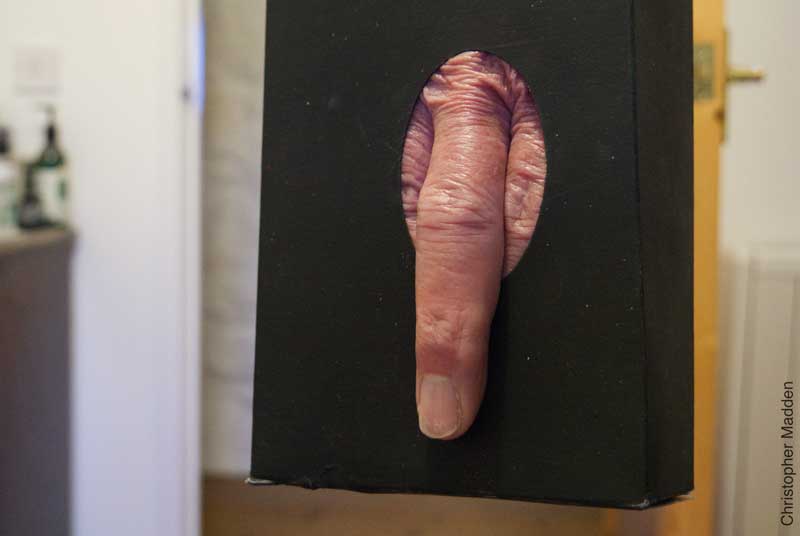
    Cardboard cereal carton, acrylic gouache, finger. June 2020

    A cardboard cereal carton of the type with an oval window in it to reveal the contents, painted with black acrylic gouache. A hand is placed inside the carton, with one finger protruding through the window.
    The photograph here has a strange unsettling quality partly due to the disconcerting suggestive appearance of the finger, which looks like a penis. If it had been a penis the image would have definitely been a piece of fetish art. The fact that it’s actually only a finger gives the image an uneasy air of dissonance. It’s meant to be quite humorous.
    Another unsettling element to the image is that the physical context of the components are quite hard to read. The black box is not on a surface, as it is on the end of the arm that the finger belongs to (mine). The background includes an open door The door handle is visible upper right, with the door frame to the immediate left of the box) and there is the edge of a chest of drawers at the extreme left.

  • 3D wall mounted artwork

    contemporary art assemblage wall-mounted

    Wall mounted assemblage and abstract painting

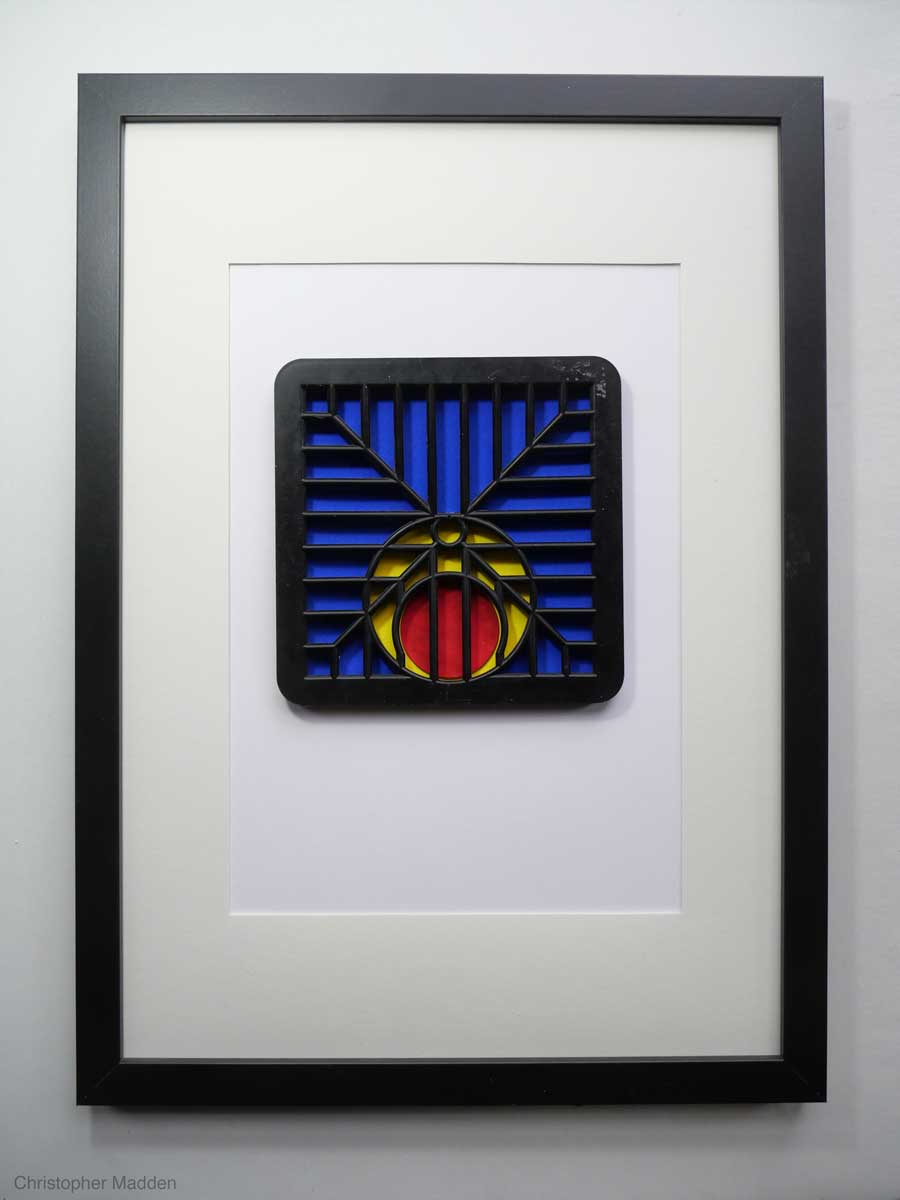
    Gouache, plastic drain cover, paper. 15x15cm. 2020

    A hybrid painting/assemblage artwork composed of an abstract gouache painting behind a contemporary plastic gulley grid (outdoor drain cover). The painting and the grid are both symmetrical, resulting in a square symmetrical artwork.

    The brightness of the colours of the gouache painting are visually heightened by the matt black lines of the grid, creating an effect that has some allusions to stained glass windows. The contrast between the elevating qualities of a stained glass window and the more utilitarian qualities of a drain cover are noteworthy.

    contemporary art using mundane objects
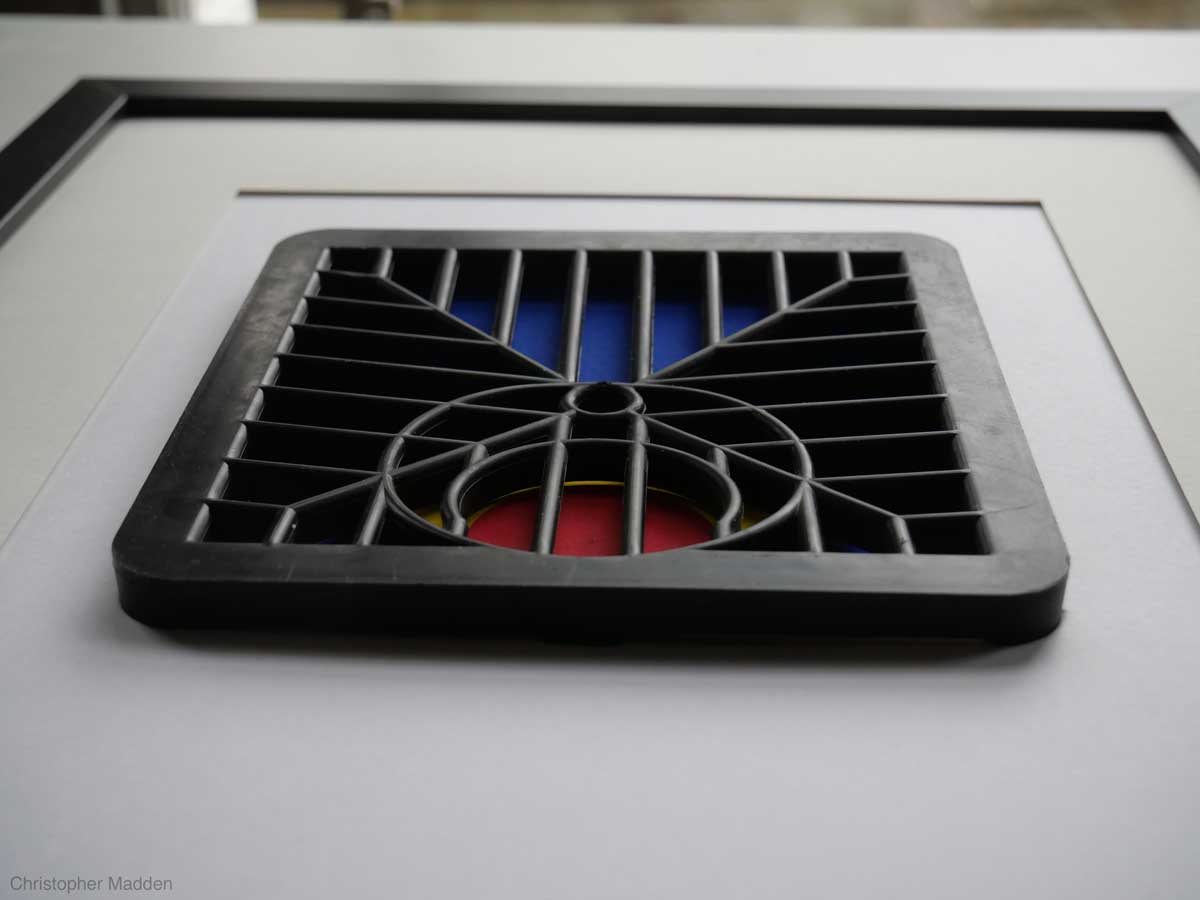
    The work viewed from an angle.
  • Plastic milk bottle heads as a large wall mounted installation (visualisation).

    Contemporary environemtal installation – oversized plastic bottles

    Giant milk bottle heads

    Visualisation of wall mounted sculpture or installation. September 2018

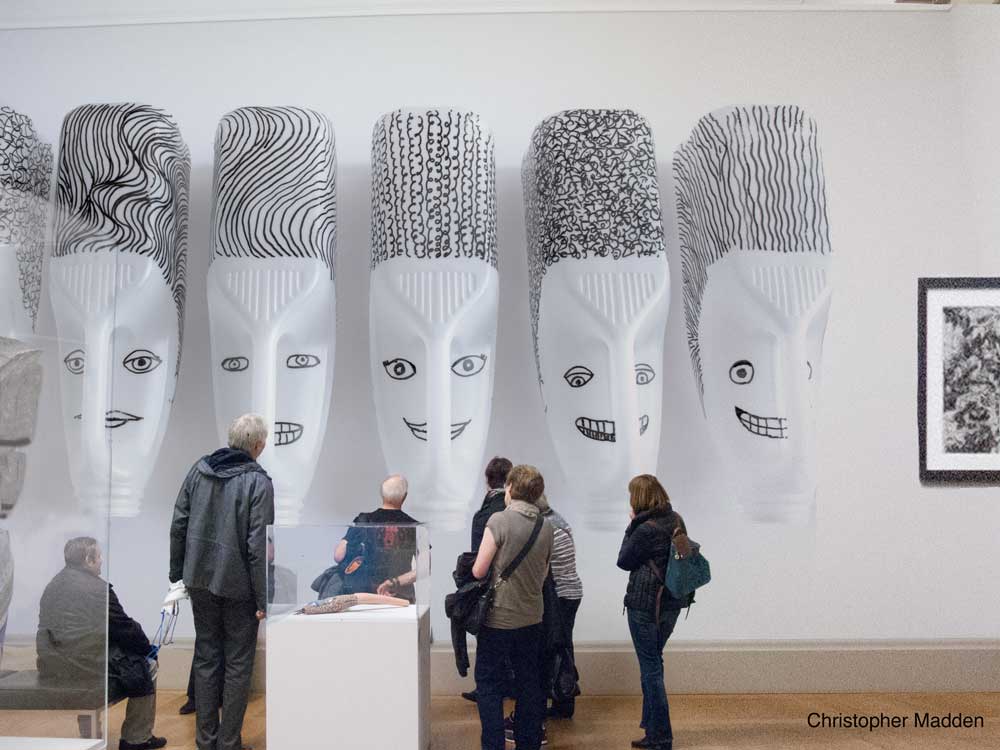
    This visualisation is a development of my work in creating human heads from plastic milk bottles.
    The sculptural heads are vastly over-sized compared to the original plastic milk bottles.
    The size of the heads gives them an impressive air, similar to that created by, for example, Easter Island statues. The primitive markings that create the faces are reminiscent of ancient ritualistic statuary. These factors, the ancient and the impressive, give the work a tension due to the mundanity of the objects that are actually represented – discarded plastic milk bottles with fibre tip pen faces drawn on them.
    These heads are partly a comment on our throw-away consumer culture and the environmental hazard that it represents. The size of the milk bottles can be taken to represent the size of the problem of consumer waste, especially of one-use consumer waste (such as plastic milk bottles). The faces drawn on the bottles are partly a reference to the fact that it’s normal people who are generating the waste.

    The work reflects my interest in art and the environment (I created my first environmental art in the early 1970s).

  • Milk bottle heads – sculpture from recycled rubbish

    Contemporary art - sculpture from recycled rubbish or junk - milk bottle heads

    Milk bottle heads
    Plastic milk bottles, ink. September 2018

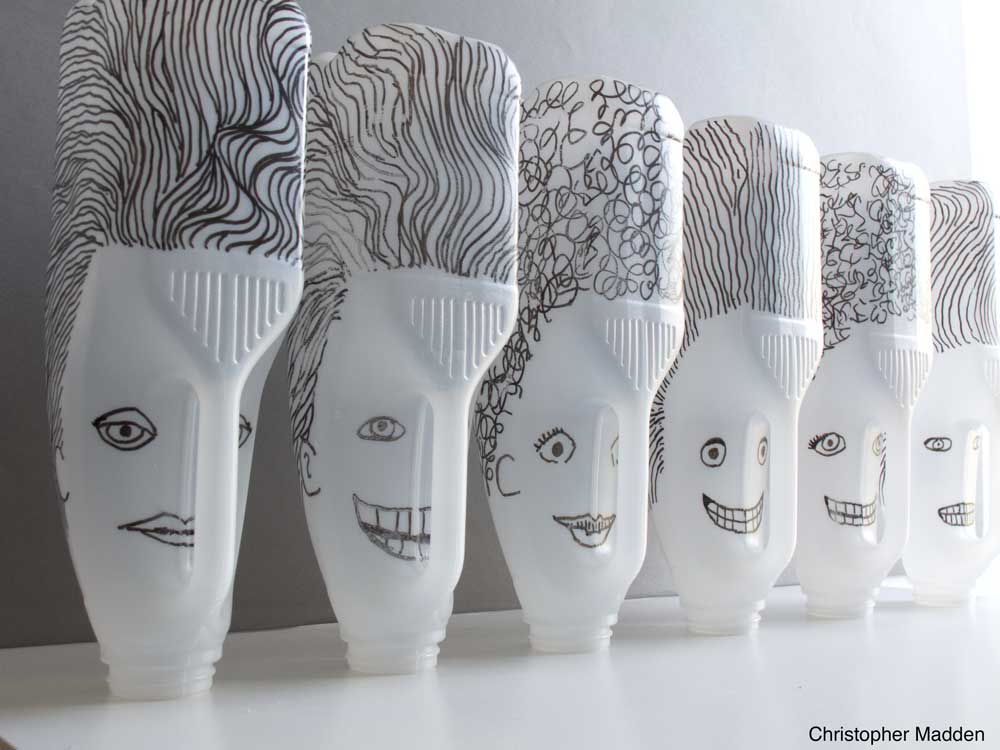
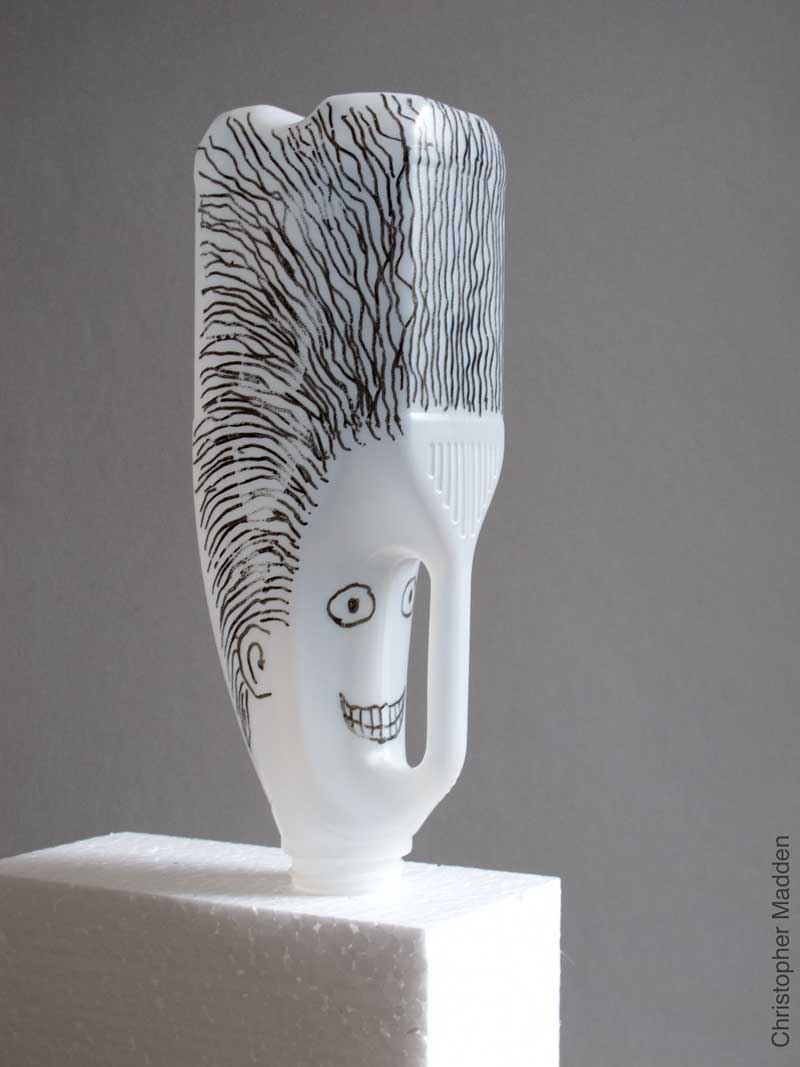
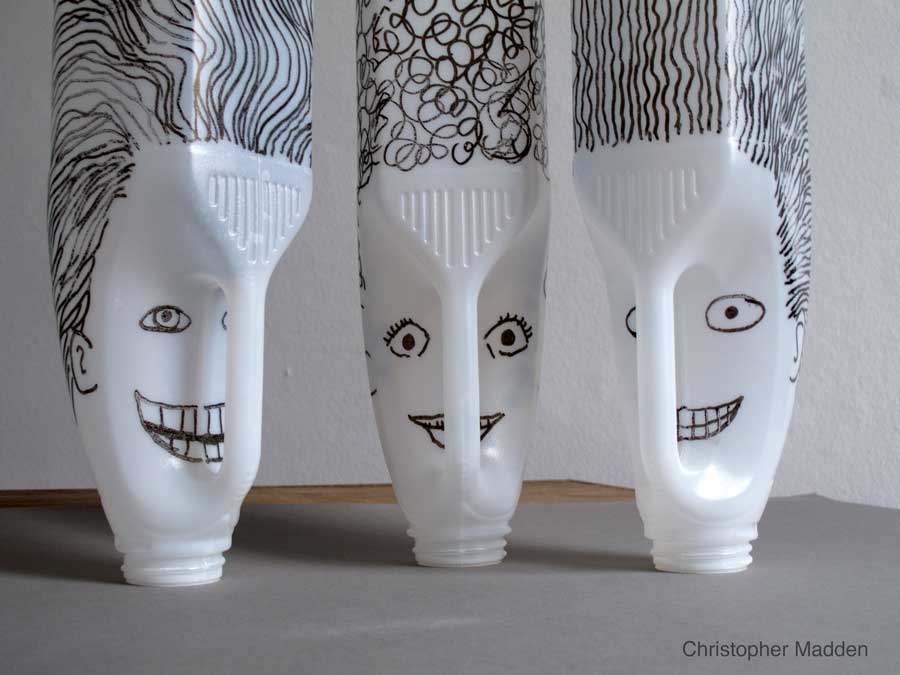
    Plastic milk bottles with human heads drawn onto them.
    These heads are an example of art created from rubbish. Their recycled nature is partly an observation on our throw-away consumer culture.
    The bottles are surprisingly head-shaped, reminding me somewhat of various non-Western forms of sculpture. I particularly like the way that the milk bottle handles make very interesting and bizarre noses.
    I’m in the process of making several dozen of them, as their impact is increased as their numbers increase.

  • Environmental art – a leaf changes colour in autumn

    Contemporary art in the environment- a painted leaf

    A Leaf Changes Colour in Autumn

    Leaf, acrylic paint. September 2018

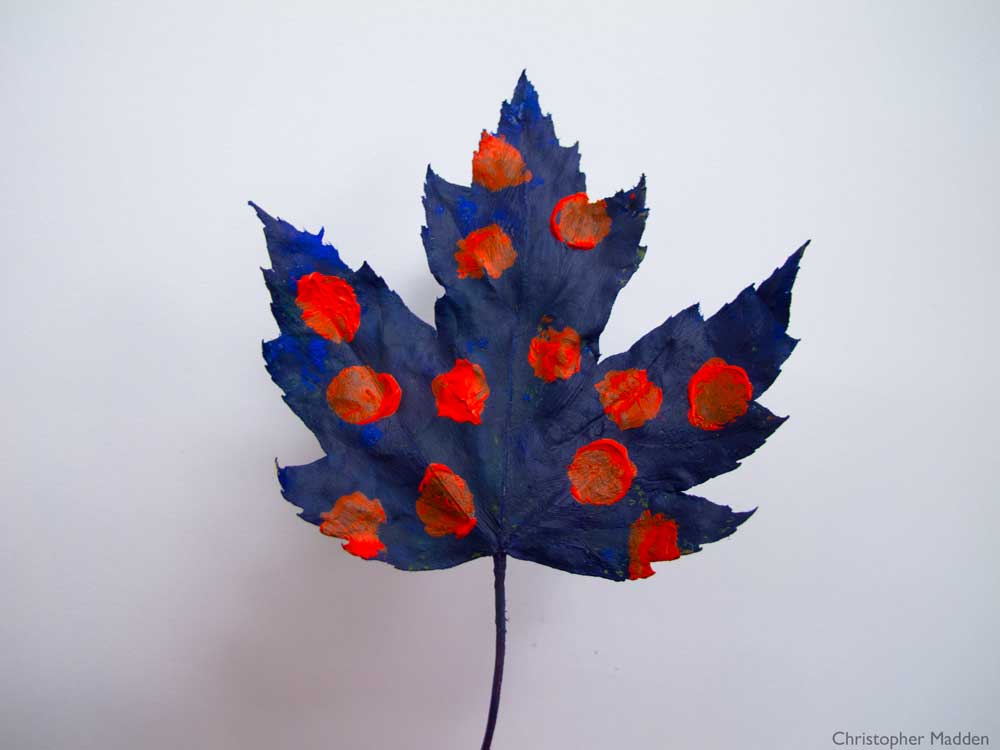
    A maple leaf painted blue with red polka dots.
    The leaf had fallen from the tree in autumn.
    The inspiration for this work came partly from the fact that the leaves on the trees were changing colour in the autumn, prompting me to think of changing their colours in other ways.
    In previous years I’ve painted acorns and suchlike in unusual colours.
    Like a lot of my work, this work involved interacting with and responding to the natural environment.
    Unlike a lot of environmental art, my own environmenntal art often involves interventions of a deliberately unnatural nature, such as here where I’ve painted a perfectly nice autumn leaf in unnatural paint (acrylic) and in a design generated from human esthetics. This is partly to convey the way that we impose our tastes and our values on the natural world.

    Contemporary art and the environment - a painted maple leaf
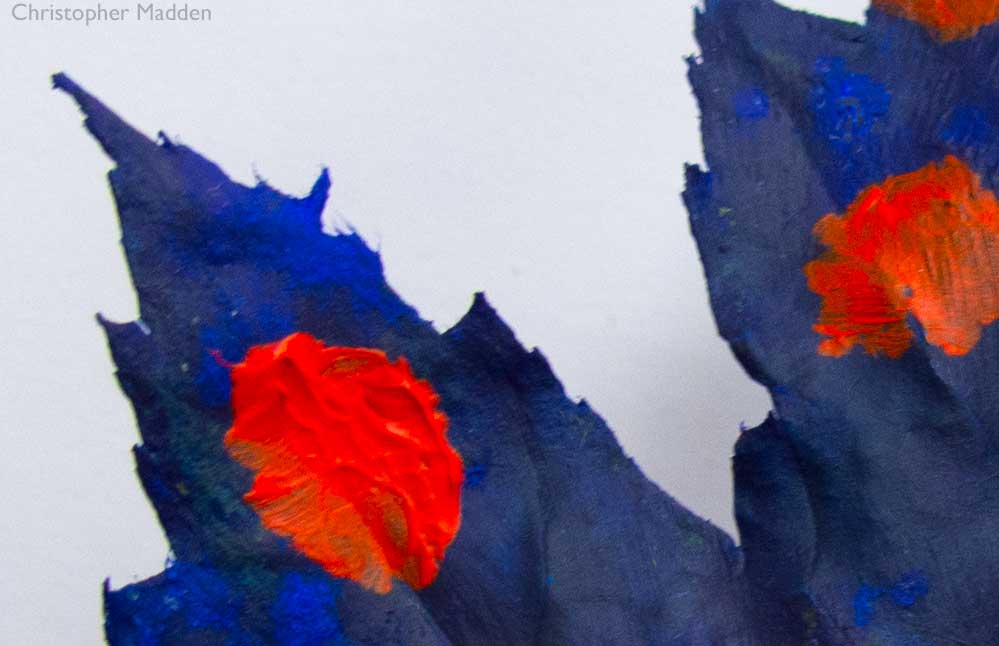
    A detail of the painted leaf.
  • Mirror-based artwork – multiple reflections inside a cube creating the illusion of the word “OXO” in infinite regression

    contemporary art infinity mirror cube multiple reflections

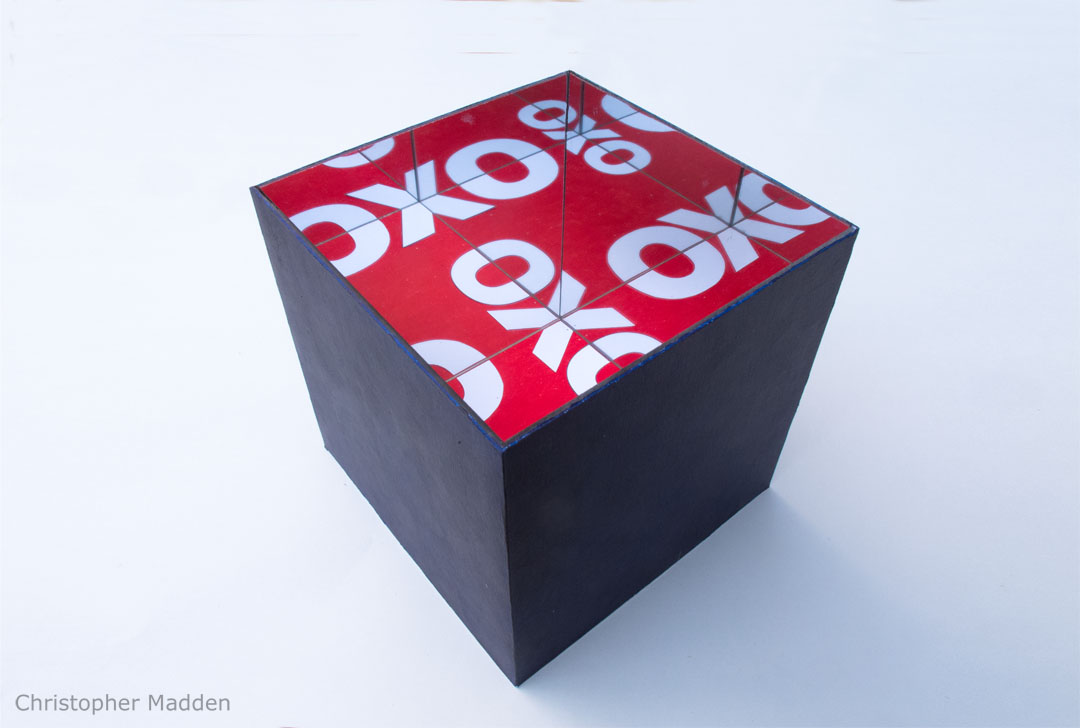
    OXO Cube infinity mirror cube

    Mirrors, paper, acrylic. March 2017

    This is a mirror-based artwork that uses the concept of infinity mirrors (which is a phenomenon I first became aware of while I was a student of maths and physics in the early 1970s).
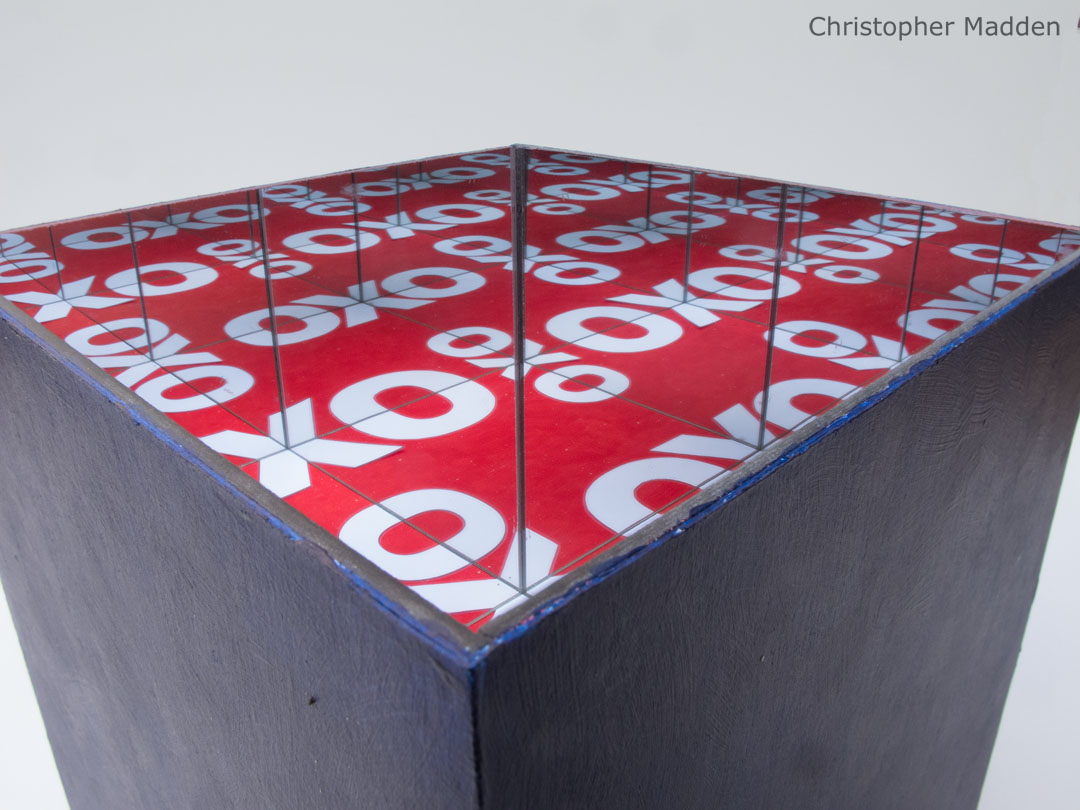
    The work consists of four mirrors forming the vertical walls of a cube, with the mirrored surfaces facing inwards. Each mirror reflects the mirror opposite it, including the reflections in that mirror, so the reflections build up to form infinite reflections (or, more accurately, multiple reflections, as the reflections gradually fade due to light loss).
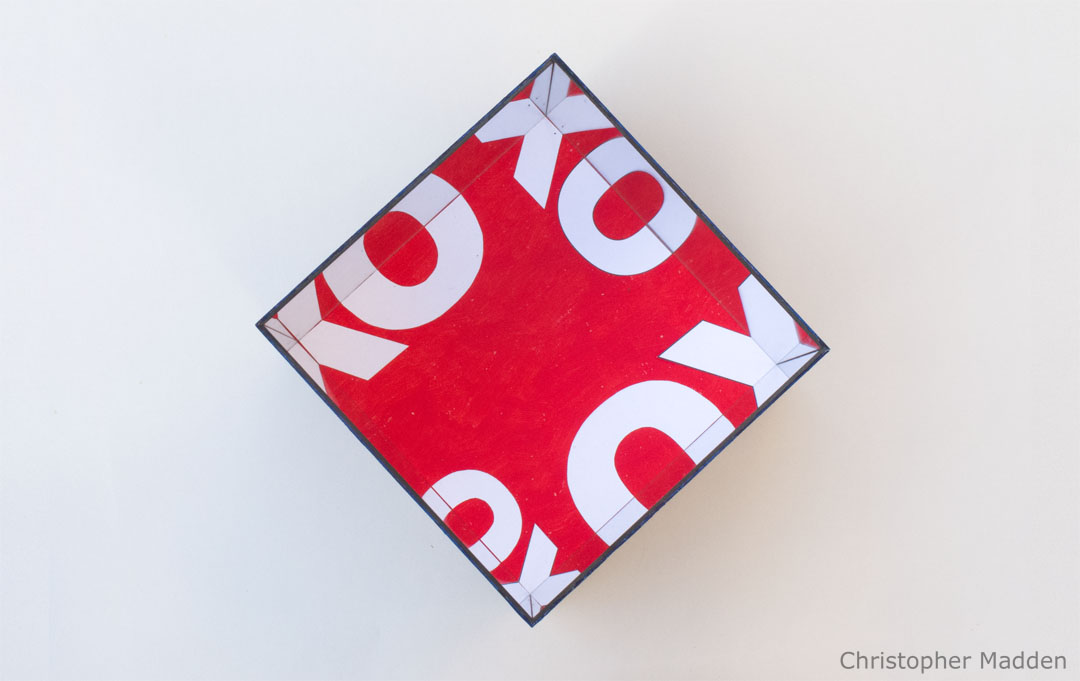
    Where two mirrors meet in the cube’s corners each mirror reflects the other corner mirror, creating a different set of multiple reflections.

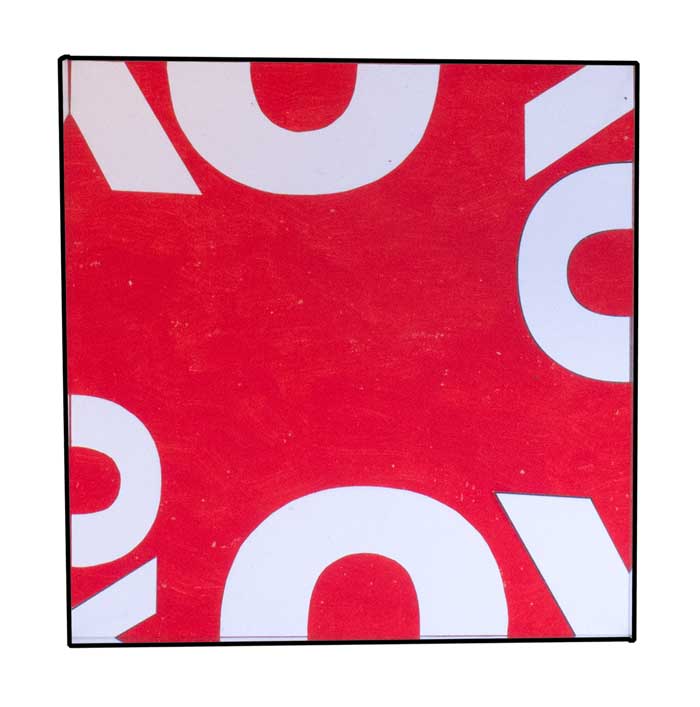
    The design on the cube’s floor forms the abstract image below:

    contemporary mirror OXO Cube base

    In each corner of the cube the abstract images are reflected in the mirrors to appear to form the word “OXO”.
    Each of these words “OXO” is then reflected infinite times in the other mirrors in the cube.
    This artwork is titled “OXO Cube”, as it’s just too good a title to ignore (The artwork is meant to contain an element of humour).

    contemporary art mirror cube

    A low viewpoint looking into the mirror cube, as below, shows the infinity mirror effect at its best.

    contemporary art infinity mirror reflections in cube

    Below: a video of the mirror cube.

  • Steel Eye – reflections in a sphere

    steel sphere sculpture - reflections in a sphere

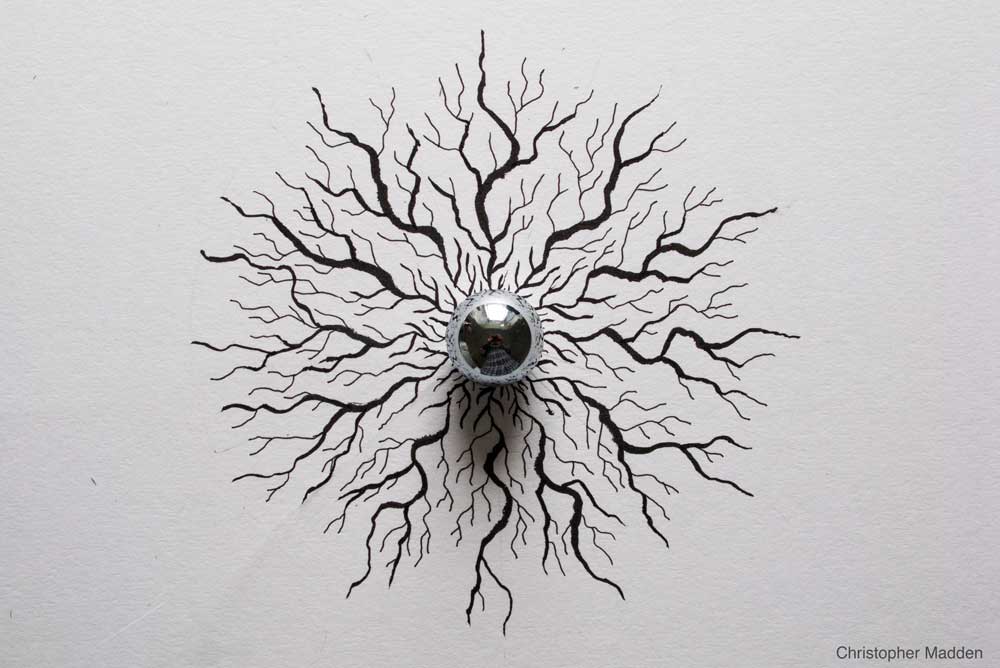
    Steel Eye

    Steel ball on ink sketch. 13x13x2cm. August 2018

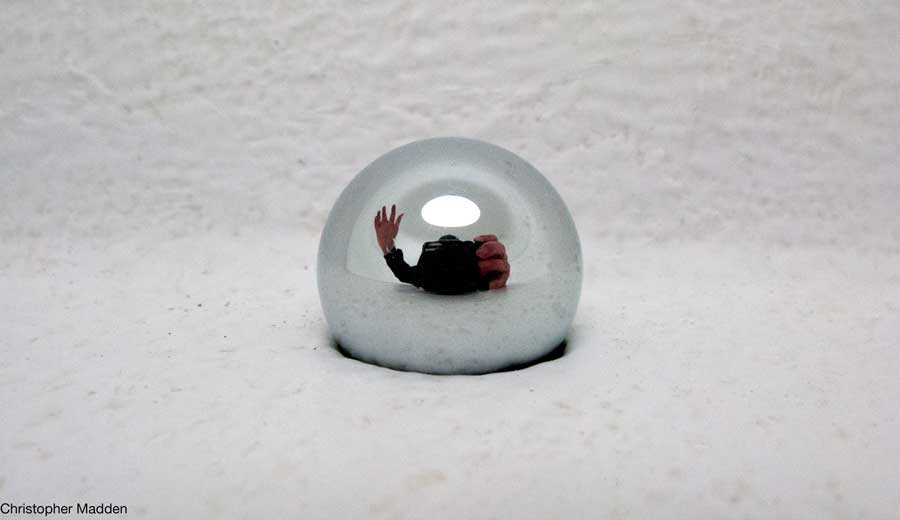
    A study of reflections in a sphere.
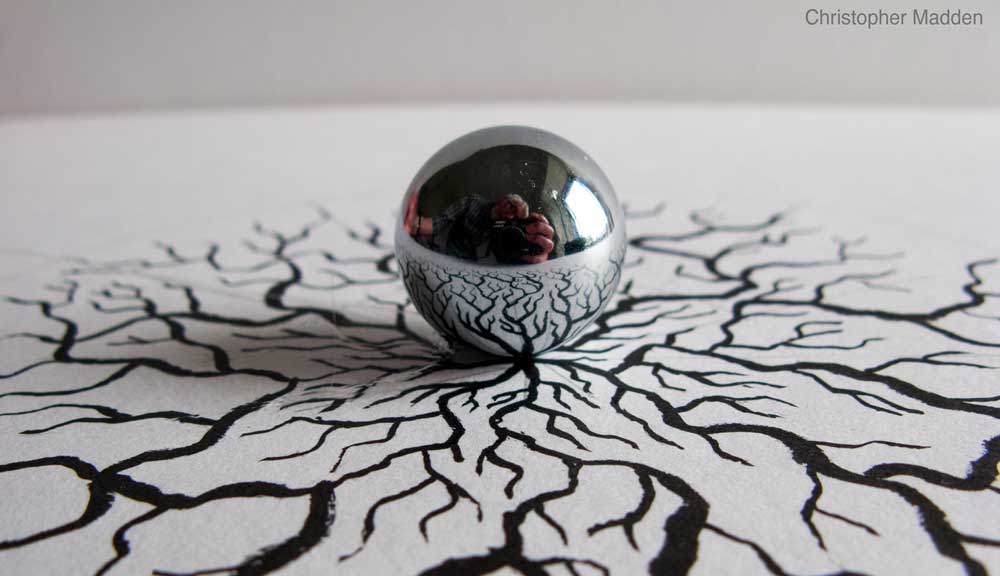
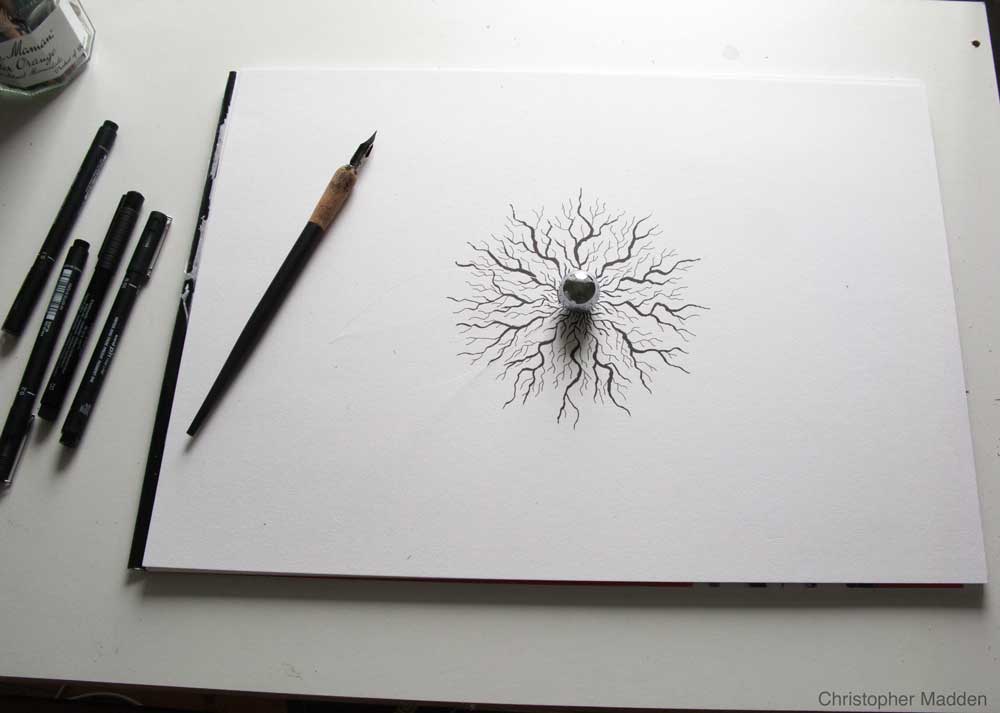
    A steel ball placed on a sketch pad in the centre of a radiating vein-like pattern. The reflections in the sphere give the effect of an eye-like form.
    The work can be thought of as a study for a floor-based sculpture with a large steel sphere placed on a floor onto which the radiating vein-like lines are applied. It works very well at a small scale however, with the steel ball approximately the same size as a human eye. The intimate size of the small version makes this version quite unsettling, while a larger version would possibly be less unsettling but more visually intriguing (because the reflections in the ball wouldn’t invoke so precisely a human eye).
    The initial concept came to me while working on a different project involving a steel ball (but not reflections) on a sheet of paper. I noticed that the reflection of the white paper and the room on the ball gave the impression of the white of an eye and the iris of the eye.

    sculpture - reflections in a sphere creating eyeball effect
    A close-up of the steel sphere, showing the reflection from the side
    spherical reflection sculpture - steel sphere creating eyeball
    The sketch on the sketchpad, with the steel ball reflecting the pad and the room
  • Chess in art: disintegrating board with optical illusion (there are no black squares).

    Contemporary art sculpture - Chess board with illusion of black squares

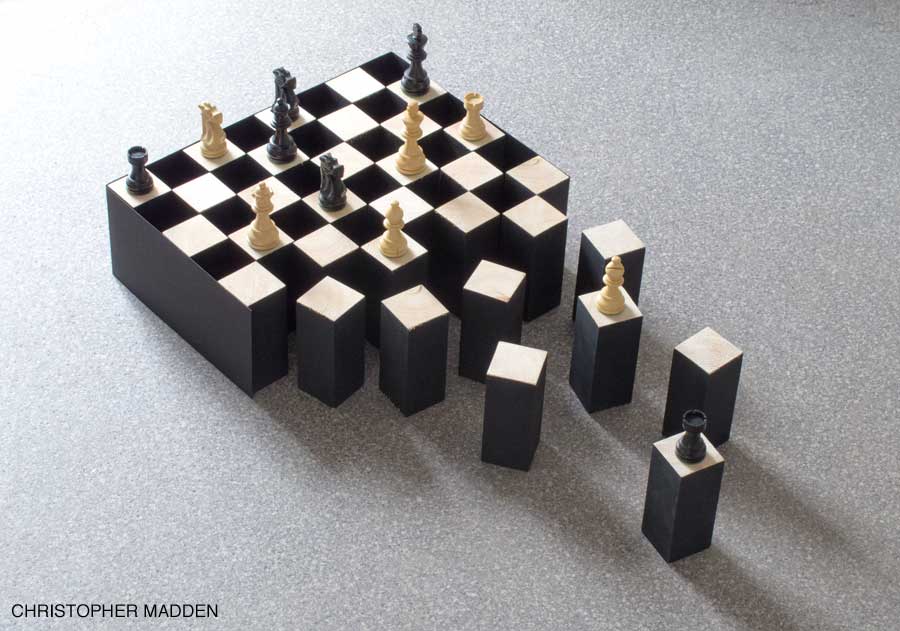
    Chess: Black Holes

    Chess pieces, wood, card, acrylic. February 2016

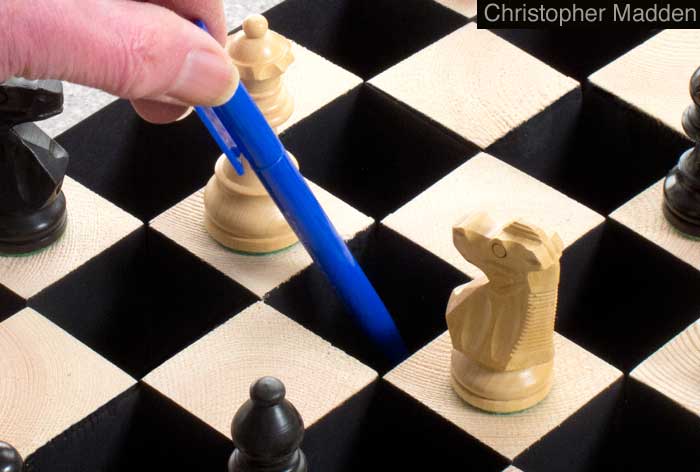
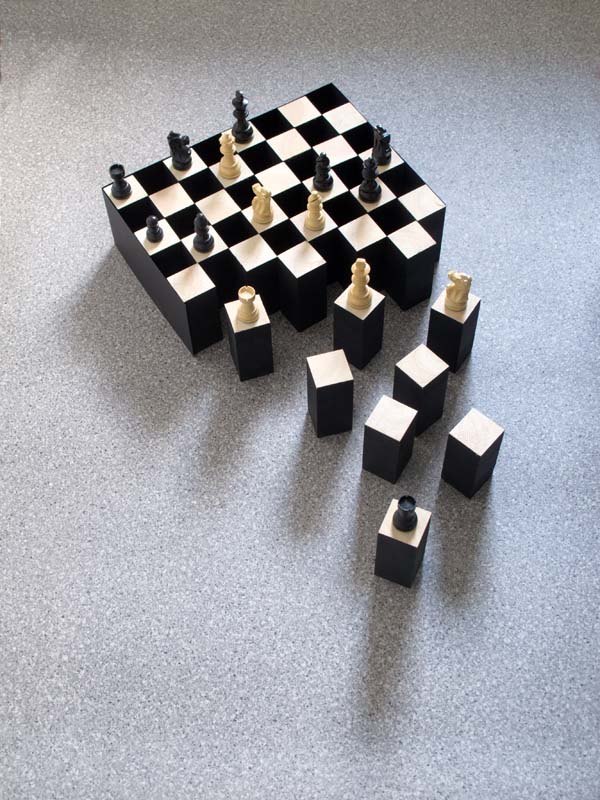
    In this work I’ve created a chess set out of short blocks of wood.
    The first thing that the viewer notices when looking at the work is that the chess board is fragmenting or disintegrating.
    Less obvious however is the fact that the chess board is composed only of the white squares. These white squares are the tops of blocks of wood, the sides of which are painted black. It is the black sides of the blocks that give the impression of the black squares of the chess board. The seeming existence of the black squares is a visual illusion, as they are nothing more than black holes. See the photograph below. The illusion is as true with the actual, three dimensional chess set as it is with these photographs.
    A large number of viewers of the work don’t notice that the black squares are an illusion.
    Part of the impact of the piece is in the way that the viewer only notices the ‘black holes’ of the missing black squares on the chess board after already being intrigued by the disintegrating nature of the board.
    The piece has political overtones, in that it is partly about the disintegration of power (as symbolised by the combative nature of the game of chess) and the disintegration of order (as symbolised by the rigid grid of the chess board). It is also about more existentialist themes such as dangers that lurk in the world (the black holes as traps or stumbling blocks) and the nature of physical reality (with the holes representing the unknown parts of the physical universe (such as the actual black holes that result from collapsed stars). It’s also just a nice visual illusion, and thus contains humor as well as its more weighty themes.

    Contemporary art chess set with black square illusion


    The chess board contains no black squares – they are an illusion.

    Contemporary art chess board disintegrating
  • Environmental art – heads created from discarded milk bottles

    contemporary environmental sculpture from consumer waste - sculptural head created from milk bottles

    Milkman

    Plastic milk bottle, ink    August 2018

    Slightly unsettling heads created from empty plastic milk bottles.

    Like many artists I have a habit of collecting waste and recycling it into works of art.
    The slightly sinister appearance of these heads, drawn as they are on post-consumer waste in the form of discarded plastic milk bottles, can be interpreted as a comment on the fact that we as humans are destroying the environment through (amongst other things) our profligate use of plastic packaging (I’ve been producinng work connserned with environmental issues since the 1970s).
    The fact that the heads also resemble the type of craft-play objects produced by children can be interpreted as alluding to the western world’s current tendency towards a philosophy of consequence-denying pleasure seeking in which the adults in society fail to take responsibility for their actions beyond immediate self-gratification.

    contemporary environmental art sculpture created from consumer waste - heads created from plastic milk bottles
  • Paper sculpture

    Contemporary art abstract paper sculpture

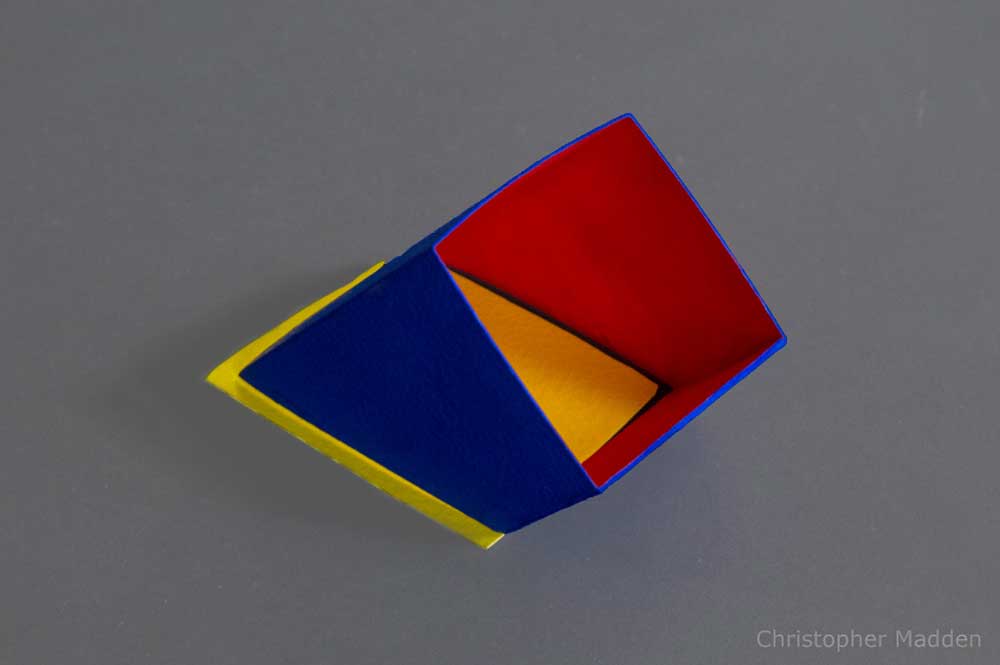
    Paper sculpture: Folded Form

    Paper, acrylic. 10 x 7 x 6cm. July 2018

    A small paper sculpture of an abstract form in primary colours created from folded and coloured watercolour paper.

    Contemporary paper sculptures are frequently very intricate, often featuring frill-like or fringe-like elements. My own works in this medium tend towards the more minimal end of the spectrum. There’s often a nod towards constructivist art. The fact that the sculptures are made of paper or card gives them a sense of fragility or vulnerability. Along with this, the fact that they look as though they may be made of cut pieces of metal sheeting rather than paper gives them an ambiguous quality of robustness. Most paper sculpture unambiguously exploits the fragility evident in the sculptures.

  • Fin – art in the environment, Cornwall

    contemporary art - sculpture in the environment, St Ives, Cornwall

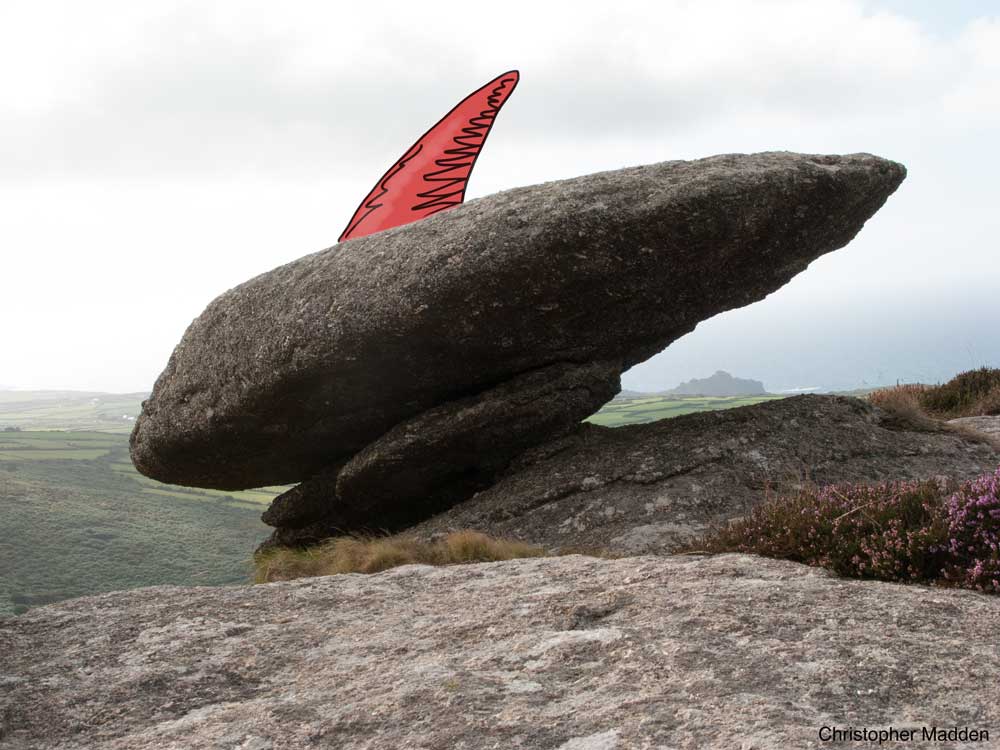
    Fin: art in the environment

    Photograph with digital drawing, September 2018

    A photograph of a natural granite rock formation with a drawing of a fin-like object added to the photograph as though it is attached to the rock.
    The rock formation in the photograph is on the Penwith peninsula in west Cornwall, a few miles from St Ives. The large rock on which the fin is  drawn is a rocking stone, known locally as a Logan stone. The stone is said to move slightly when pushed correctly.
    The image is a finished artwork, despite the fact that it resembles a concept study for a sculpture in the landscape. The drawing of the fin is deliberately  inconsistent in terms  of photographic realism with the rest of the image.
    Having said that, I’m not ruling out the possibility of an actual sculpture.

  • Hammers – photomontage for sculpture in the environment, Cornwall

    Contemporary sculpture  in the landscape Cornwall - hammers

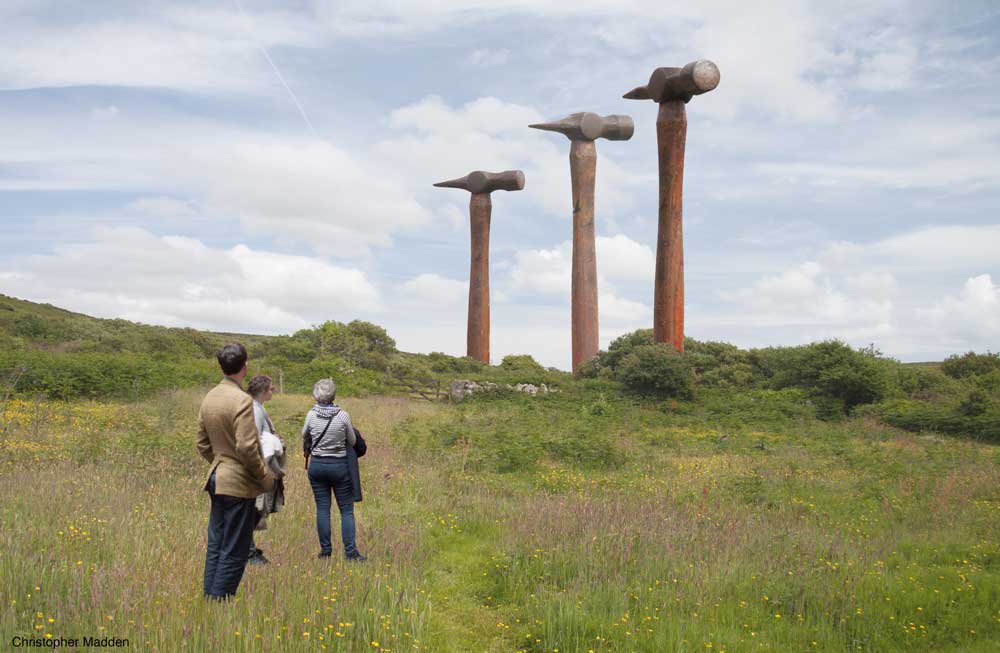
    Hammers: sculpture in the landscape

    Photomontage visualisation. Cornwall. June 2018

    A visualisation of a concept for a sculpture in the landscape.
    The landscape in the photograph is the Penwith peninsula in west Cornwall.
    The hammers are meant to project a sense of overbearing force, the fact that there are several of them possibly implying organised force (such as military force). Hammers, to me, have a certain anthropomorphic quality to them, suggesting a degree of human identity – a long thin body with a head at the top. The blank facelessness of the heads of the hammers in this image suggest a mindless power (I’ve done other works in which hammers have faces).

  • Land art, UK. Cornwall

    contemporary land art Cornwall

    Land art on a granite outcrop, Cornwall

    Wood, acrylic. Zennor Hill, Cornwall, UK. June 2018

    One of my temporary sculptural works or interventions in the landscape near St Ives, Cornwall.

    There’s a tendency for land art to be either very ephemeral and transient (such as Andy Goldsworthy’s work with leaves) or very permanent (such as Robert Smithson’s Spiral Jetty). The photo below shows my work becoming very ephemeral indeed by floating up off the ground as if defying gravity. The photo was achieved by taking several photos of the wooden batons being held in the air and then photoshopping the holder of the batons out of the picture.

    Land art also has a tendency to involve circles, probably because of the circle’s links to some spiritual concepts (such as the circle of life, yin and yang, the cosmos etc). Spirals and other sinuous or organic forms are also common for similar reasons. I’ve chosen to go the other way with this work, employing very mechanical straight lines (as a comment on the common phrase “There are no straight lines in nature”) and primary colours that in nature are normally only seen in small concentrated quantities in such places as flowers and birds’ feathers.

    land art in the environment - abstract sculpture Cornwall
  • Art in the environment, Cornwall

    art in the environment - abstract sculpture Cornwall

    Transience

    Wood and acrylic paint. Land art on Zennor Hill, near St Ives, Cornwall. 25th June 2018

    Land art sculpture composed of lengths of painted wood battens (the type of wood commonly used in building construction).
    The sculpture was created by positioning a small number of battens in the landscape, photographing them, repositioning them, rephotographing them and then merging the photographs.
    As a result the work has an interesting relationship with time. The sculpture never existed in its entirety as depicted in the photograph, each batten only being in position for long enough to take a photograph. The sculpture only takes on its final form when the twenty-five minutes that it took to position and photograph the battens are compressed into a single instant.

    A work of transient land art near St Ives,Cornwall: an intervention in the landscape, or art in the environment. The wood battens are about a metre long.

  • Surrealist photomontage – wellington boots with arms

    contemporary surrealist photomontage - wellington boots with arms emerging

    Surrealist photomontage – wellington boots with arms

    Photomontage. June 2018

    A photomontage showing arms emerging from the tops of a pair of wellington boots.
    The arms are sinking down into the boots, as though the footware is devouring the owner of the arms. The theme of predatory footwear is one that I’ve explored several times over the past few decades. Another example can be seen here – shoes with teeth.
    Or are the arms emerging from the boots? An example of ambiguity in art.
    This photomontage was created while I was exploring various options for creating a sculpture that included wellington boots. I feel that these boots have a strong sculptural presence, and I’m quite surprised how under-represented they are in the field of sculpture.
    The image, which I think probably falls into the category of contemporary surrealism, is meant to be both humorous and unsettling.