Black holes in the floor of an art gallery (concept). 2016
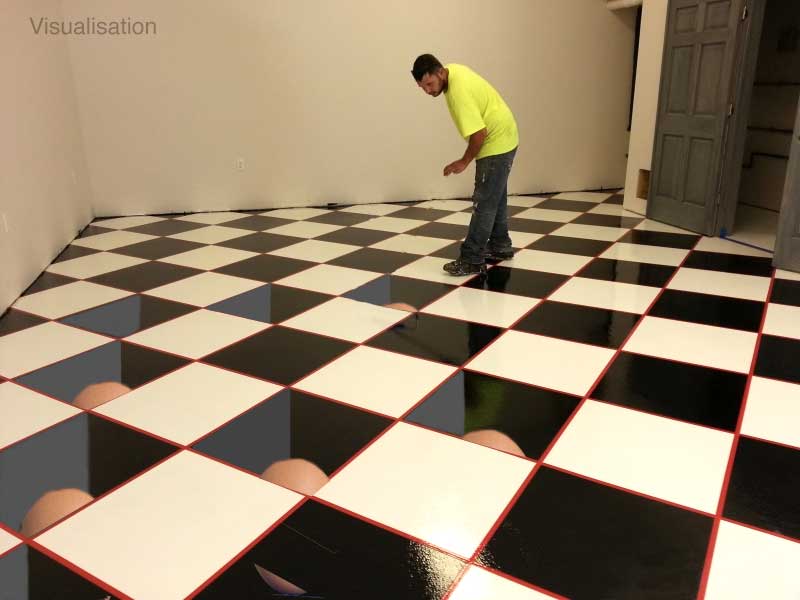
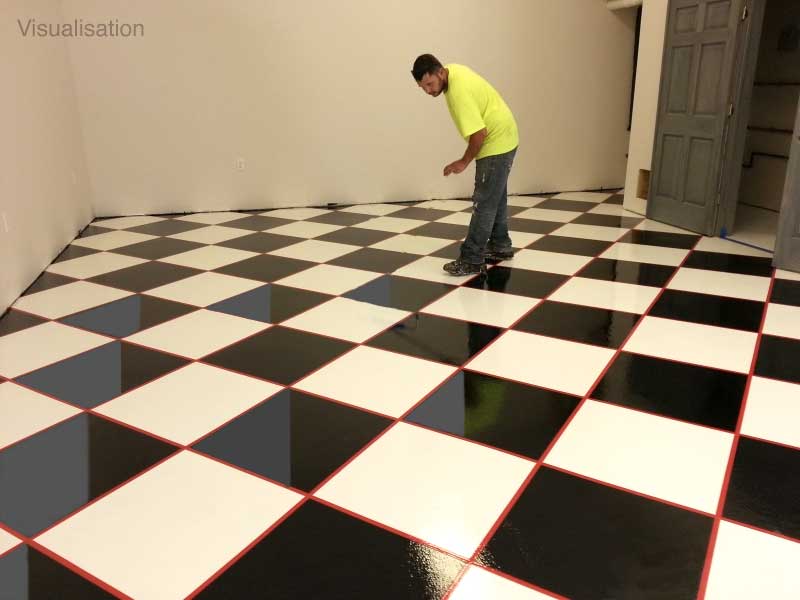
A floor composed of a checkered pattern of black and white floor tiles, with some of the black tiles being replaced by holes with black sides.
A concept for an art gallery installation. In the installation several of the black tiles in the tiled floor are replaced by holes with sides painted black so that they are hard to differentiate from the black tiles themselves.
Black and white tiled floors are generally a symbol of order, however in this instance the regular and reassuring pattern of the tiles is subverted by the presence of the trap-like black holes, which are in turn made more sinister by the fact that they are hiding within the regular structure of the floor. What can you trust?
Although tiled floors are usually a sign of order and stability, black and white checkered patterns are also a feature of board games such as chess and draughts, where the checkered board represents a battleground. I have used a similar concept in a chess-related piece here.
The concept of holes in the floor is associated with Anish Kapoor, especially his work Descent into Limbo (1992).
If my tiled floor concept was executed with the use of Vantablack, the extremely light-absorbent pigment that Kapoor uses in his work, it would be impossible to tell which black squares were tiles and which were holes (assuming that both the sides of the holes and the surface of the tiles themselves were coated with Vantablack). However I suspect that such an extreme level of blackness may be excessive for this work and that a degree of differentiation between the holes and the tiles (maybe only when viewed from a particular angle) may be effective in rooting the work in reality rather than making it seem like an interesting optical illusion (even though it is of course an optical illusion.
To be fully effective this work would require access to the room by the audience, who would then have to pick their way around avoiding the holes.
An alternative version of the work is shown below in which there are objects lurking at the bottom of the holes. These would make the holes easier to identify, and therefore safer for anyone in the room, and depending on what the objects were it may make the work more unsettling. What lurks beneath the ordered surface?