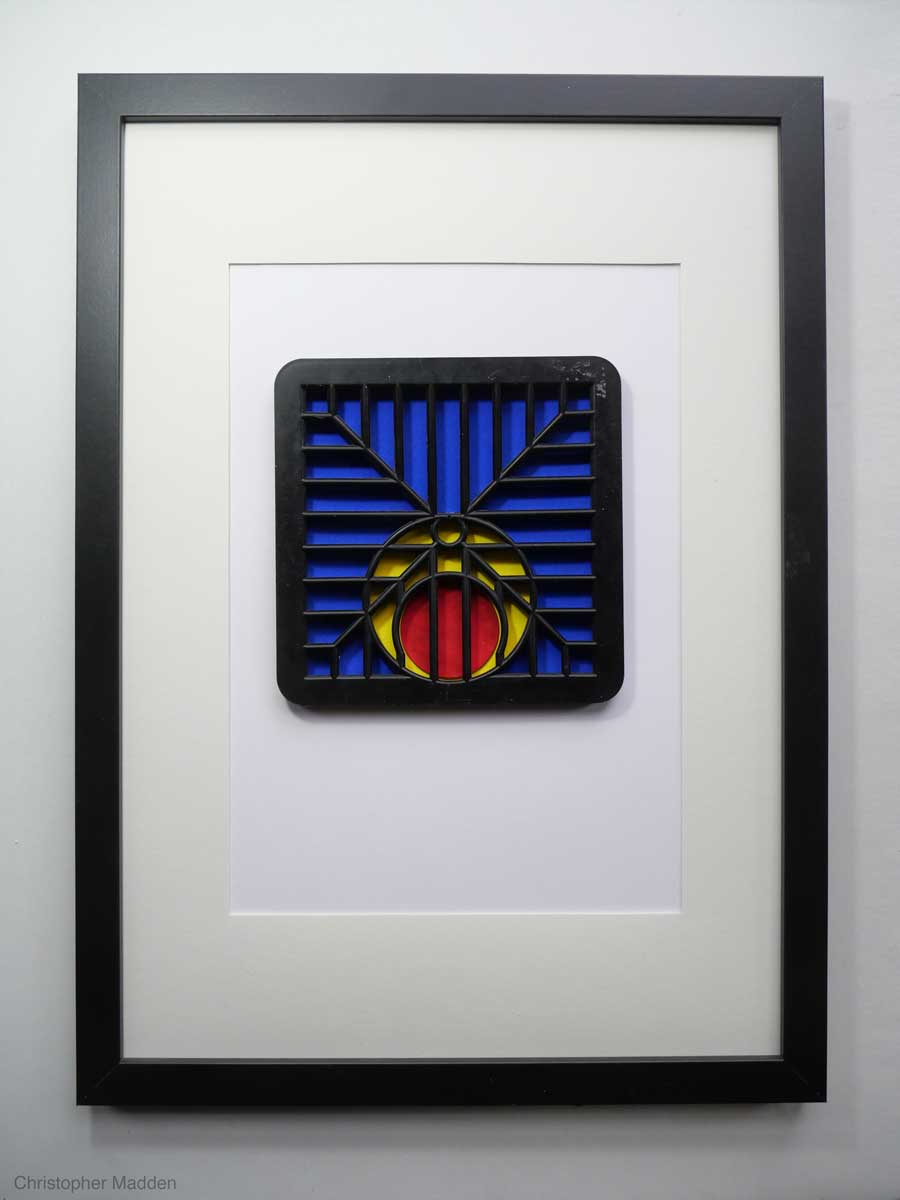
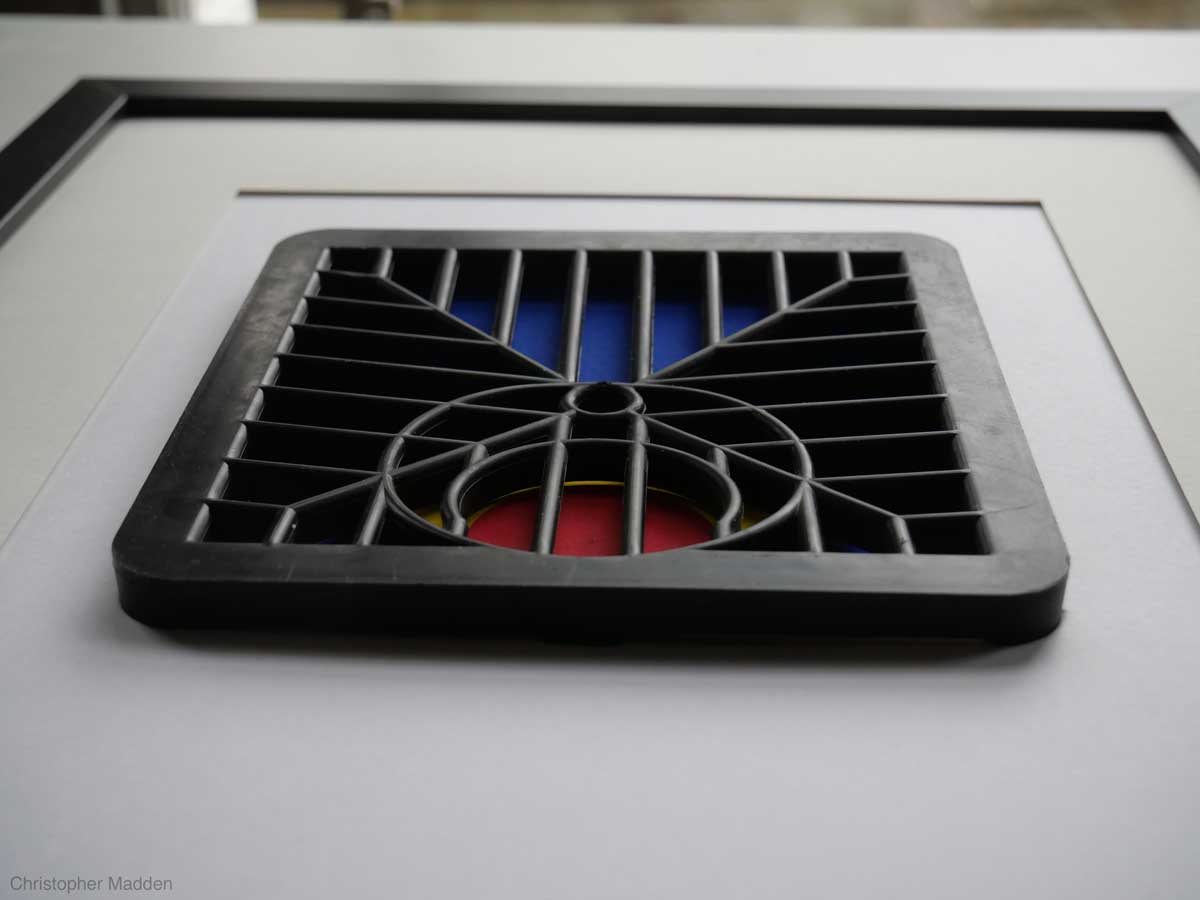
A hybrid painting/assemblage artwork composed of an abstract gouache painting behind a contemporary plastic gulley grid (outdoor drain cover). The painting and the grid are both symmetrical, resulting in a square symmetrical artwork.
The brightness of the colours of the gouache painting are visually heightened by the matt black lines of the grid, creating an effect that has some allusions to stained glass windows. The contrast between the elevating qualities of a stained glass window and the more utilitarian qualities of a drain cover are noteworthy.
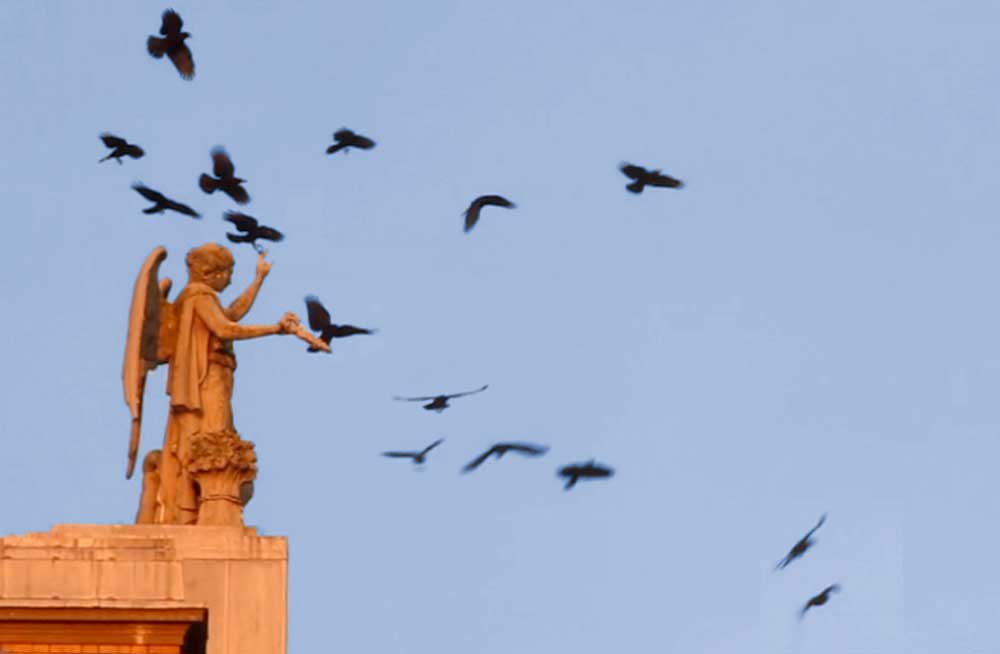
A video about freedom and its opposite: limitation or confinement. Freedom is expressed by the unconfined wheeling and soaring flight of the crows. Limitation is symbolised by the inert, motionless statue of an angel around which the crows are flying. Pathos is a major ingredient of the work, because both the birds and the statue have wings, but only the birds can fly. The unconstrained flight of the birds only serves to emphasise the fact that the statue of the angel is rooted to the spot. The work is a comment on the desire of the creators of the statue (us) to have the power of natural flight, and their obvious inability to have it.
The statue is on Alexandra Palace in north London.
An earth-bound angel and flying birds – a photomontage based on the video above.
Visualisation of wall mounted sculpture or installation. September 2018
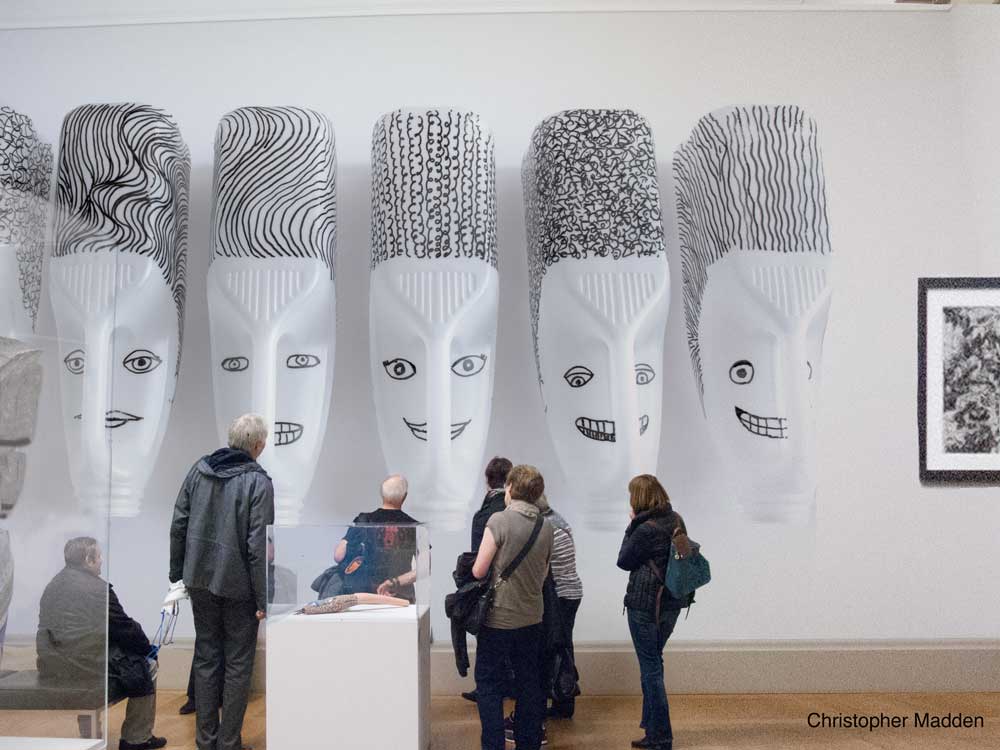
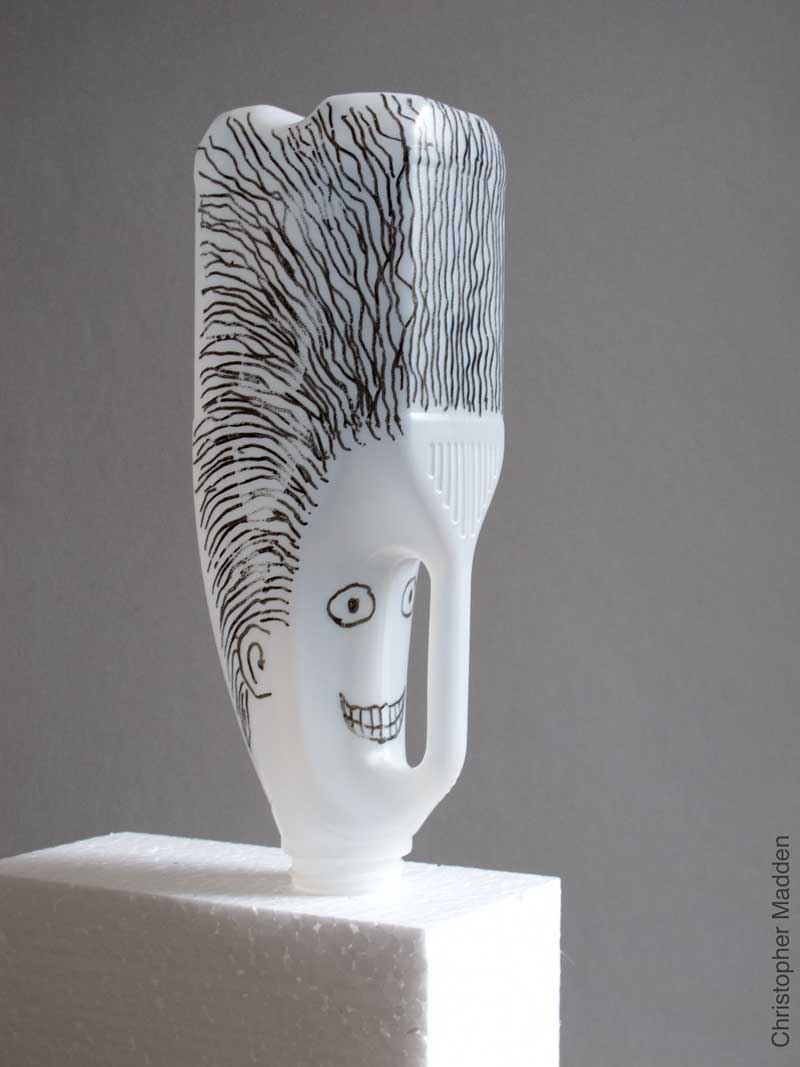
This visualisation is a development of my work in creating human heads from plastic milk bottles. The sculptural heads are vastly over-sized compared to the original plastic milk bottles. The size of the heads gives them an impressive air, similar to that created by, for example, Easter Island statues. The primitive markings that create the faces are reminiscent of ancient ritualistic statuary. These factors, the ancient and the impressive, give the work a tension due to the mundanity of the objects that are actually represented – discarded plastic milk bottles with fibre tip pen faces drawn on them. These heads are partly a comment on our throw-away consumer culture and the environmental hazard that it represents. The size of the milk bottles can be taken to represent the size of the problem of consumer waste, especially of one-use consumer waste (such as plastic milk bottles). The faces drawn on the bottles are partly a reference to the fact that it’s normal people who are generating the waste.
The work reflects my interest in art and the environment (I created my first environmental art in the early 1970s).
Milk bottle heads Plastic milk bottles, ink. September 2018
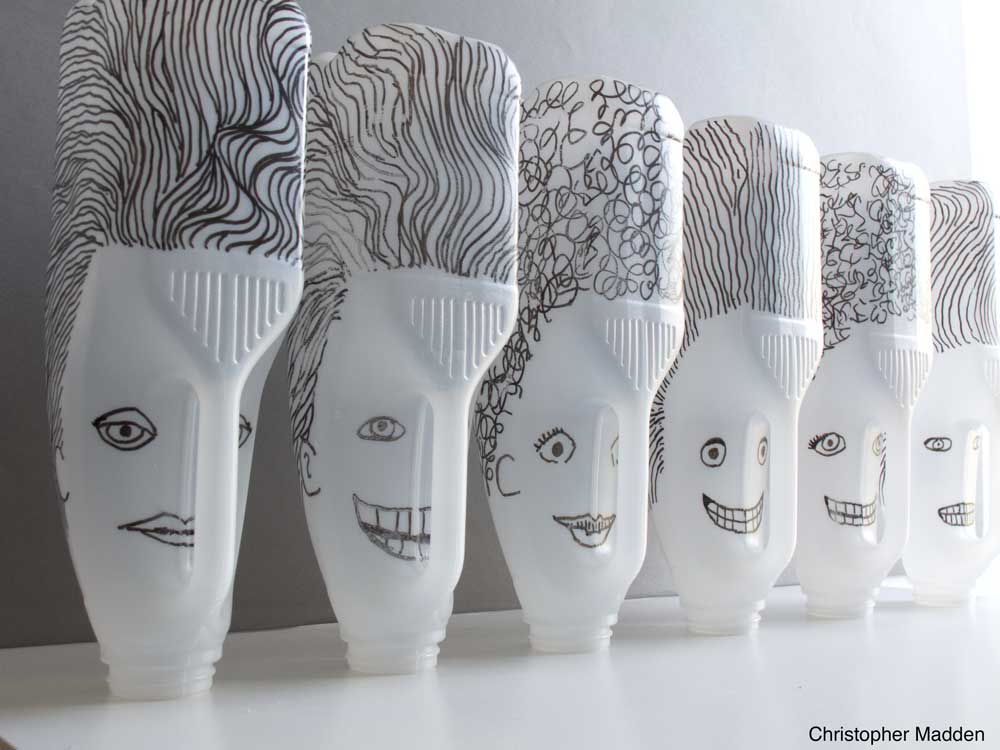
Plastic milk bottles with human heads drawn onto them. These heads are an example of art created from rubbish. Their recycled nature is partly an observation on our throw-away consumer culture. The bottles are surprisingly head-shaped, reminding me somewhat of various non-Western forms of sculpture. I particularly like the way that the milk bottle handles make very interesting and bizarre noses. I’m in the process of making several dozen of them, as their impact is increased as their numbers increase.
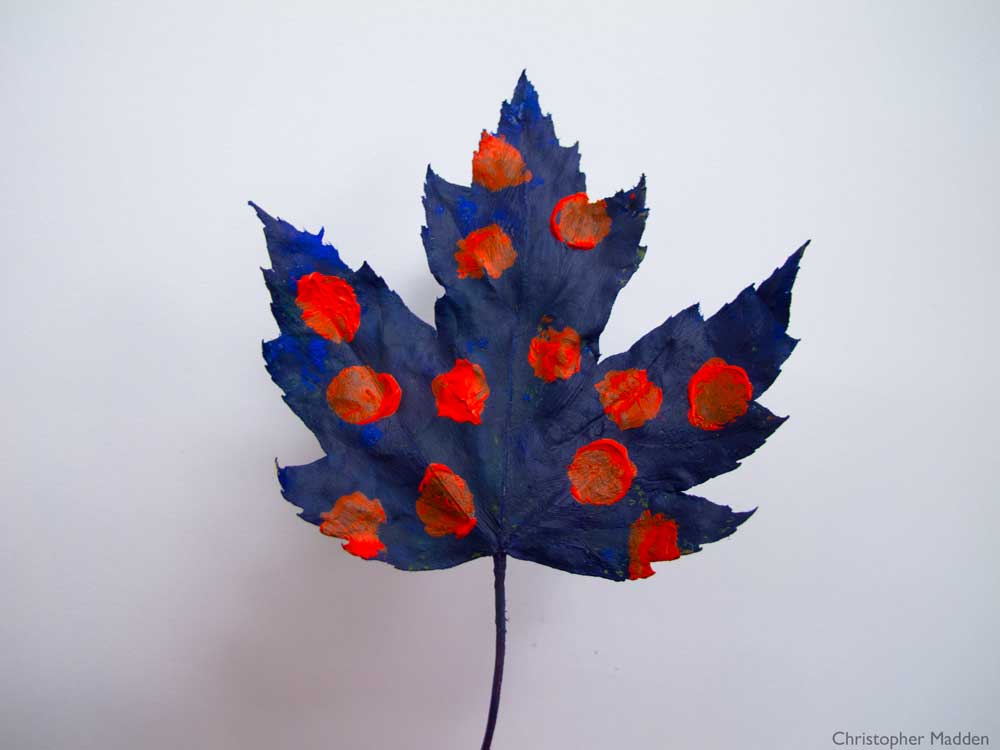
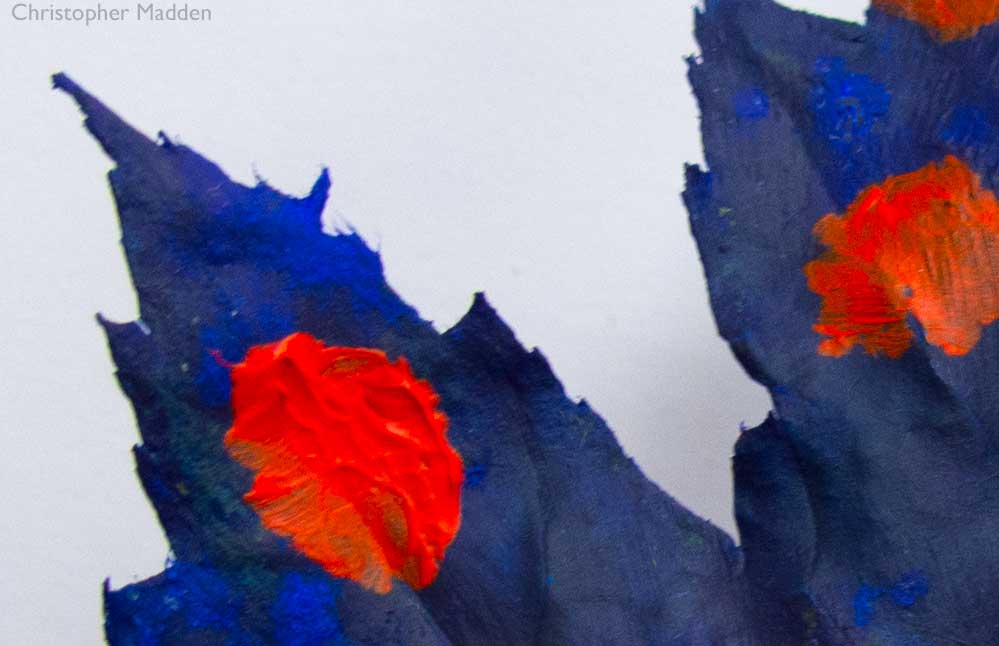
A maple leaf painted blue with red polka dots. The leaf had fallen from the tree in autumn. The inspiration for this work came partly from the fact that the leaves on the trees were changing colour in the autumn, prompting me to think of changing their colours in other ways. In previous years I’ve painted acorns and suchlike in unusual colours. Like a lot of my work, this work involved interacting with and responding to the natural environment. Unlike a lot of environmental art, my own environmenntal art often involves interventions of a deliberately unnatural nature, such as here where I’ve painted a perfectly nice autumn leaf in unnatural paint (acrylic) and in a design generated from human esthetics. This is partly to convey the way that we impose our tastes and our values on the natural world.
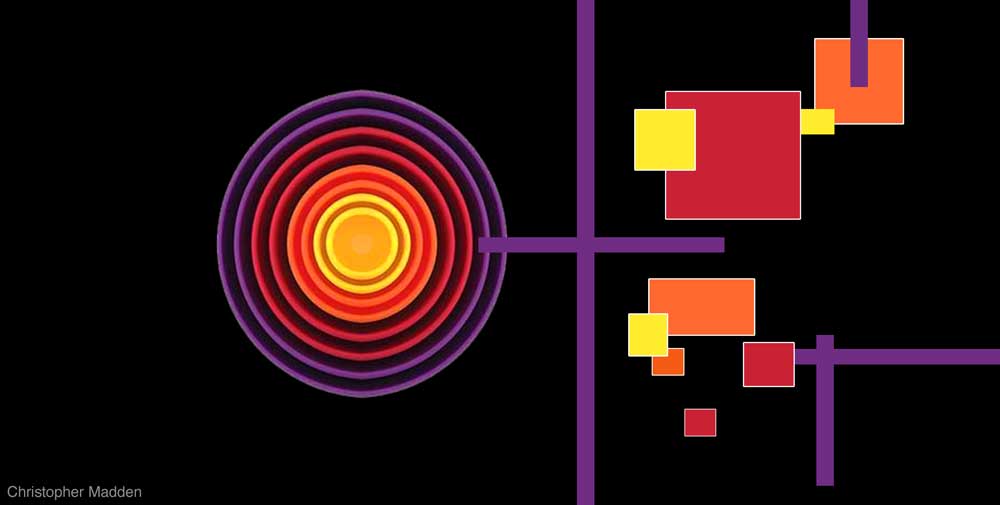
Abstract art based on circles, squares and rectangles. A major compositional feature of the image is the relatively random distribution of squares on one side contrasted with the very enclosed and restrained concentric distribution of the rings on the other side. This is a deliberate contrast between randomness and constraint. The fact that the squares all have their sides horizontal and vertical is a deliberate feature of compositional restraint imposed on the relatively randomly positioned squares. The rings are not perfect circles. This is partly to disrupt any preconception that they should be perfect circles, especially in an image that’s composed of basic geometric shapes. The use of squares and long thin rectangles is probably influenced in part by Mondrian and the de Stijl group.
The creature in this video isn’t a woodlouse, it’s a pill millipede, of the species glomeris marginata. It’s climbing up the outside of a door frame. I was struck by the way that the millipede seemed to be gliding along its course up the door frame as though hovering slightly above it, as its multitude of legs are concealed. I also like the armour plating, which, along with the hovering, makes the creature look like either a high tech machine or an alien. Or a hybrid of both. The feelers help too.
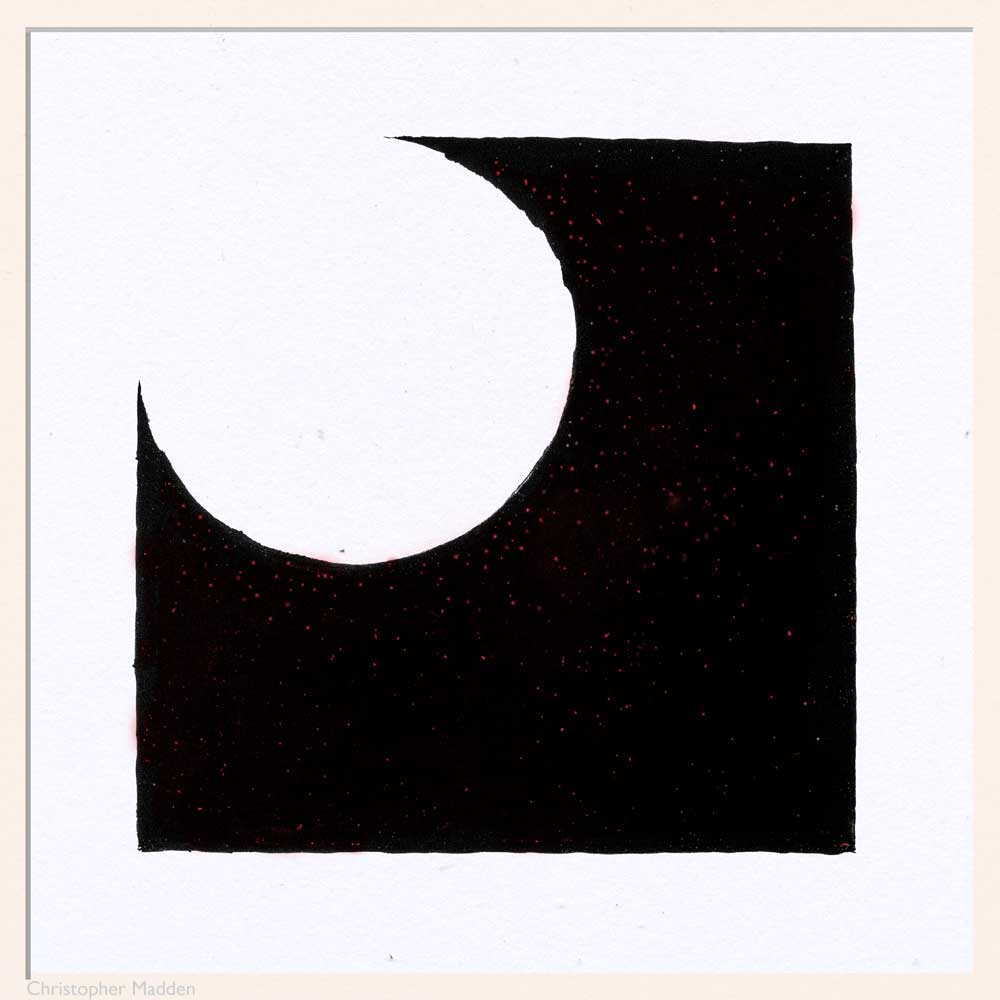
Part of a series of abstract minimalist paintings of black squares with a circle missing from a corner, in this case along with the part of the square that is separated from the main body of the square by the circle. This painting is a study of presence and absence. The black square has the quality of a solid, impactful entity while the white circle and top left corner give the impression of absence or negative space. In other images the black square itself conveys a quality of negative space, suggesting a black void in the centre of the image.
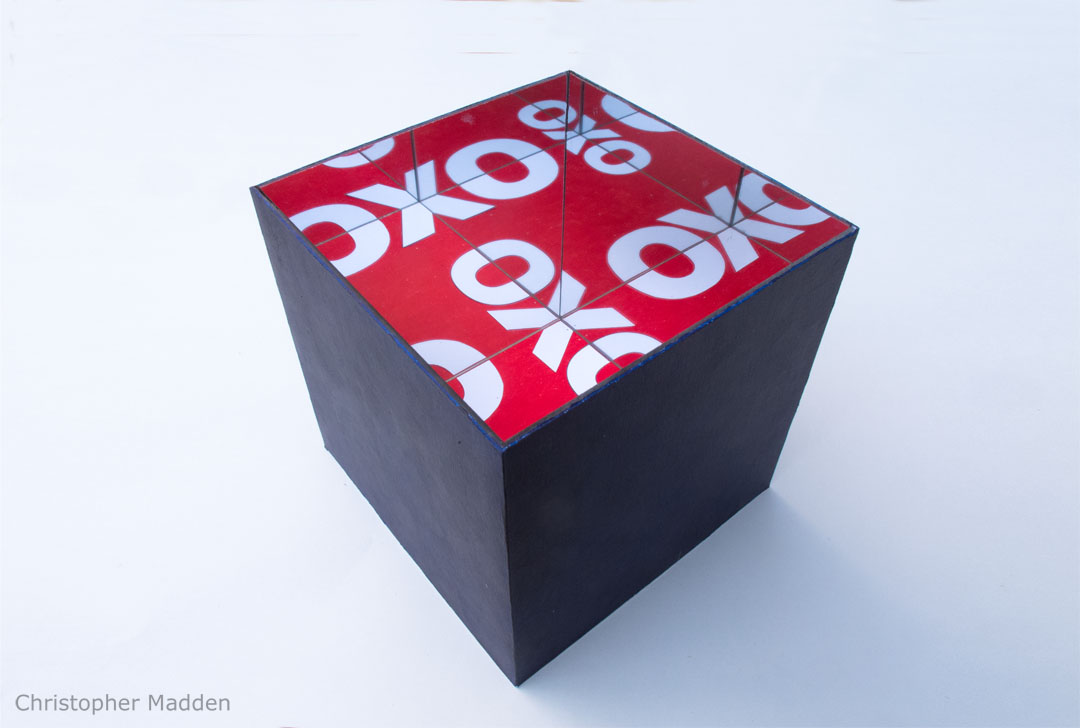
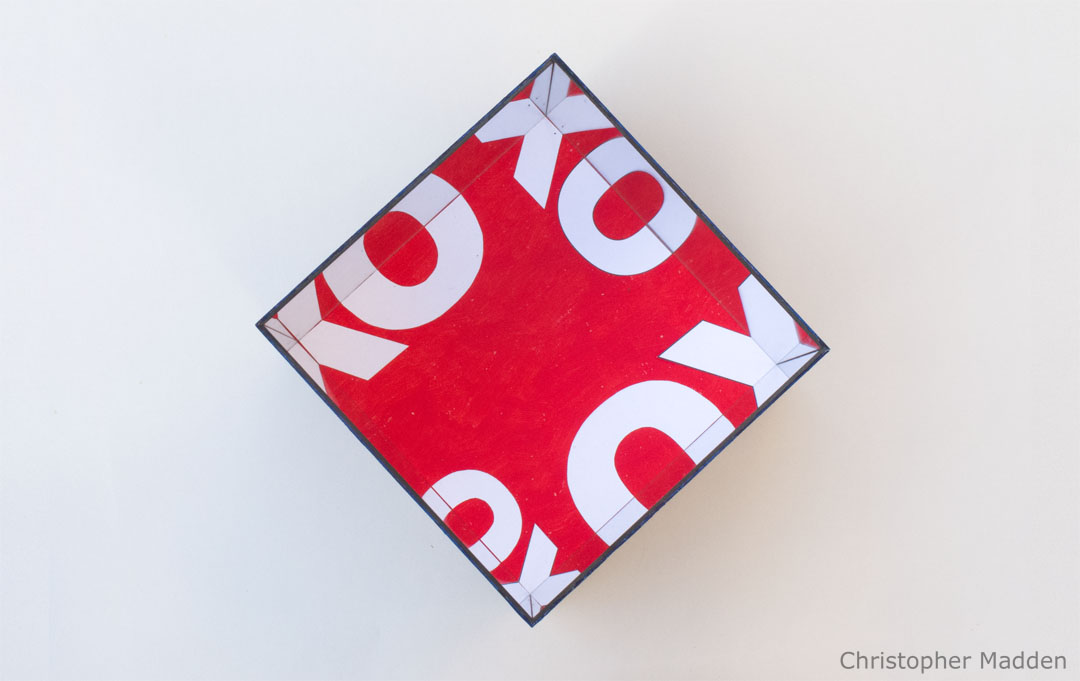
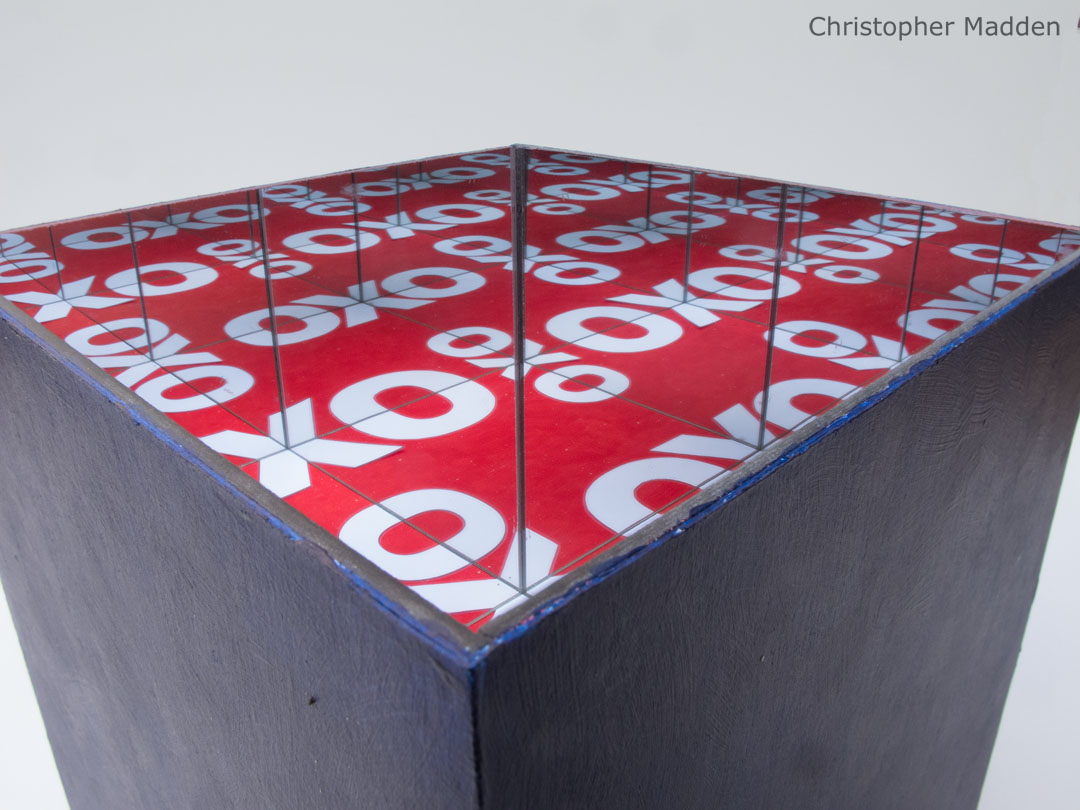
This is a mirror-based artwork that uses the concept of infinity mirrors (which is a phenomenon I first became interested in while I was a student of maths and physics in the early 1970s). The work consists of four mirrors forming the vertical walls of a cube, with the mirrored surfaces facing inwards. Each mirror reflects the mirror opposite it, including the reflections in that mirror, so the reflections build up to form infinite reflections (or, more accurately, multiple reflections, as the reflections gradually fade due to light loss). Where two mirrors meet in the cube’s corners each mirror reflects the other corner mirror, creating a different set of multiple reflections.
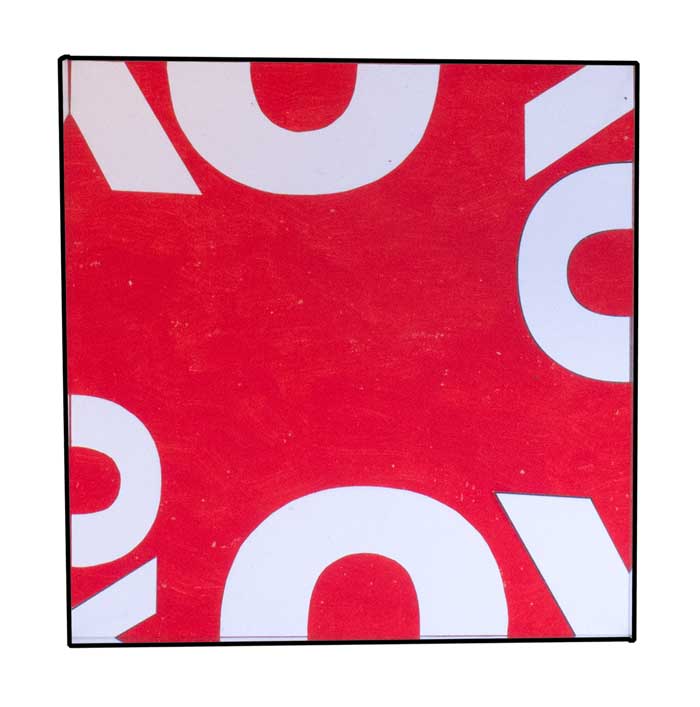
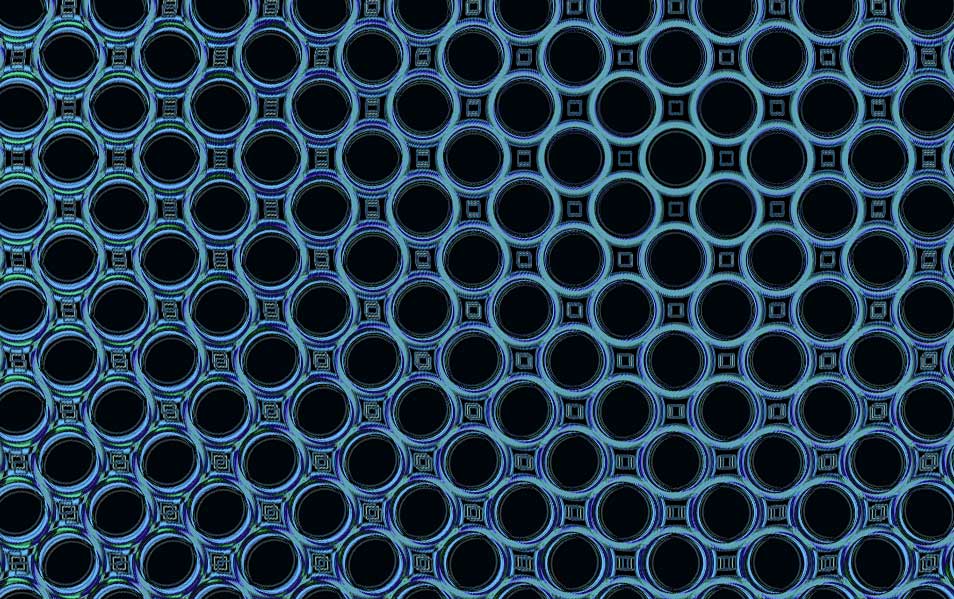
The design on the cube’s floor forms the abstract image below:
In each corner of the cube the abstract images are reflected in the mirrors to appear to form the word “OXO”. Each of these words “OXO” is then reflected infinite times in the other mirrors in the cube. This artwork is titled “OXO Cube”, as it’s just too good a title to ignore (The artwork is meant to contain an element of humour).
A low viewpoint looking into the mirror cube, as below, shows the infinity mirror effect at its best.
Below: a video of the mirror cube.
The work is partly the result of my interest in food and consumer packaging in contemporary art.
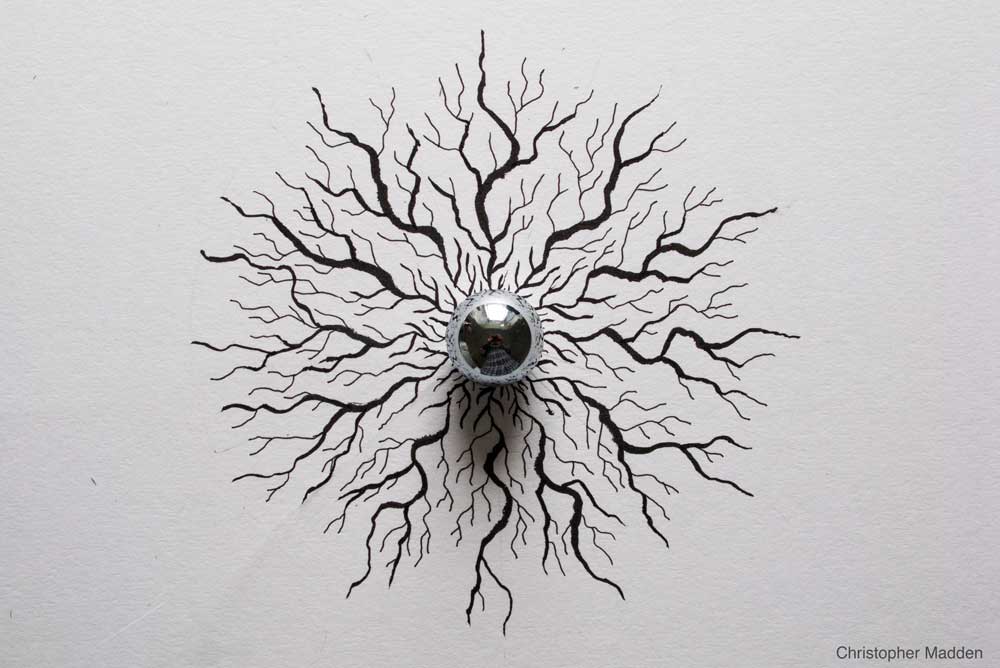
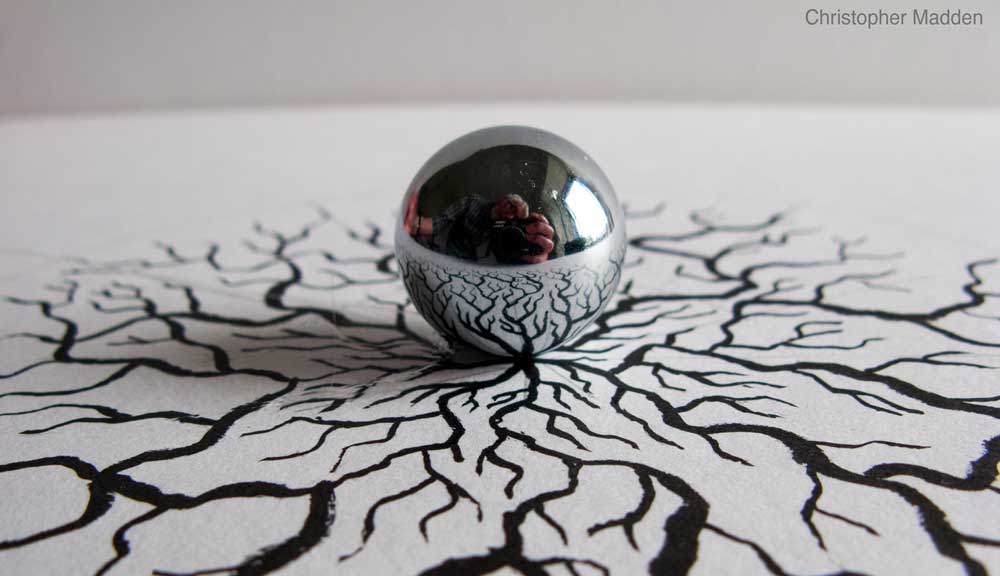
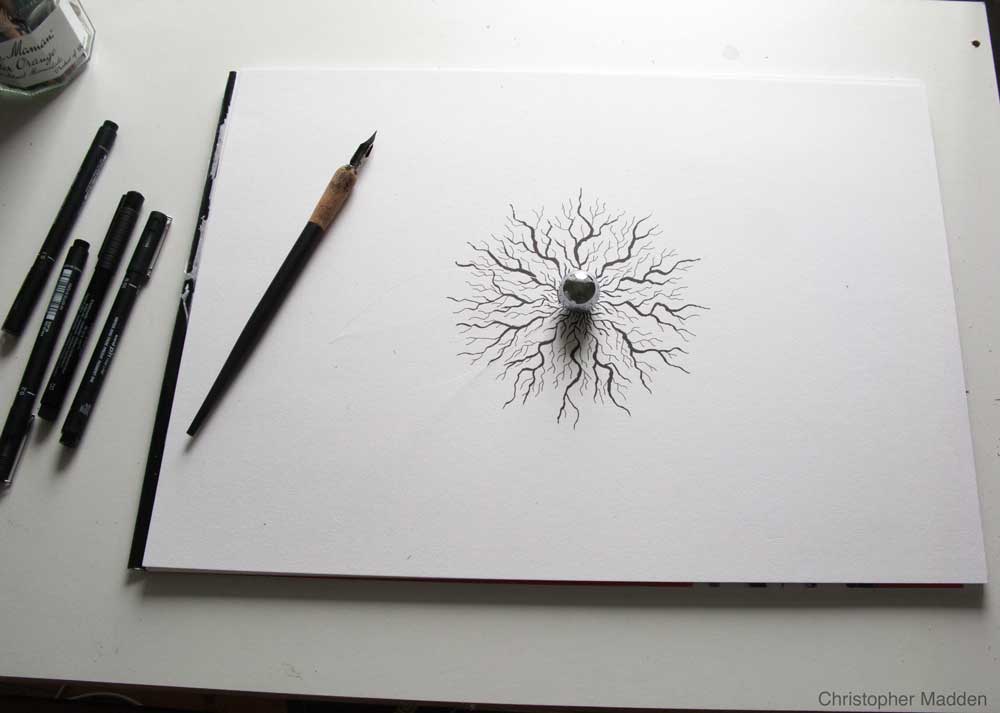
A study of reflections in a sphere. A steel ball placed on a sketch pad in the centre of a radiating vein-like pattern. The reflections in the sphere give the effect of an eye-like form. The work can be thought of as a study for a floor-based sculpture with a large steel sphere placed on a floor onto which the radiating vein-like lines are applied. It works very well at a small scale however, with the steel ball approximately the same size as a human eye. The intimate size of the small version makes this version quite unsettling, while a larger version would possibly be less unsettling but more visually intriguing (because the reflections in the ball wouldn’t invoke so precisely a human eye). The initial concept came to me while working on a different project involving a steel ball (but not reflections) on a sheet of paper. I noticed that the reflection of the white paper and the room on the ball gave the impression of the white of an eye and the iris of the eye.
A close-up of the steel sphere, showing the reflection from the sideThe sketch on the sketchpad, with the steel ball reflecting the pad and the room
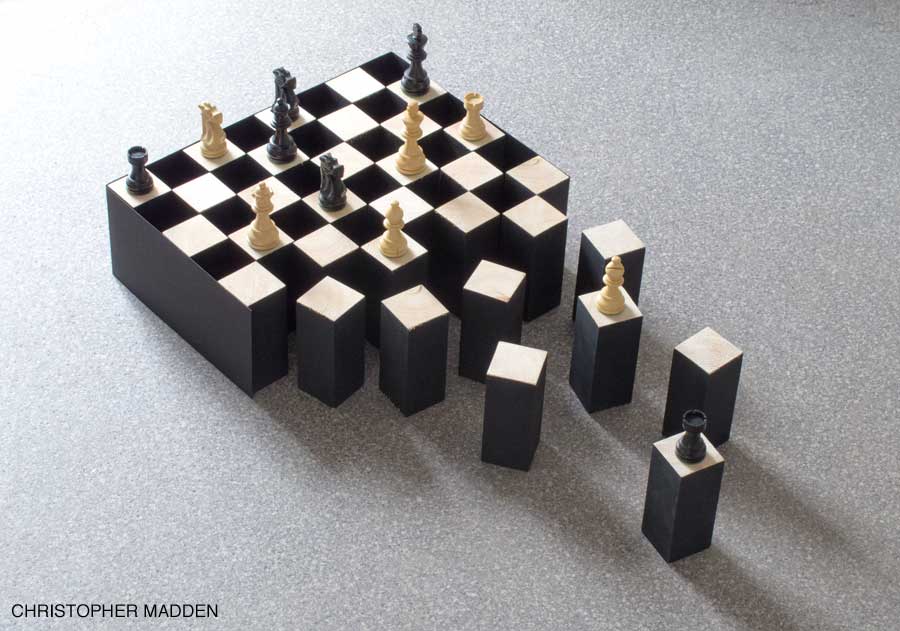
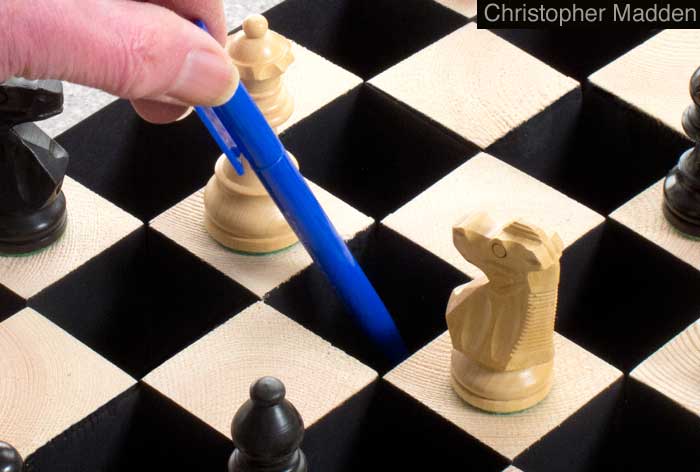
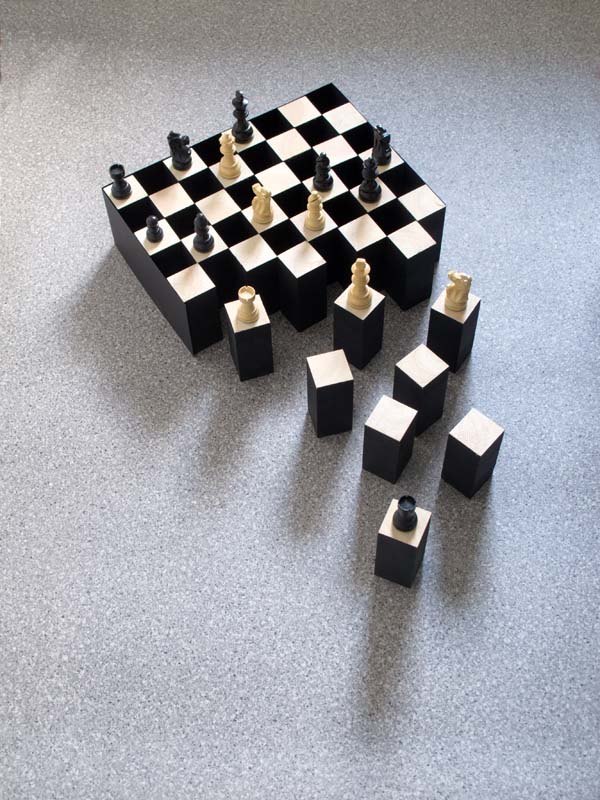
In this work I’ve created a chess set out of short blocks of wood. The first thing that the viewer notices when looking at the work is that the chess board is fragmenting or disintegrating. Less obvious however is the fact that the chess board is composed only of the white squares. These white squares are the tops of blocks of wood, the sides of which are painted black. It is the black sides of the blocks that give the impression of the black squares of the chess board. The seeming existence of the black squares is a visual illusion, as they are nothing more than black holes. See the photograph below. The illusion is as true with the actual, three dimensional chess set as it is with these photographs. A large number of viewers of the work don’t notice that the black squares are an illusion. Part of the impact of the piece is in the way that the viewer only notices the ‘black holes’ of the missing black squares on the chess board after already being intrigued by the disintegrating nature of the board. The piece has political overtones, in that it is partly about the disintegration of power (as symbolised by the combative nature of the game of chess) and the disintegration of order (as symbolised by the rigid grid of the chess board). It is also about more existentialist themes such as dangers that lurk in the world (the black holes as traps or stumbling blocks) and the nature of physical reality (with the holes representing the unknown parts of the physical universe (such as the actual black holes that result from collapsed stars). It’s also just a nice visual illusion, and thus contains humor as well as its more weighty themes.
The chess board contains no black squares – they are an illusion.
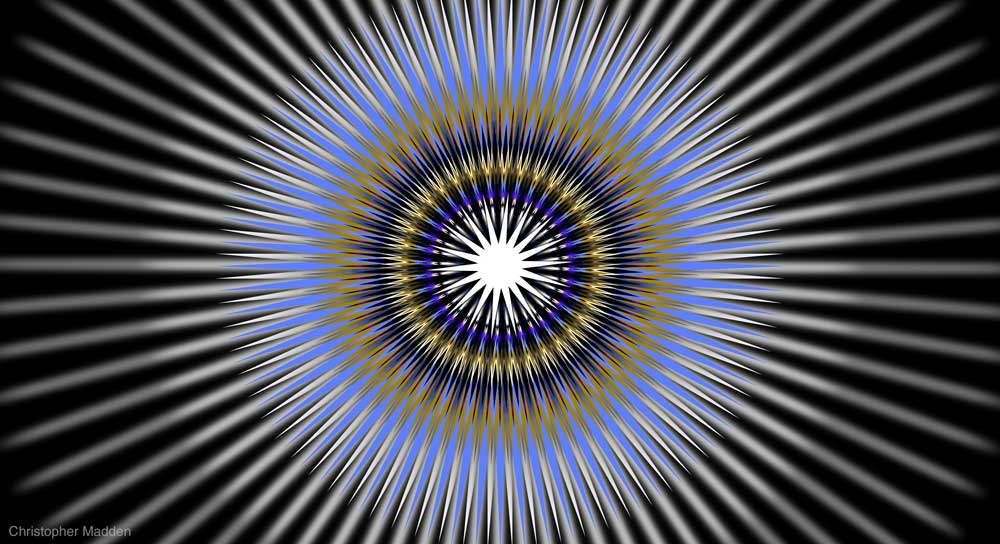
A still image from an animated artwork showing a starburst effect. The image was used in the Deep Space event on 21st April 2018 at Sterts Theatre near Liskeard in Cornwall.
The image is the result of my interest in astronomy and cosmology and in the nature of the universe in general, especially the nature of its creation. My interest in the cosmos dates back to my childhood when I constructed an astronomical telescope (including the grinding of the main 8.5″ papabolic mirror).
An image about cosmology, astronomy, the universe and creation.
Exploring the generation of complexity from simplicity. Electrom. 2015
An abstract moving image artwork in which multiple copies of a single shape move and interact using simple computer algorithms, resulting in the generation of complex shapes.
This work is from a series of works exploring the theme of the generation of complexity from simplicity. The original motivation behind the series was to attempt to depict in metaphorical form the way in which our complex universe is formed through the interaction of incredibly simple forces.
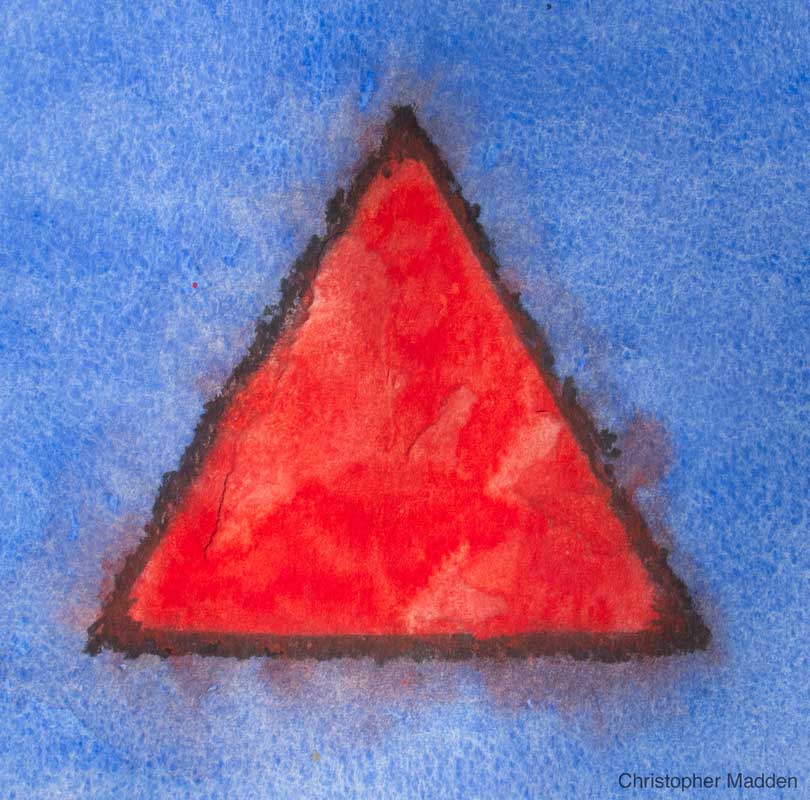
A watercolour painting created as part of a series exploring the depiction of simple, precise geometric forms (such as the triangle here) using techniques that introduce imprecision to the geometry of the image. A study of order, stability, uncertainty and potential disintegration.
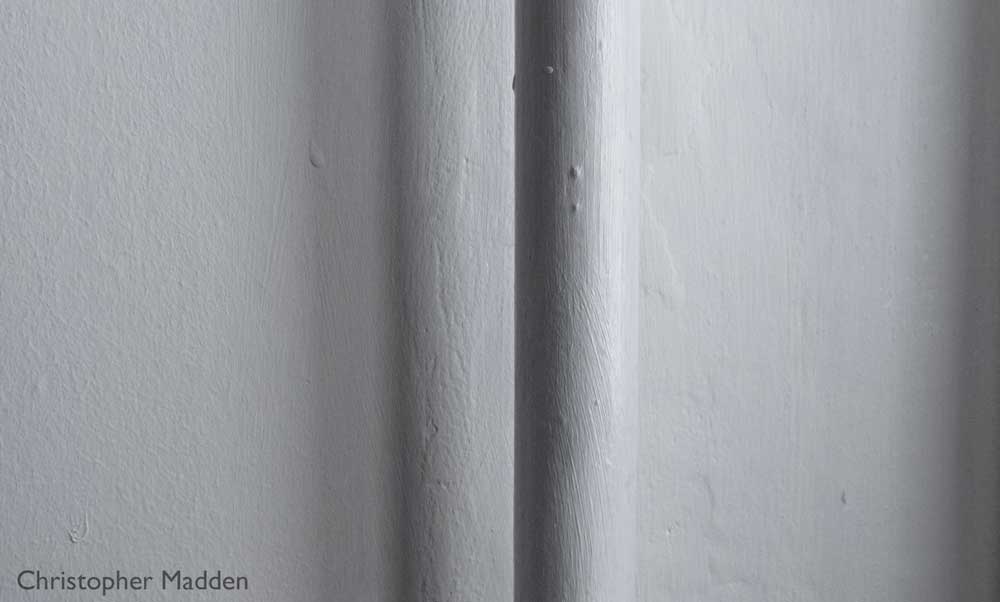
An unretouched photograph of a single pipe inside a room near a window. The shadows generated by the light through the window create varying dark areas on the wall that give the illusion of a second pipe – a Ghost Pipe.
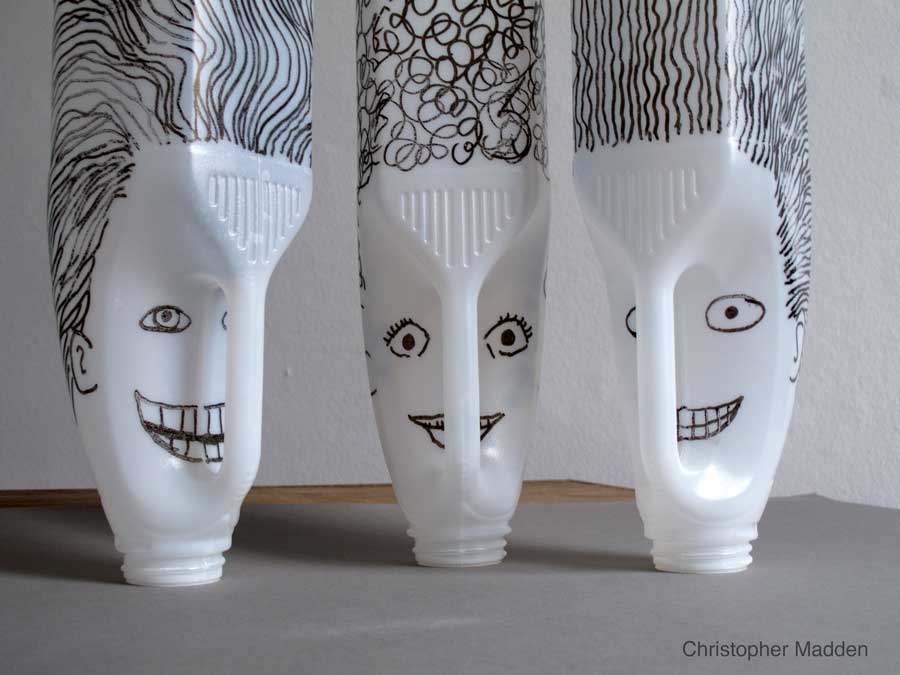
Slightly unsettling heads created from empty plastic milk bottles.
Like many artists I have a habit of collecting waste and recycling it into works of art. The slightly sinister appearance of these heads, drawn as they are on post-consumer waste in the form of discarded plastic milk bottles, can be interpreted as a comment on the fact that we as humans are destroying the environment through (amongst other things) our profligate use of plastic consumer packaging (I’ve been producinng work concerned with environmental issues since the 1970s). The fact that the heads also resemble the type of craft-play objects produced by children can be interpreted as alluding to the western world’s current tendency towards a philosophy of consequence-denying pleasure seeking in which the adults in society fail to take responsibility for their actions beyond immediate self-gratification.
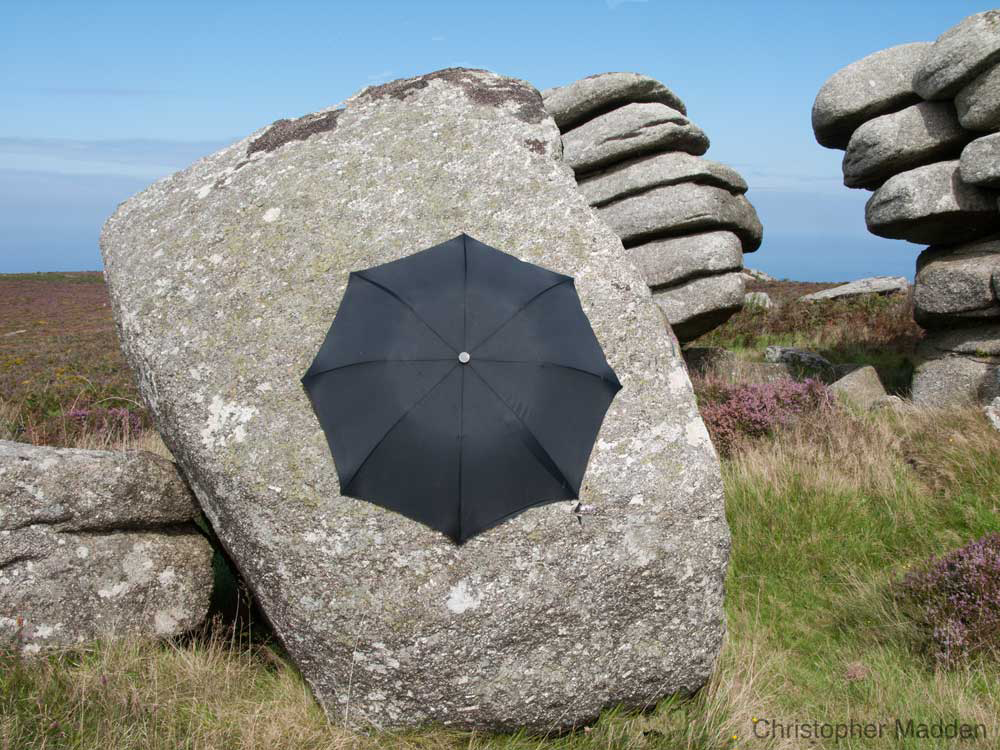
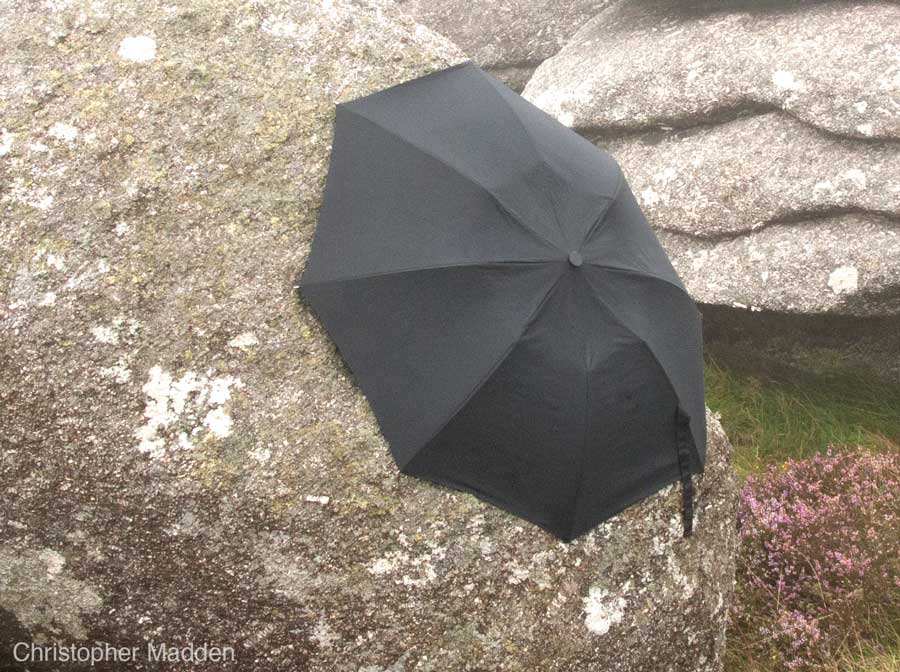
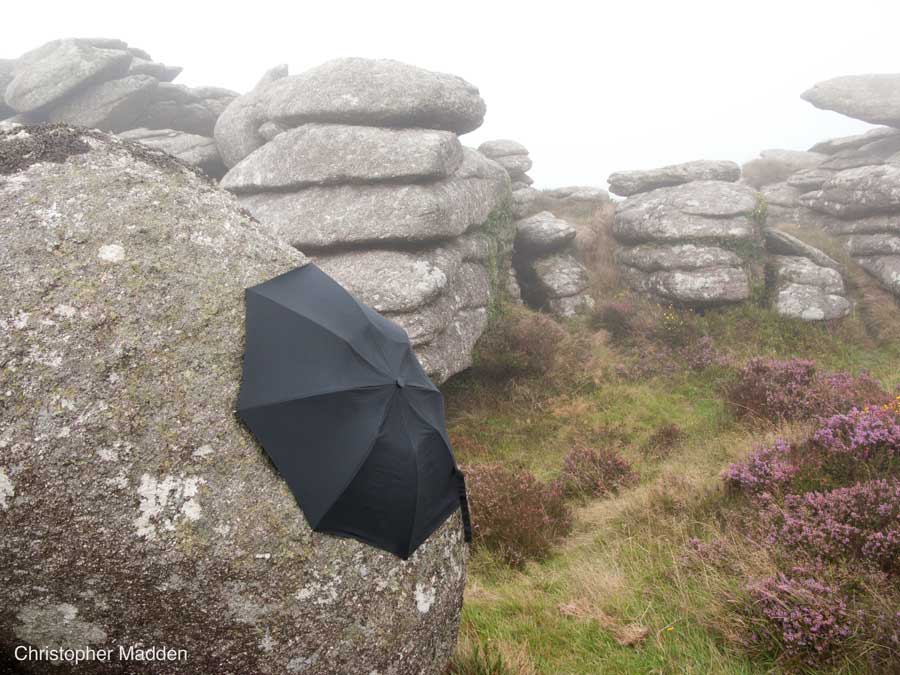
Art in the environment: umbrella, granite rocks. 1st September 2018
A work of environmental art consisting of an umbrella clinging to a granite rock on a misty hilltop in Cornwall.
The umbrella in this work of contemporary environmental art or land art can be seen as representing shelter. Perhaps it’s shelter from bad weather caused by climate change or global warming. Umbrellas after all are primarily designed to provide shelter from the weather. The shelter provided by the umbrella in the face of climate change is however woefully inadequate. An umbrella after all is a very flimsy structure.