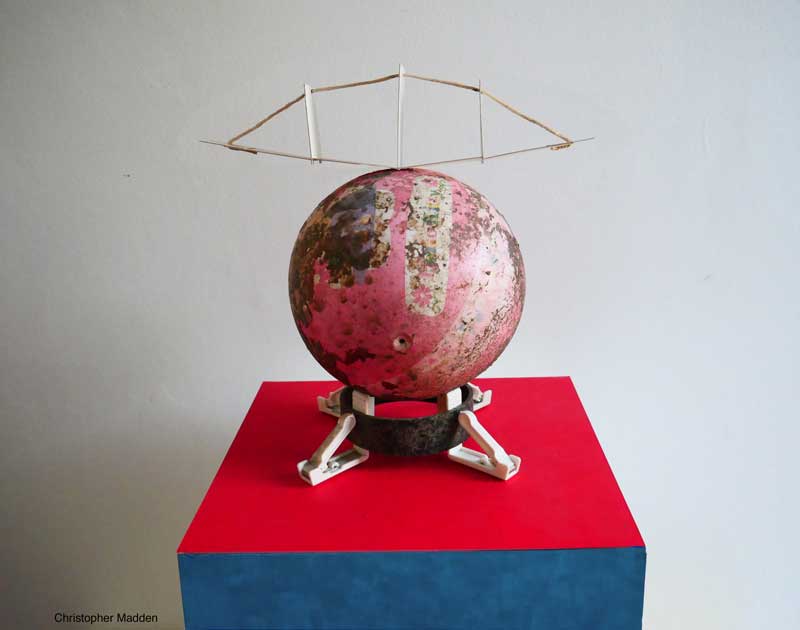
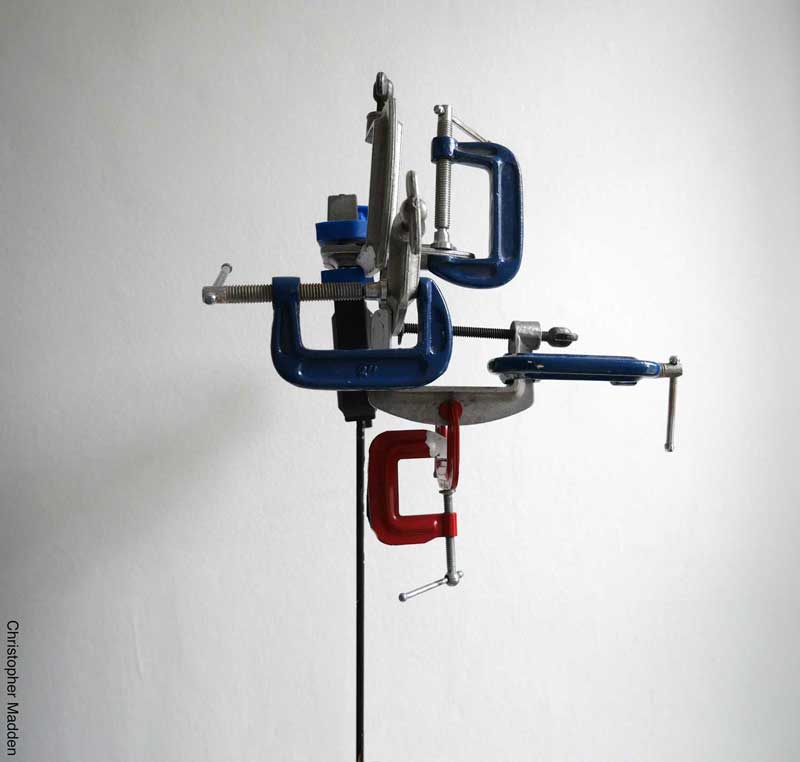
A sculpture constructed from G-clamps attached to a speed clamp.
Normally clamps are used in order to hold other objects together (such as glued pieces of wood while the glue dries). Here the clamps are holding each other together. The assemblage can be interpreted as a metaphor for human society holding itseld together by using its own inherent qualities and strengths.
An version of this concept shows the clamps at an angle – possibly a metaphor for the precariousness of the cohesion of human society.
A video of the sun creating complex patterns on the ground.
The video was shot in the gardens of Hatfield House in Hertfordshire, UK. The shadows are created by the branches of a pleached lime walk and the structure that is supporting it.
The video points to, amongst other things, the concept that the earth is connected to the sun in complex ways, with the sun creating the intricate patterns of life on earth (here portrayed by the complex patterns in the shadows of the branches). The fact that the pleached lime hedge is partly a work of artifice emphasises the link between the human race and the natural world (here portrayed by the shadows of the hedge’s supporting structure).
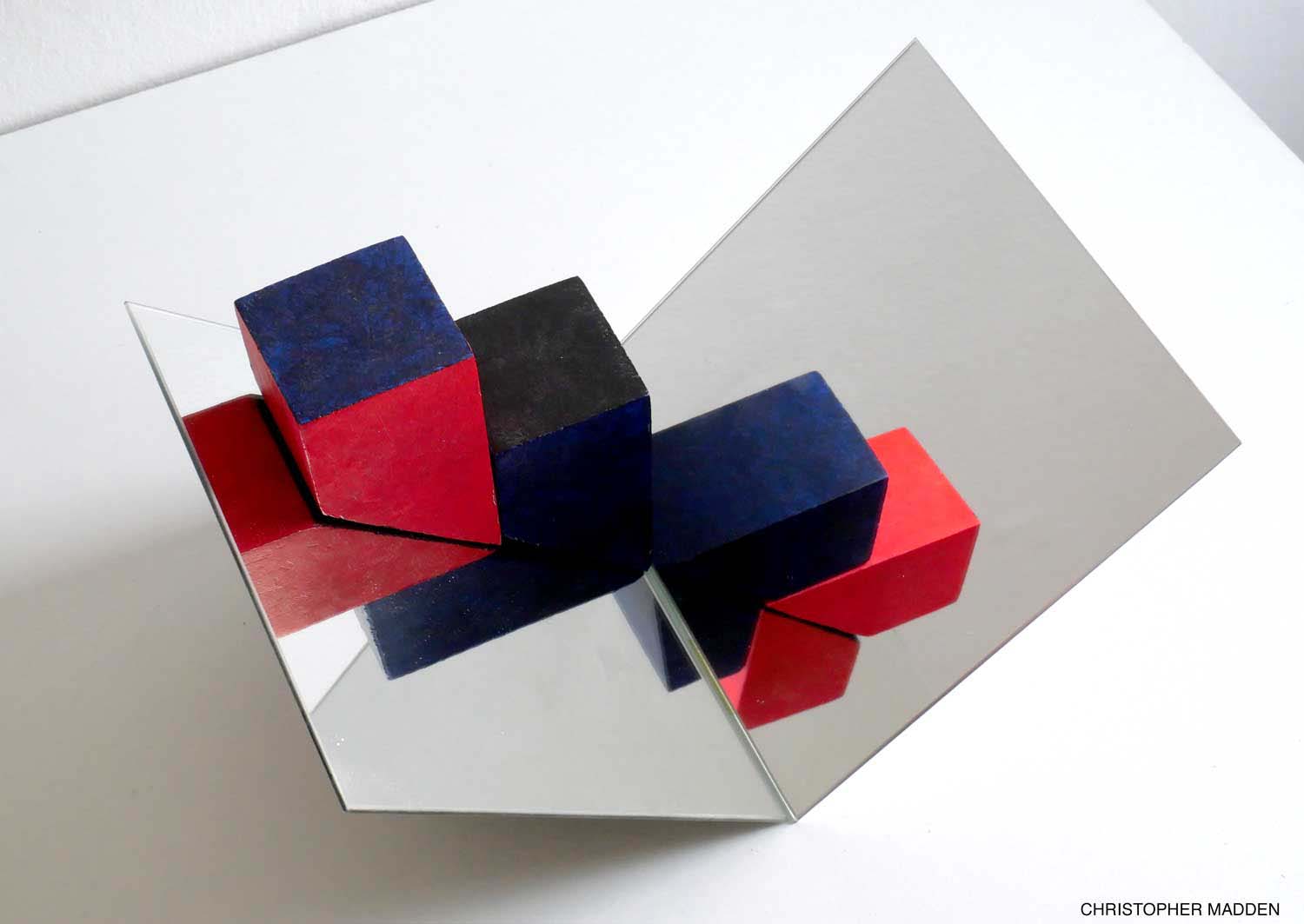
A sculpture formed of two painted wood blocks placed between two mirrors at angles to each other.
Unlike with most mirrors, which are vertical, the mirrors in this work are at 45 degrees to the horizontal, producing a reflection that includes the vertical axis rather than just the usual horizontal one. I think that reflections on the verticle axis are inherently more interesting than those on the horizontal axis because they invert the image top to bottom rather than just flipping it right to left – a right to left reflection simply puts the right side to the left, with the only striking evidence of anything being unusual is when writing becomes back-to-front. Vertically reflected images however turn the whole world upsidedown.
Wood, plastic, acrylic, torch, 18x18x11cm. November 2020
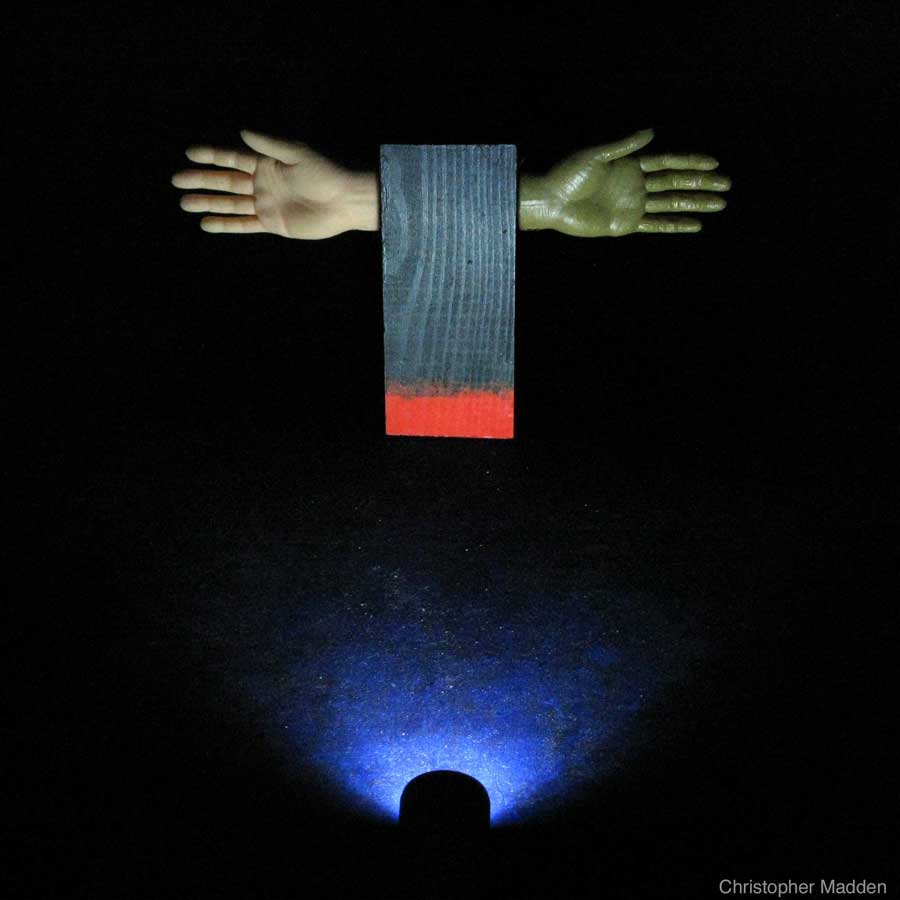
This sculpture suggests a contemporary art Christian crucifix.
A sculpture formed from a wood block, plastic hands and a small hand torch. The work is composed of very simple components (the wood block is a piece of 2×2). In this version the cross is dramatically lit by a pocket torch. The work bears a resemblence to a Christian crucifix, although this is actually an emergent property of the work rather than a primary aim. The initial concept behind the sculpture is of hands that also resemble wings attached to a geometrically simple form (In this case a rectangular block, in other cases spheres). The position of the hands give an impressing of offering embrace, while also giving the impression of being elevating (when the hands are seen as wings). These are properties that enhance the work’s identification to the ideals of Christianity. The feeling of elevation in the work is enhanced by the fact that the cross seems to be suspended in the air. It is actually firmly rooted on a dark blue, flat horizontal surface, with the atmosphere of elevation being provided by the simple dramatic light of the hand torch. You may also notice that one hand is black while the other is white, which may be seen as a symbol of inclusivity and universal human togetherness.
An acrylic and watercolour painting of a black flower.
This painting is an example of my work relating to environmental issues, a subject with which I’ve been involved since the late 1960s.
In this painting the flower’s petals are black, the flower’s stem is black, and the grass is black. The flower’s petals are shrivelled and misshapen and the stem is crooked. It’s an image of foreboding.
In contrast to all this blackness the centre of the flower is reflective gold. But it’s a dull gold, which may act to reinforce the bleakness of the black rather than creating a glimmer of brightness. It’s ambiguous.
The gold centre to the flower and the spiky petals give a hint of a dying sun or star, with the accompanying implications for life on earth (such as the flower). It’s a dying sunflower.
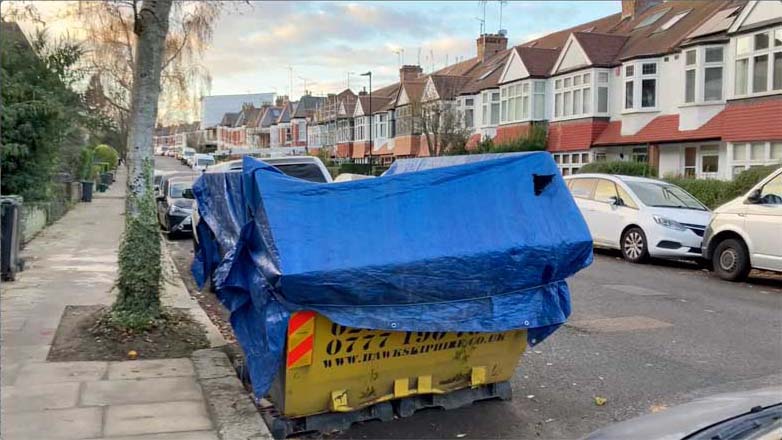
A video camera moves towards a builder’s skip and travels through a hole in the tarpaulin that covers the skip to reveal the contents of the skip.
The contents are seen to be a view of outer space with planet Earth suspended or floating in it. The builder’s skip may be thought of as a portal to another dimension.
A meaning of the artwork is that the Earth has been reduced to the rubble and rubbish that is disposed of in builder’s skips or dumpsters, which are primarily designed to hold the debris and waste from construction projects and demolition projects. The work is a critique of our disposable consumer society and the environmental crisis that we are currently living through. In the area of London in which I live there are frequently builder’s skips positioned on the road in front of houses as the owners rip out perfectly good kitchens and replace them with new kitchens. It’s happening just a few doors away right now.
A video still from the Earth in a Builder’s Skip video.
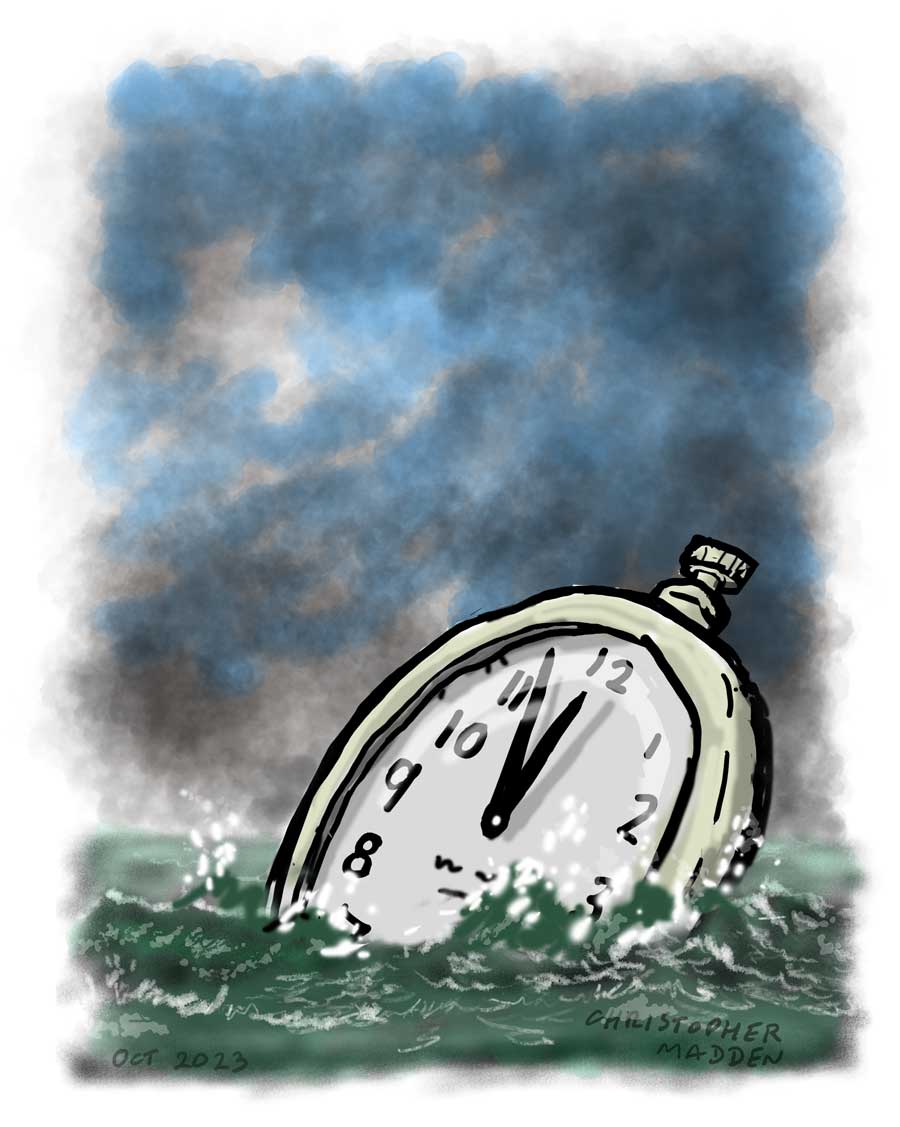
A digital sketch or painting that reflects my concerns about environmental issues, showing a watch sinking in a stormy sea.
The watch or clock is a metaphor for time (as usual). The watch is being buffeted by a stormy sea and is in the process of sinking. The sea is a metaphor for climate change, global warming and other environmental concerns, both generally and specifically as they apply to the sea. The fact that the clock or watch is sinking is a sign that we are running out of time. The clock is not just a metaphor for time, it is also a metaphor for civilisation and the technology on which we rely ( A clock being an elaborate piece of highly sophisticated engineering). The fact that it is impossible for a watch to float in the first place may be a factor to consider too.
The theme of this sketch reflects my interest in creating environmental art because of my concerns about the state of the planet due to climate change, environmental degradation and other aspects of environmentalism (which has been a concern of mine since the 1960s).
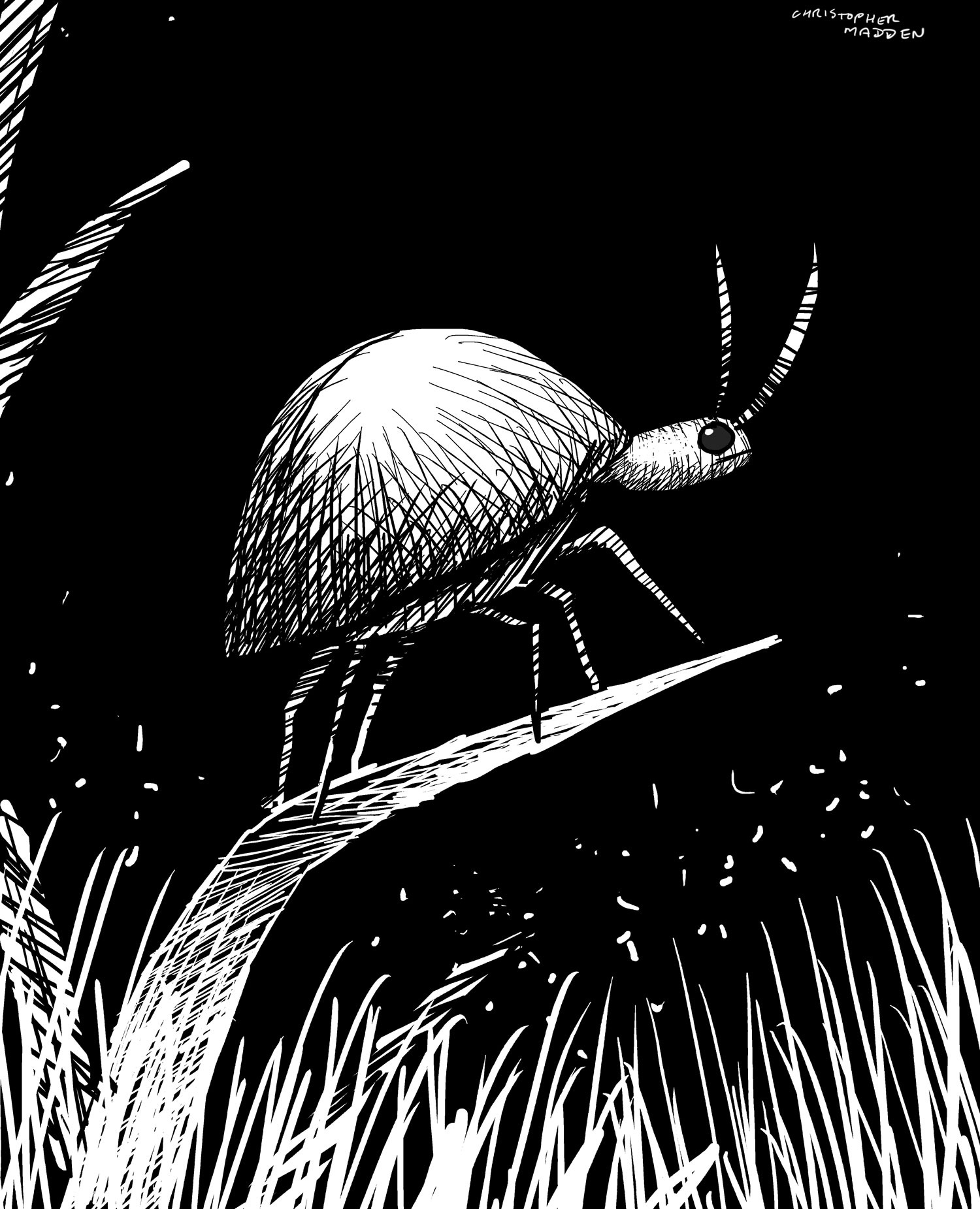
A digital sketch created for a print. It features a stylised insect drawn from my imagination. The insect is drawn in a sketchy black and white style that is perhaps suggestive of images produced using traditional printmaking techniques such as woodcut, woodblock or linocut. It also reminds me of scraper board. The black sky makes me think that it’s a nocturnal insect of some kind. It also looks a bit like a tortoise for some reason, with perhaps a bit of rhinoceros thrown in.
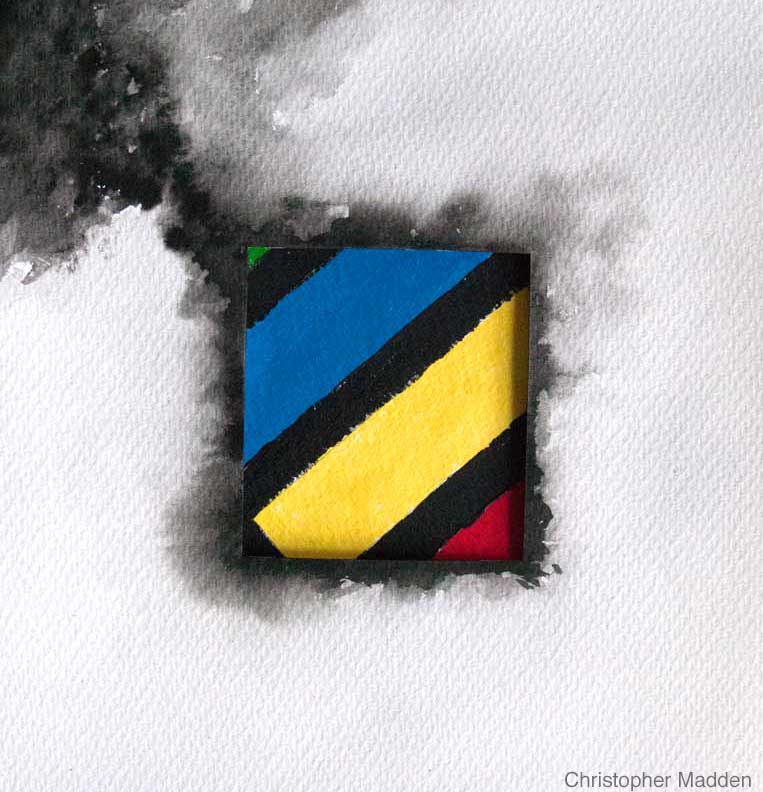
Acrylic and gouache on paper, collage. 14x14cm. September 2020
An acrylic and gouache abstract painting composed of a square of brightly coloured stripes embedded within a smoke-like form in gouache. The coloured square is revealed through a hole in the paper on which the smoke is painted.
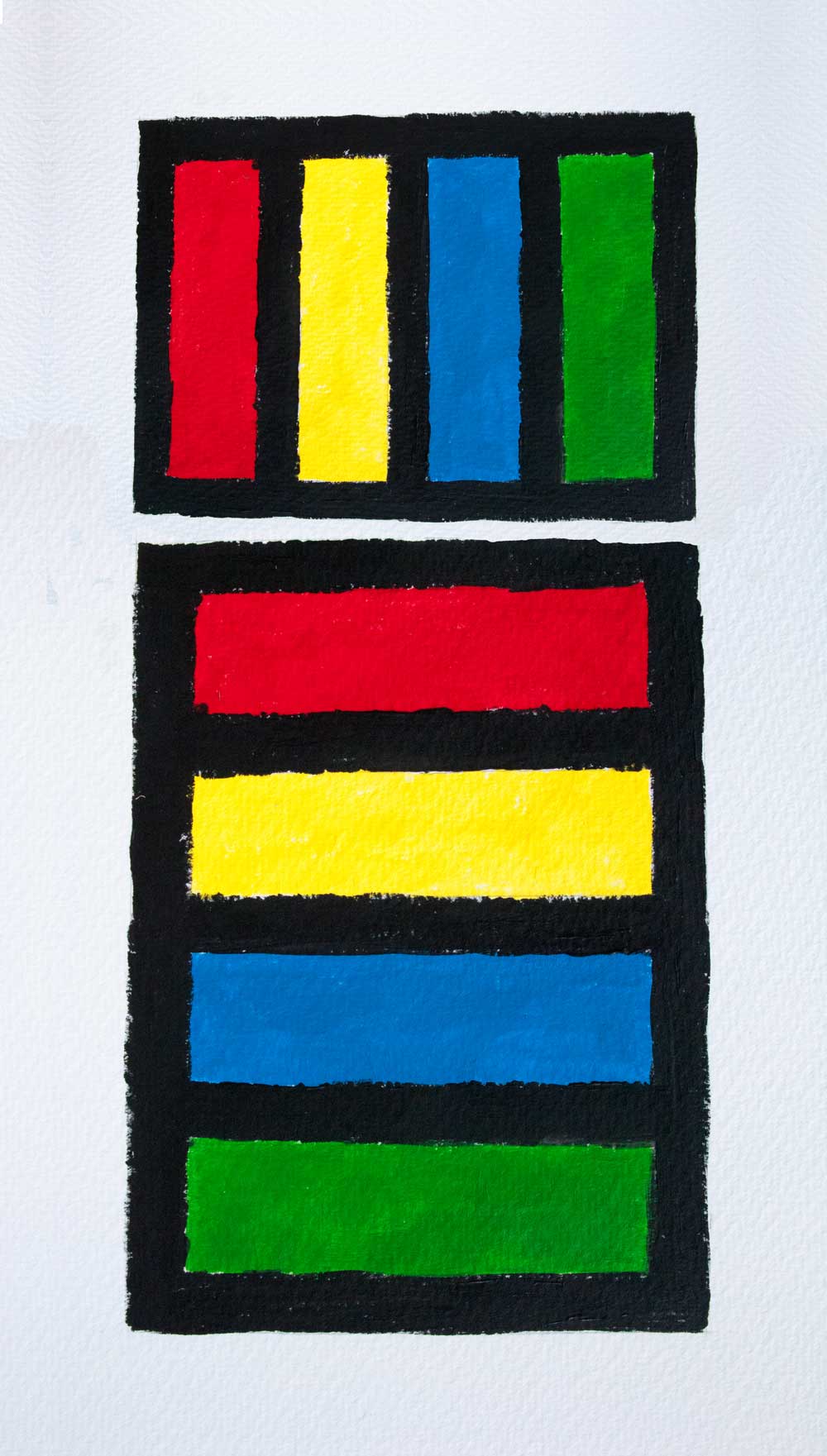
A geometrical acrylic abstract painting composed of two separate rectangular areas each with a stack of smaller coloured rectangles embedded within it. The rectangles in the upper area form a ladder while those in the lower area are more brightly coloured. The amount of white paper on which the shapes are placed is important, as the forms seem to float on the surface rather than the surface simply being the base onto which the image is painted.
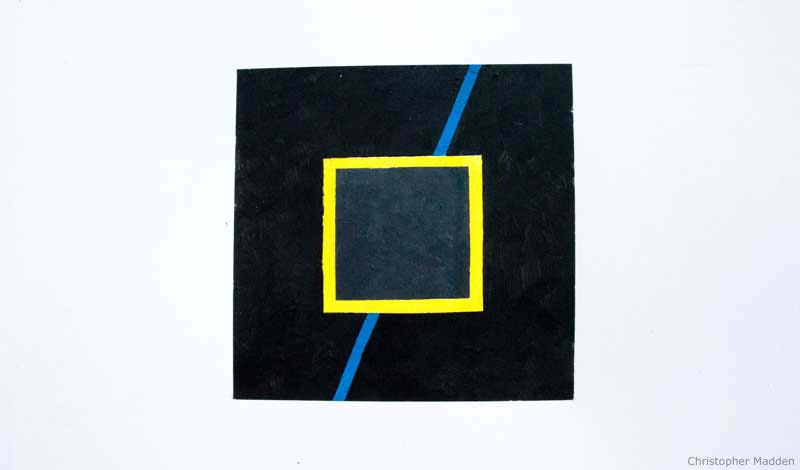
Geometrical abstract acrylic painting – yellow square blue diagonal
Acrylic on paper 8.5×8.5cm on a 21x29cm sheet. July 2020
An acrylic minimalist geometric abstract of a yellow square on a black background, with a blue diagonal. The interior of the square is very dark grey, not black. The paint is high viscosity acrylic, so it has a slight texture. The edges of the forms in the painting are generally sharp due to the use of masking film. A very small amount of bleed under the film was allowed in places (by not pressing the film too firmly onto the paper) so that a few imperfections could occur, thus preventing the forms being too clinically precise.
Note: this work has coincidental similarities to House Taken by Rafael Gomezbarros.
My concept predates that of Gomezbarros, mine being originally conceived in the 1990s to accompany an article in the Guardian newspaper, while Gomezbarros’s work was created in the 2000’s (as far as I can tell).
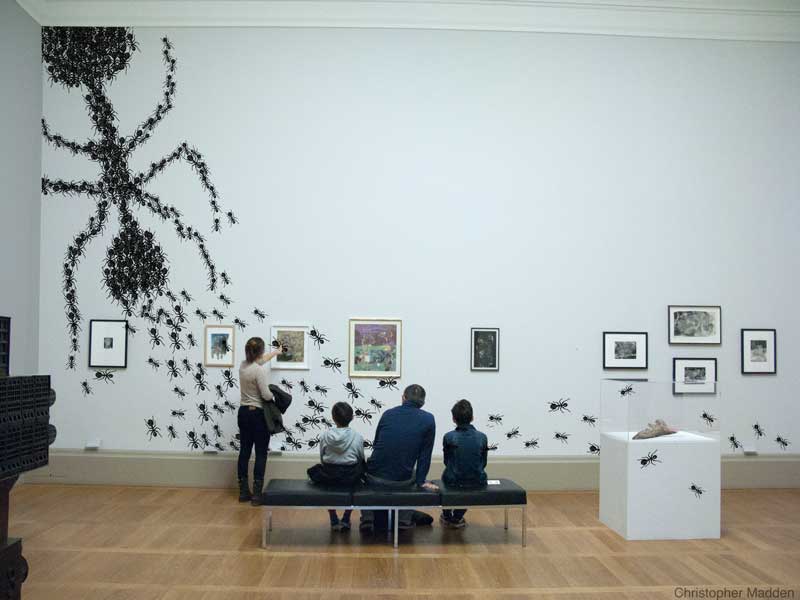
A proposal for an artwork about ants as a super organism
Artist’s impression for a gallery installation. January 2020. Based on a work from 1990
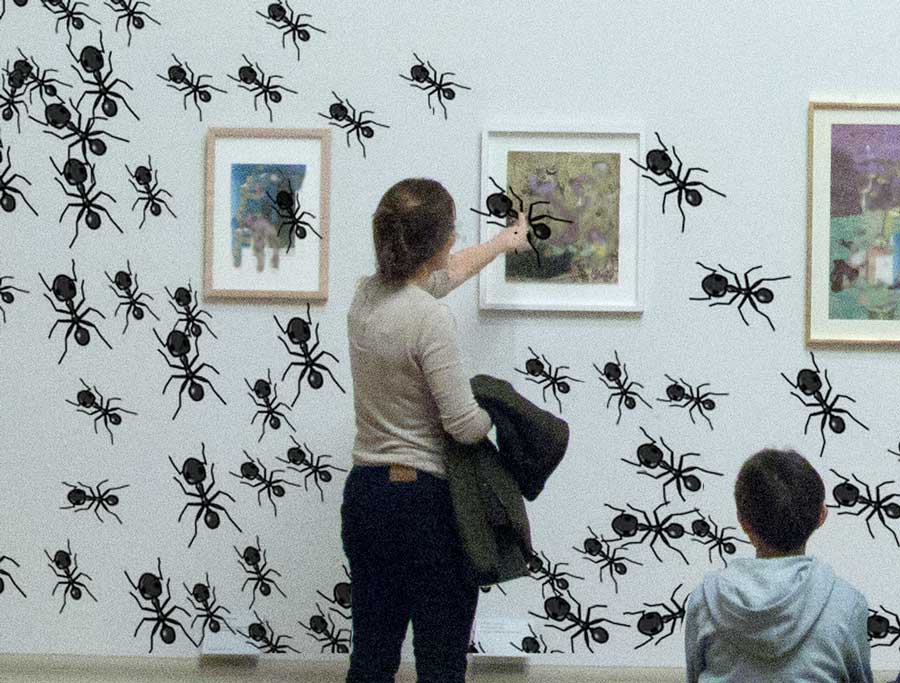
A proposal or concept for an artwork showing ants crawling across an art gallery wall, with the ants grouping together and coalescing into the form of a single gigantic ant. The artwork depicts the concept of the superorganism, in which multiple individual organisms of the same species (in this case ants) interact by a process of synergy to give rise to a collective body that can operate in ways that the individuals can’t. The individual organisms within the superorganism usually display a degree of division of labour or specialisatoin of function, meaning that the individual organisms can’t survive for long on their own. Human civilisation is often defined as a form of superorganism, although this isn’t strictly accurate, as humans can survive alone.
The ants in the work may be two dimensional, such as in a mural, or three dimensional such as in a sculptural work.
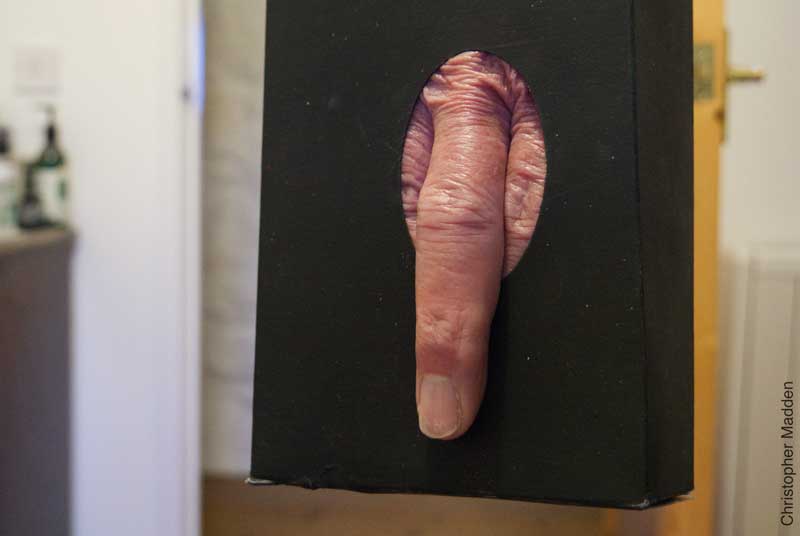
Finger Cardboard cereal carton, acrylic gouache, finger. June 2020
A cardboard cereal carton of the type with an oval window in it to reveal the contents, painted with black acrylic gouache. A hand is placed inside the carton, with one finger protruding through the window. The photograph here has a strange unsettling quality partly due to the disconcerting suggestive appearance of the finger, which looks like a penis. If it had been a penis the image would have definitely been a piece of fetish art. The fact that it’s actually only a finger gives the image an uneasy air of dissonance. It’s meant to be quite humorous. Another unsettling element to the image is that the physical context of the components are quite hard to read. The black box is not on a surface, as it is on the end of the arm that the finger belongs to (mine). The background includes an open door The door handle is visible upper right, with the door frame to the immediate left of the box) and there is the edge of a chest of drawers at the extreme left.
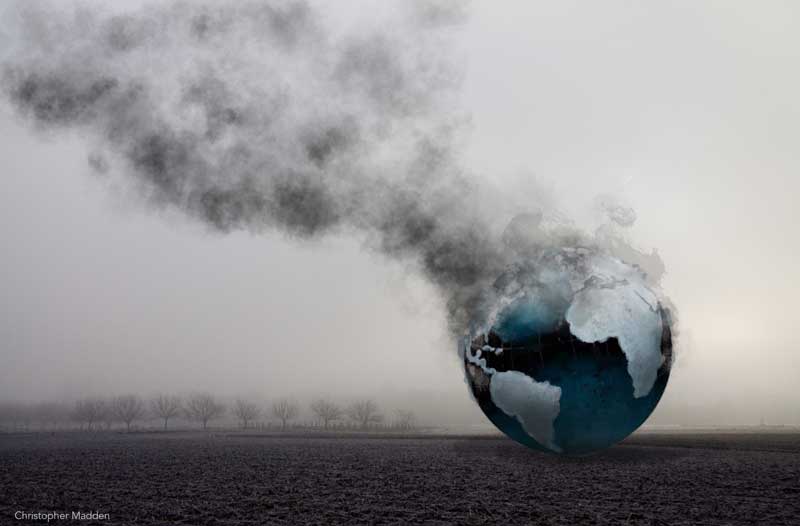
A smoking globe. Planet Earth suffering the consequences of climate change or global warming.
The globe in the image is resting on the ground rather than floating in space. It may be a giant sculpture of the earth smouldering as a result of climate change. It also has the appearance of being some sort of crashed or abandoned man-made structure, as though the earth is an artificial artefact, which in many ways it is, and that this is the reason for its stricken state.
The globe is resting on the ground in a very large field. In the background is a row of trees. These trees give a hint towards the existence of nature and the natural world, however on a second look it may be noticed that the trees themselves are in a perfectly straight line and are all the same age and species – they are in fact part of a completely man-made landscape.
This is one of my many works dealing with environmental issues such as climate change and global warming.
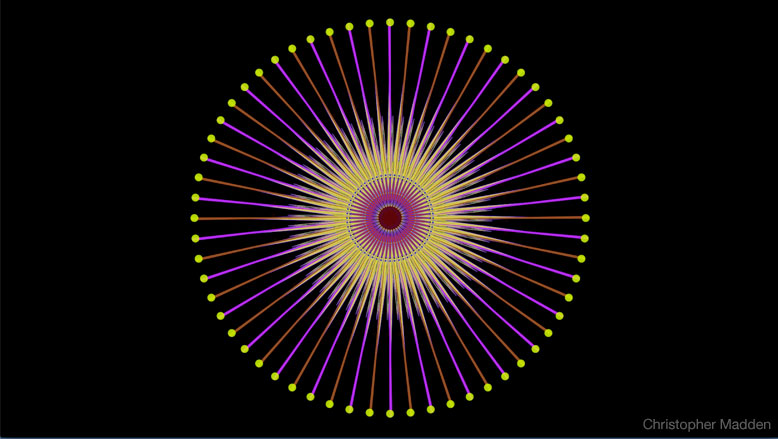
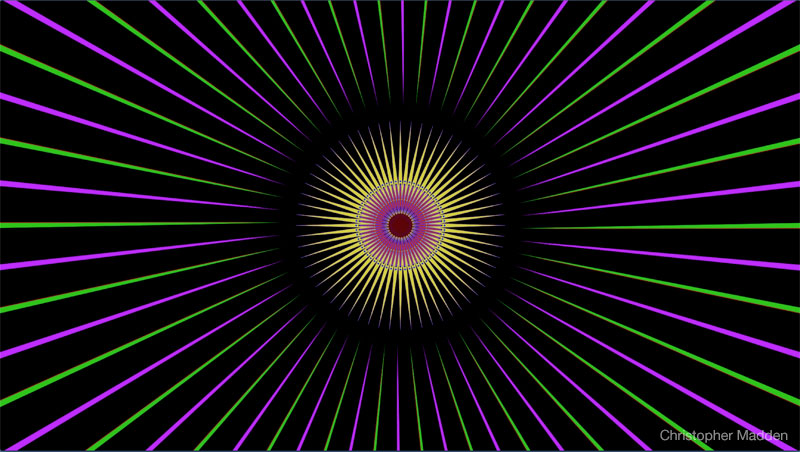
A work from my series of abstract animations depicting radiating forms expanding outwards from a central point of emergence. The work is linked to my interest in the process of creation on a cosmic scale, such as the creation of the universe at the Big Bang or the expansion of a star or other celestial object.
A video still from the work
The work is ideally viewed on a large screen.
This work was exhibited in the London Group gallery, Waterloo, London in December 2019 and the Penwith Gallery, St Ives Cornwall in February 2020.
A hybrid painting/assemblage artwork composed of an abstract gouache painting behind a contemporary plastic gulley grid (outdoor drain cover). The painting and the grid are both symmetrical, resulting in a square symmetrical artwork.
The brightness of the colours of the gouache painting are visually heightened by the matt black lines of the grid, creating an effect that has some allusions to stained glass windows. The contrast between the elevating qualities of a stained glass window and the more utilitarian qualities of a drain cover are noteworthy.
A video about freedom and its opposite: limitation or confinement. Freedom is expressed by the unconfined wheeling and soaring flight of the crows. Limitation is symbolised by the inert, motionless statue of an angel around which the crows are flying. Pathos is a major ingredient of the work, because both the birds and the statue have wings, but only the birds can fly. The unconstrained flight of the birds only serves to emphasise the fact that the statue of the angel is rooted to the spot. The work is a comment on the desire of the creators of the statue (us) to have the power of natural flight, and their obvious inability to have it.
The statue is on Alexandra Palace in north London.
An earth-bound angel and flying birds – a photomontage based on the video above.