The generation of something from (almost) nothing.
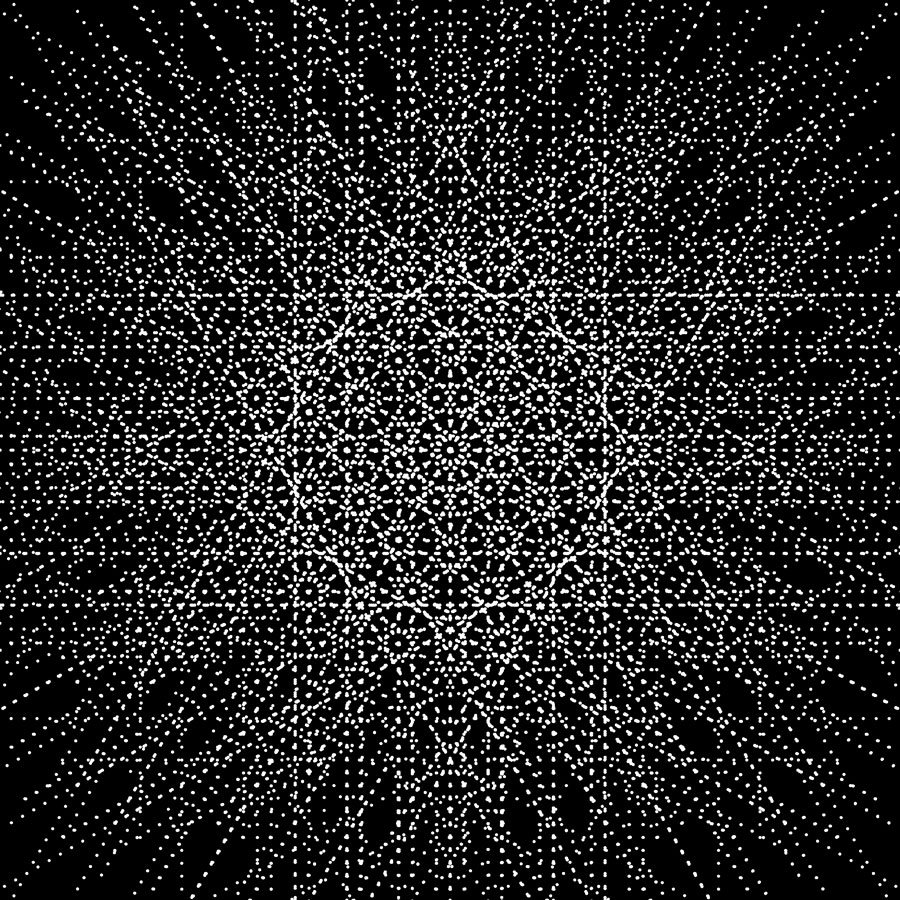
Rows of dots interacting to generate circles. Digital This version: June 2025
This image is composed of multiple identical rows of dots with the rows arranged at regular angles to each other and with regular spacing. An animation showing the positioning of the rows of dots can be se
The circles in the image are formed as the result of the interaction between the separate rows of dots. There are no circles in the underlying components of the image. An idea of the underlying rows of dots in the image can be found by looking at the corners of the image where the number of rows is fewer.
I’ve produced several images of this type over the years since about 2017.
The work is linked to my interest in the scientific principles concerning the generation of complexity in the universe from simpler forms. Ultimately this involves trying to comprehend the generation of the most basic entities in the universe from something that’s just one step removed from nothing. It’s about the generation of something from nothing.
The work can be seen as a metaphor for the generation of complexity is any area of existence. It demonstrates the way that as soon as two entities interact (in this case rows of dots) something more complicated results.
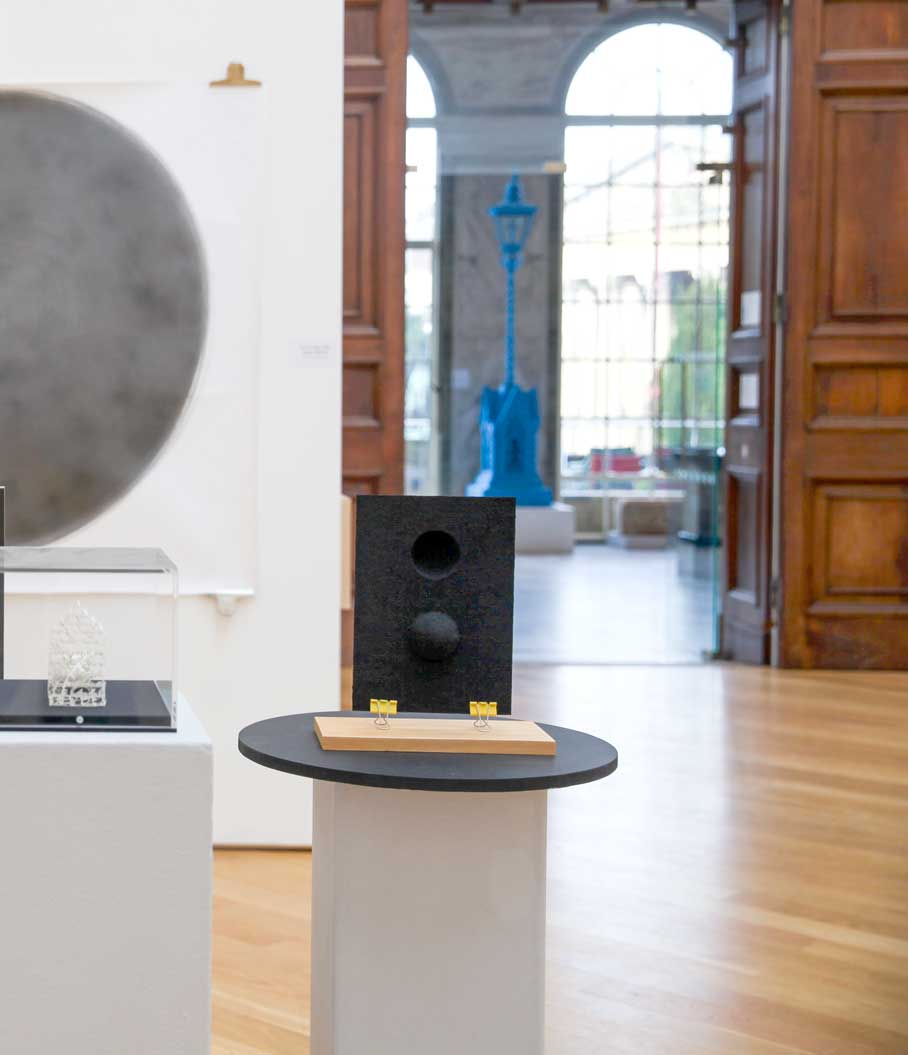
This work was displayed in the Royal West of England Academy, Bristol exhibition Paper Works, 2025.
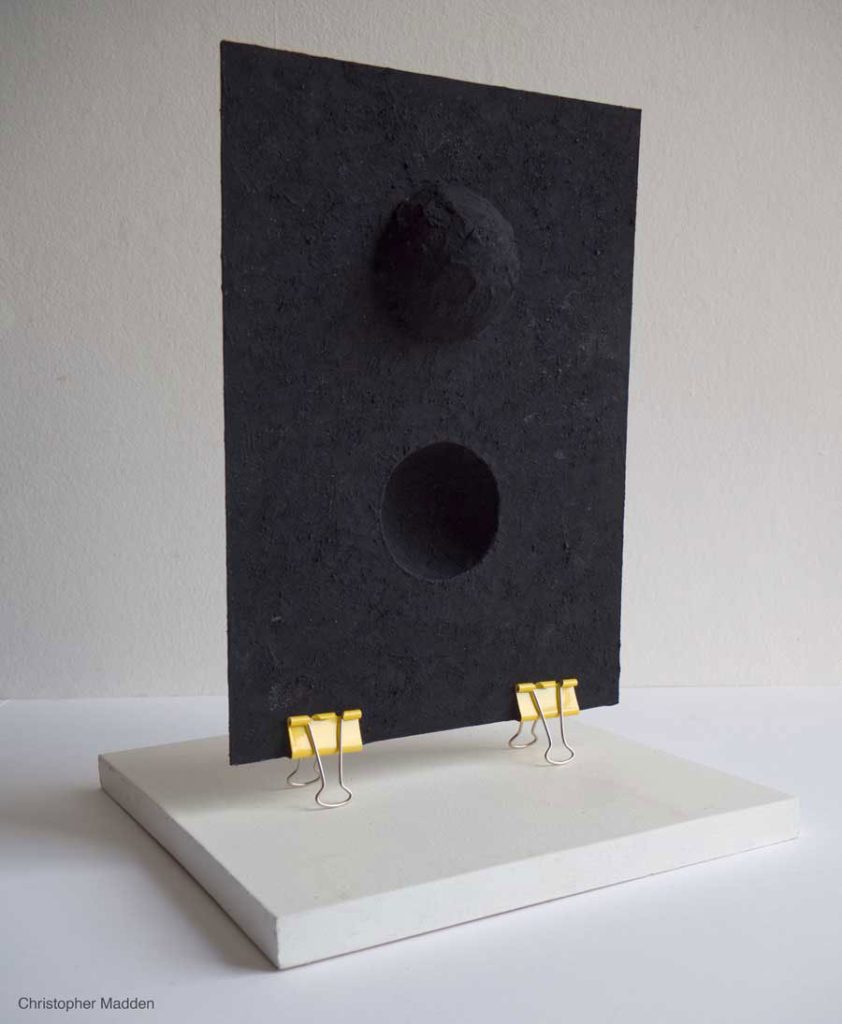
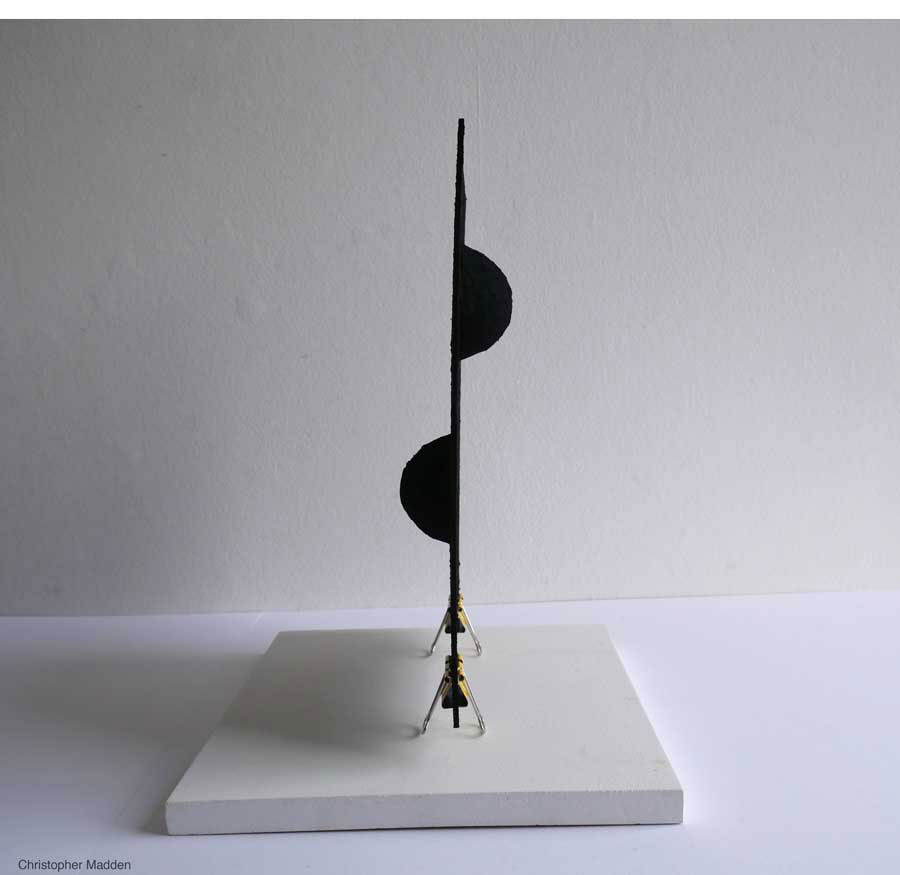
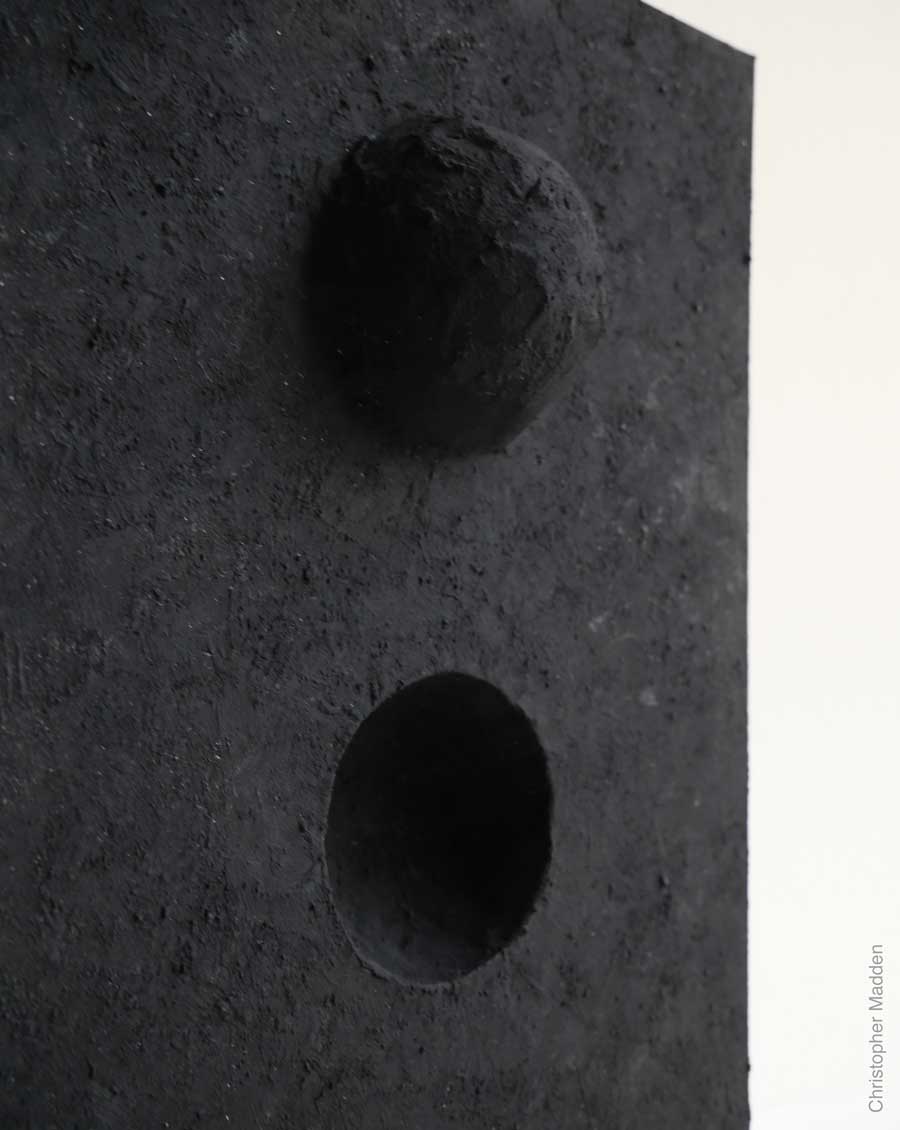
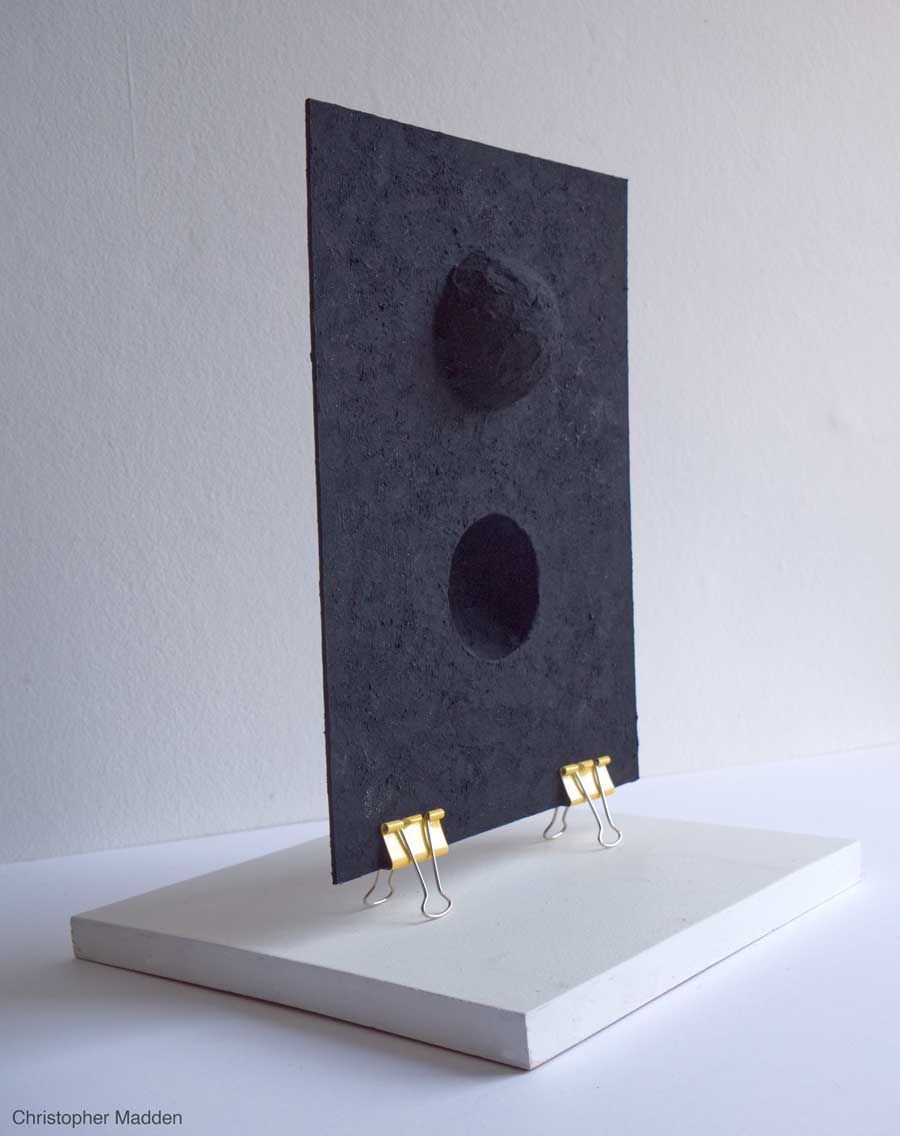
A sculpture composed of two three dimensional hemispheres on a flat sheet, with one of the hemispheres protruding from one surface of the sheet and the other protruding from the other surface. Both hemispheres are hollow, so that relative to each surface of the flat card one hemisphere protrudes and the other creates a hollow. The sculpture is coated with very matt black acrylic paint (Stuart Semple Black 4).
The matt black colour of the sculpture makes the form deliberately difficult to interpret visually. This is especially the case with the hollows (possibly because the brain is not expecting there to be hollows in the surface).
On one level the work can be viewed as a simple intriguing puzzle that engages the viewer’s perception and cognition in interpreting the positive and negative forms that are generated by the hemispheres.
The work also has a metaphorical interpretation that relates to my interest in science: in this case in the fundamental nature of the universe.
In this interpretation the flat black plane of the sculpture can be thought of as representing the ‘base state’ of physical realityt (or below) the quantum level. Think of this state as being flat and featureless – a state in which nothing physical can meaningfully be said to actually exist – maybe the ‘resting’ state of the universe. Perhaps think of it as being comparable to a graph in which the line of the graph flatlines along the zero value of the x axis, indicating that there’s nothing to measure.
In the sculpture the two hemispheres disrupt the flat surface, creating the existence of form. Returning to the graph analogy, this is similar to the presence of two blips on the flatlining graph, with one blip going up and the other going down.
Because the hemispheres are hollow the pair create a bulge and a depression on each side of the flat surface, with the one that forms a bulge on one side of the sculpture forming a depression on the other side.
On either of the two sides of the flat surface, in terms of total volume, the bulge of one of the hemispheres and the depression of the other cancel each other out, with the negative volume of the depressed hemisphere cancelling the positive volume of the protruding one.
This can be thought of as an analogy for the physical nature of the universe at its most fundamental level. The flat featureless surface of the sculpture represents the flat featureless ‘surface’ of the fundamental universe when it is devoid of energy or matter and when nothing exists other than the ‘surface’. The pair of hemispheres conceptually represents a single fundamental ‘disturbance’ in the flat fearless surface, a single simplest element of existence perhaps analogous to the most fundamental of fundamental particles.
Importantly, because this fundamental disturbance is represented by two identical forms (the hemispheres) of which one has positive volume and one has negative volume which cancel out, the total volume of the disturbance is zero. This is analogous to the physical universe arising out of a state of nothingness (the flat surface) yet adding nothing to the volume, thus adding nothing to nothing.
So, although the universe exists it is still composed of nothing.
This work reflects my interest in both art and science (I started out on a scientific career before moving over to an artistic one).
tleI believe that art and science are often much more closely linked than is often assumed. There is for instance a huge amount of aesthetics in the appreciation of mathematics, and the study of the way that our senses make sense of the world is nothing if not a science.
The title, Black Whole, is obviously a pun on black hole.
Black Whole on display in the Royal West of England Academy, 2025