Hammers, along with other handyman tools, are a frequent motif in my work.
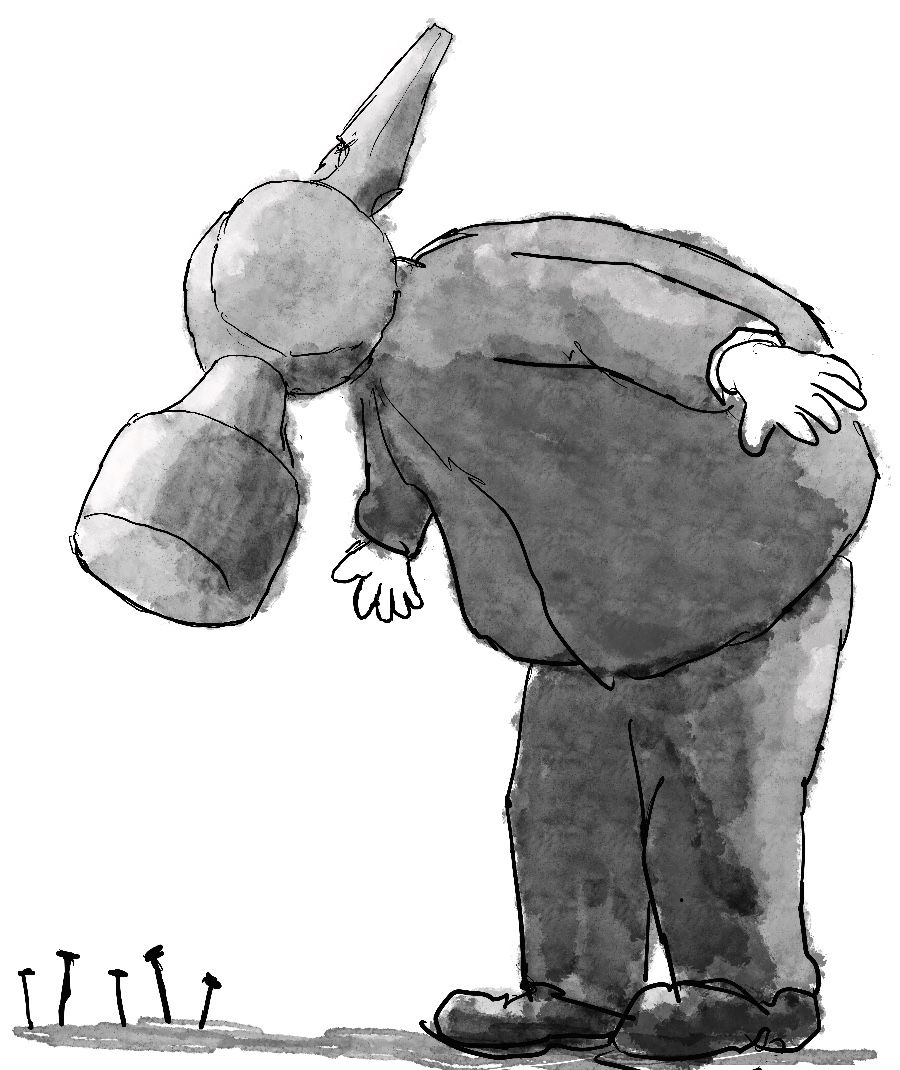
In this sketch a hammerhead forms the head of a person. The person is leaning forward and is looking at some nails that have been hammered into the ground.
A person with a hammer as a head in an artwork would normally be thought of as a symbol of oppression, however this particular person doesn’t look that much like an oppressor to me. But then again, oppressors don’t have to look like oppressors do they? This one looks almost surprised to see the nails. What’s his relationship with the nails?
Hammers are designed to strike blows. By tying several of them together they lose this ability, being rended impotent.
It invites interpretation as some sort of metaphor. The work was created largely because the components were to hand, with the composition coming together spontaneously and subconsciously. That doesn’t mean that there are no underlying meanings to the work of course – after all, why did I choose to pick up a few hammers rather than a few bottles of washing-up liquid?
This work was created for and was first exhibited in my solo show at Tremenheere Sculpture Gardens near Penzance in 2016.
It’s designed to hang on a wall, however in the image here it is on a sheet of plastic on the studio floor because I like the effect.
Contemporary sculpture composed of found objects, wooden hemispheres and card.
Idol. 25x10x8cm. September 2025
A sculpture created from two hammerheads, two ball bearings, six wooden hemispheres and length of card. The parts are held together by magnets.
The central components of this work are two hammerheads – artefacts that have been recurring features of my work for many years, usually in the form of drawings and more recently in the form of small scale sculptural work, The hammerheads are usually, but not always, used to represent the heads of people or animals.
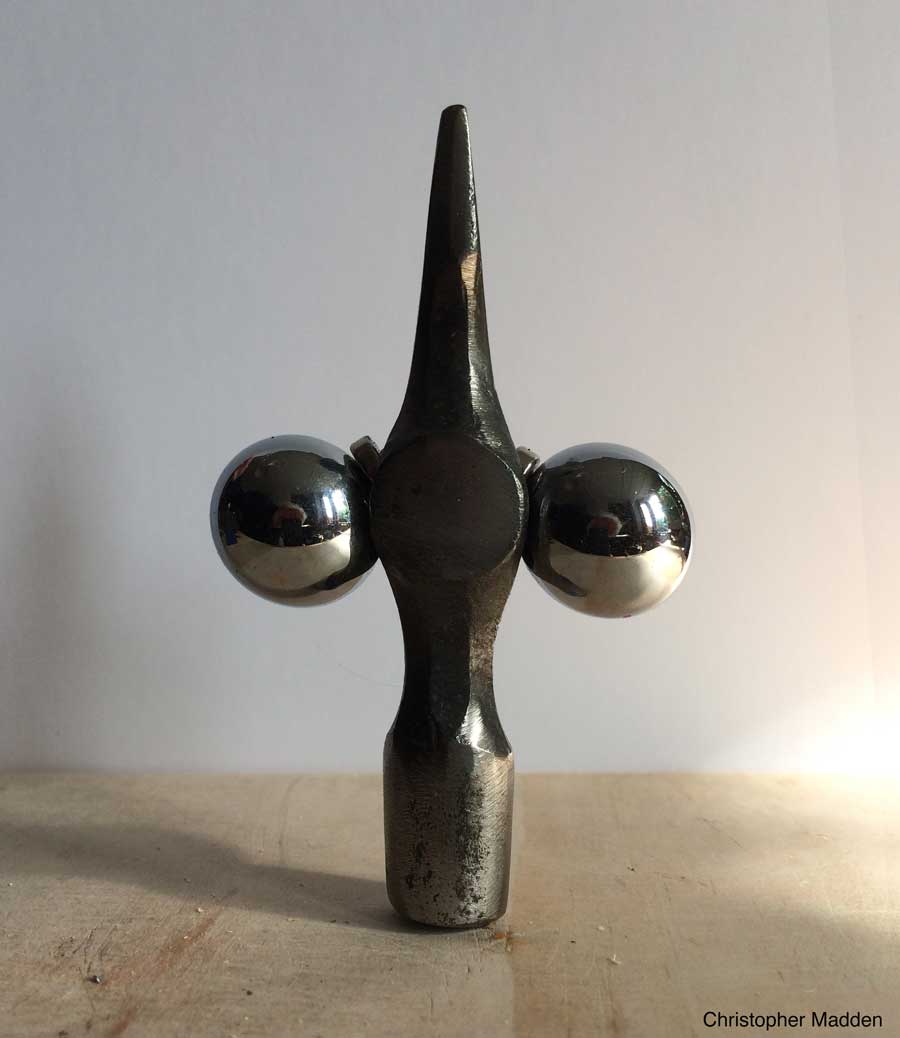
Steel sculpture: hammerhead with spheres 10x5x2cm May 2025
A sculpture composed of the head of a cross pein hammer with two steel spheres attached to its sides.
Hammerheads standing on end have an interesting anthropomorphic quality to them. This anthropomorphism is exploited in this work to create an ambiguous form.
The work possibly suggests a human figure with spheres in the place of arms. Or it could suggest the head of a creature such as an insect with the spheres as huge eyes.
The steel spheres are attached to the hammerhead by magnets.
Shown in the ING Discerning Eye exhibition in the Mall Galleries, London, November 2024.
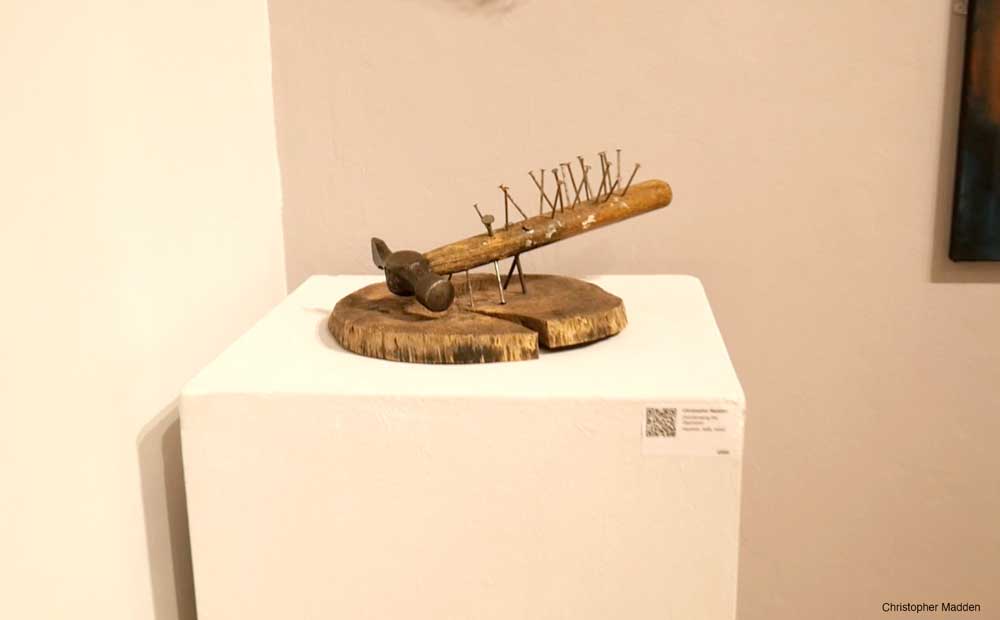
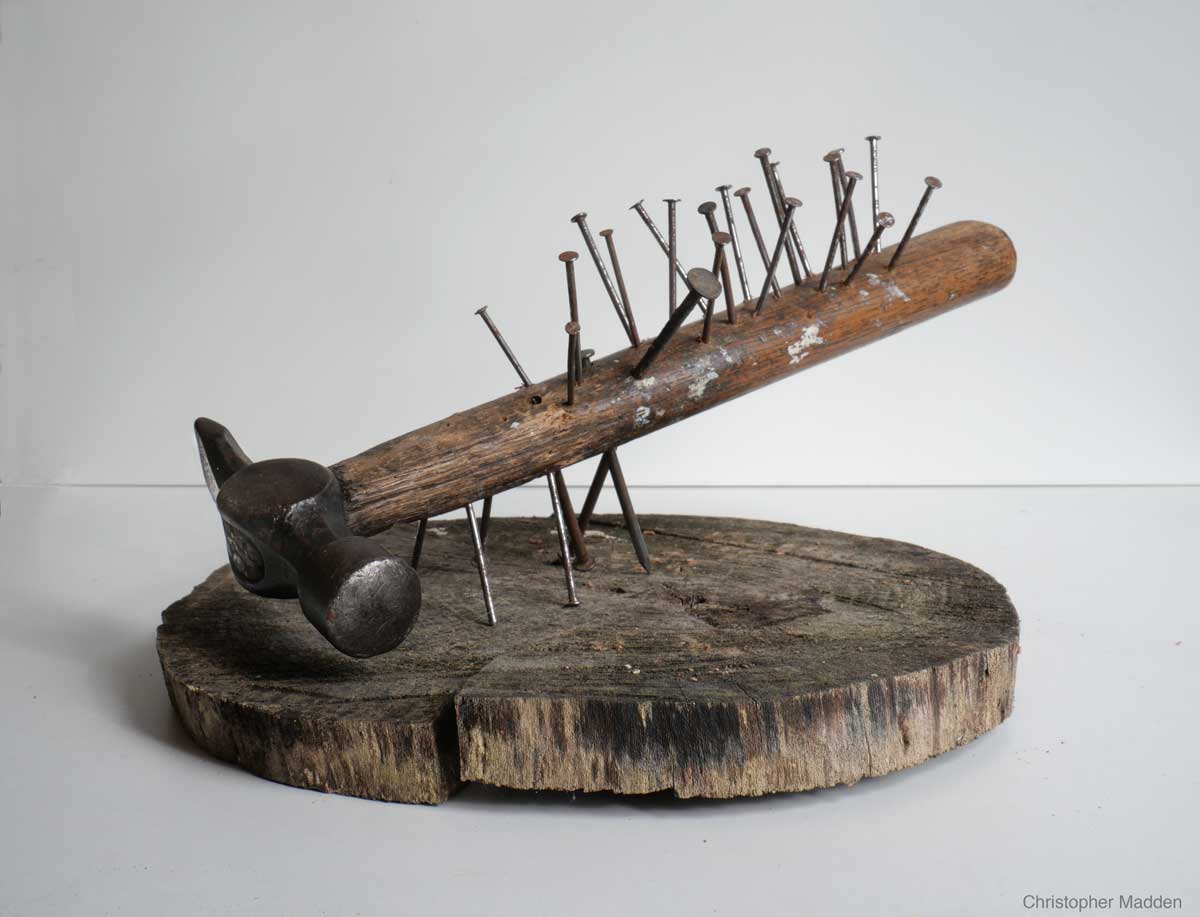
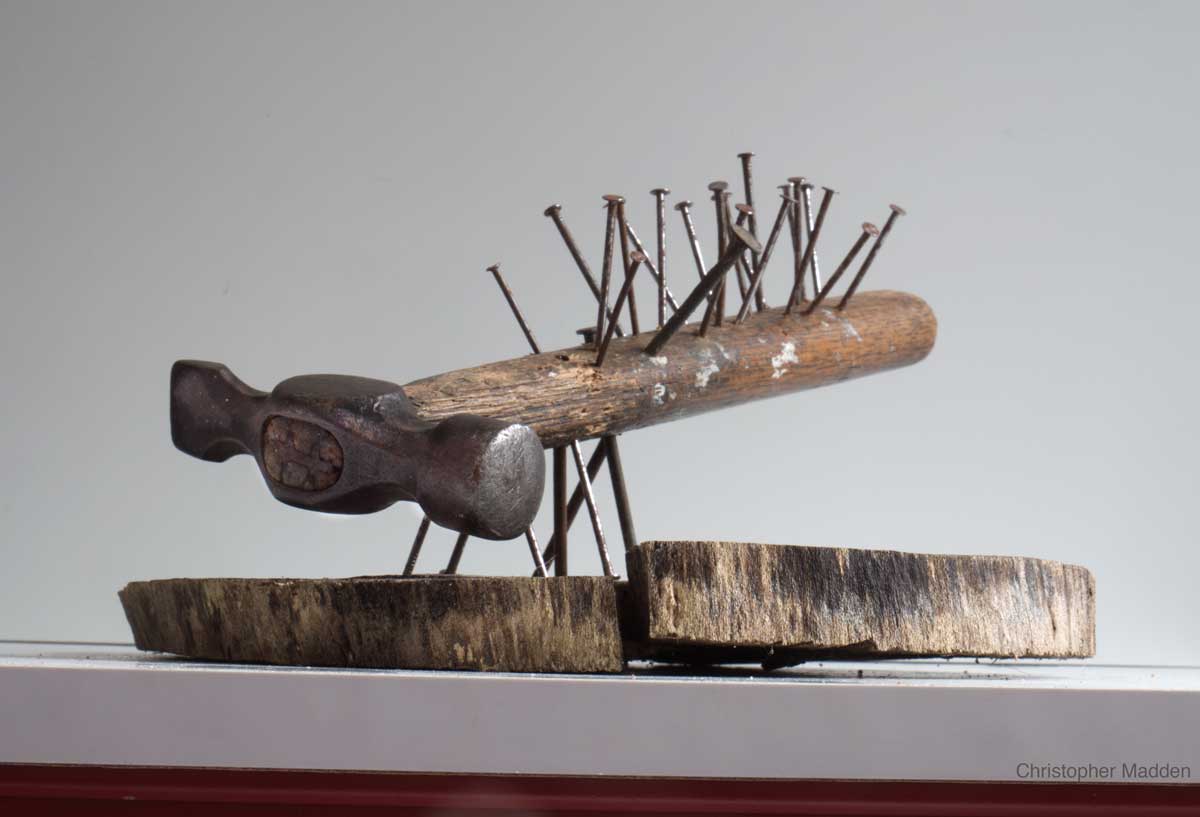
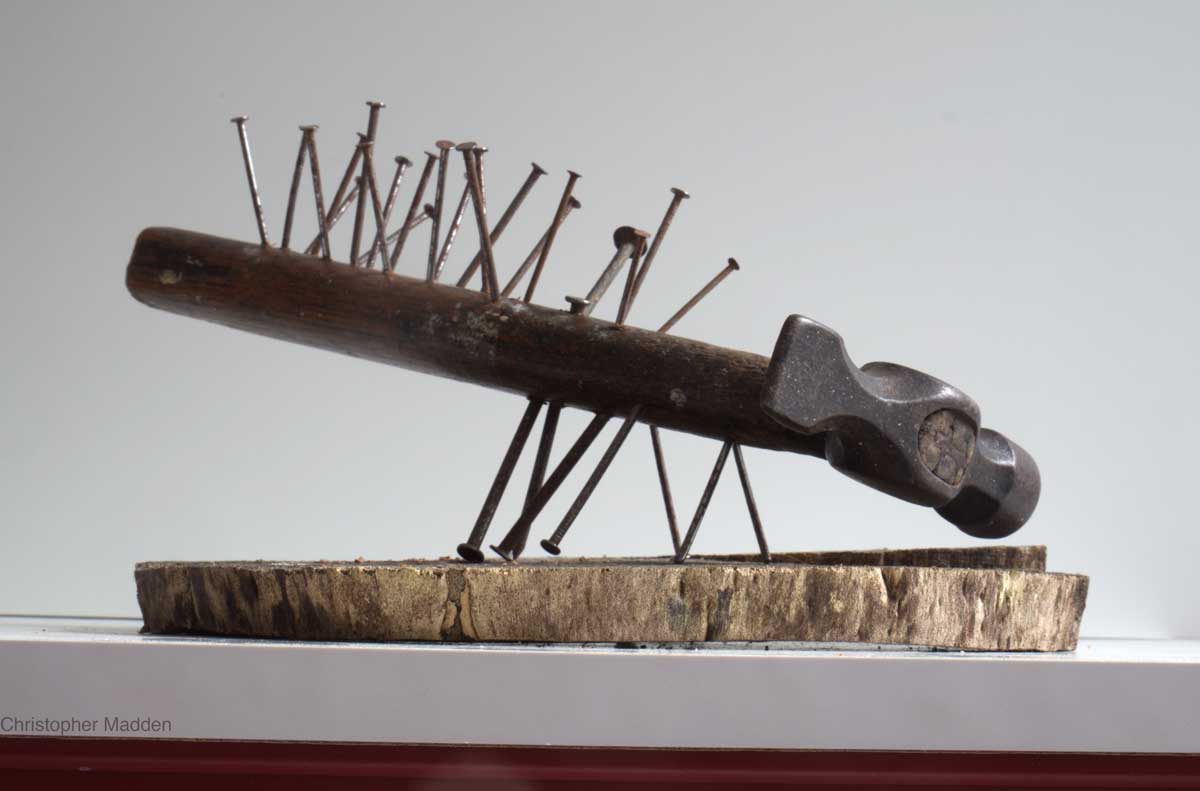
This sculpture, composed of a hammer and nails, symbolises the act of the oppressed overthrowing their oppressor. The nails represent the oppressed and the hammer represents their oppressor.
The metaphor raises a few questions . How did the nails become driven into the hammer? By another hammer? If so, is that other hammer a potential oppressor? Is the (unseen) second hammer just an oppressor in its own right, simply using the nails for its own ends?
The Oppressor Empaled. A sculpture about oppression.
Hammer, nails, wood. 18x34x26cm. May 2023.
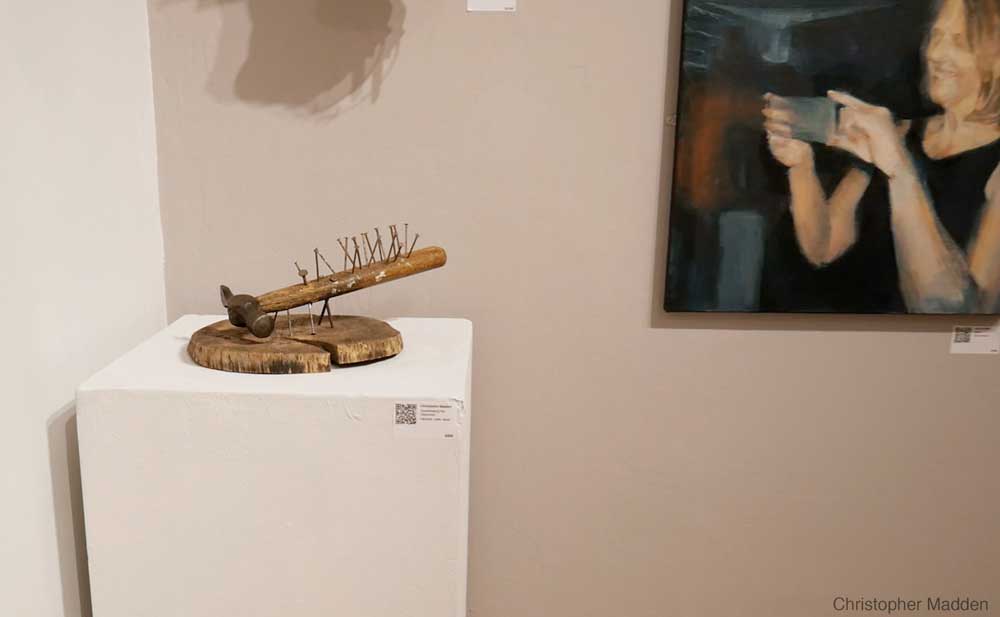
This sculpture was shown in the ING Discerning Eye exhibition in the Mall Galleries, London, November 2024. It is a work of political art, in the form of a metaphor for oppression and rebellion. The work shows a hammer empaled by nails. Part of the concept behind the sculpture is that the hammer is being impaled by the objects that it normally hits – the nails. The hammer is a symbol of oppression and dictatorship and the nails are symbols of the oppressed. But the sculpture poses a question – how did the nails manage to drive themselves into the hammer? Nails by their nature need a hammer, or a stand-in for a hammer, in order to be effective and to fulfil their purpose. Were the nails hammered into the hammer by another hammer? In that case the nails are not a metaphor for the oppressed rising up against their oppressor (the hammer) using their own power, but are more like the followers of another power (another hammer?) that may turn out to be as oppressive as the hammer that they’ve empaled.
The leaders of liberation movements against repression often become oppressors or dictators in their turn.
This sculpture is a development of an idea that I had in 2010 when it started life as a drawing of a hammer with three nails driven into it. Since then it developed into a 3D sculptural work composed of a hammer nailed directly onto a flat surface as though pinned down. The iteration here has the hammer suspended above a surface and with many more nails driven into it so that it’s starting to resemble a nail fetish figure.
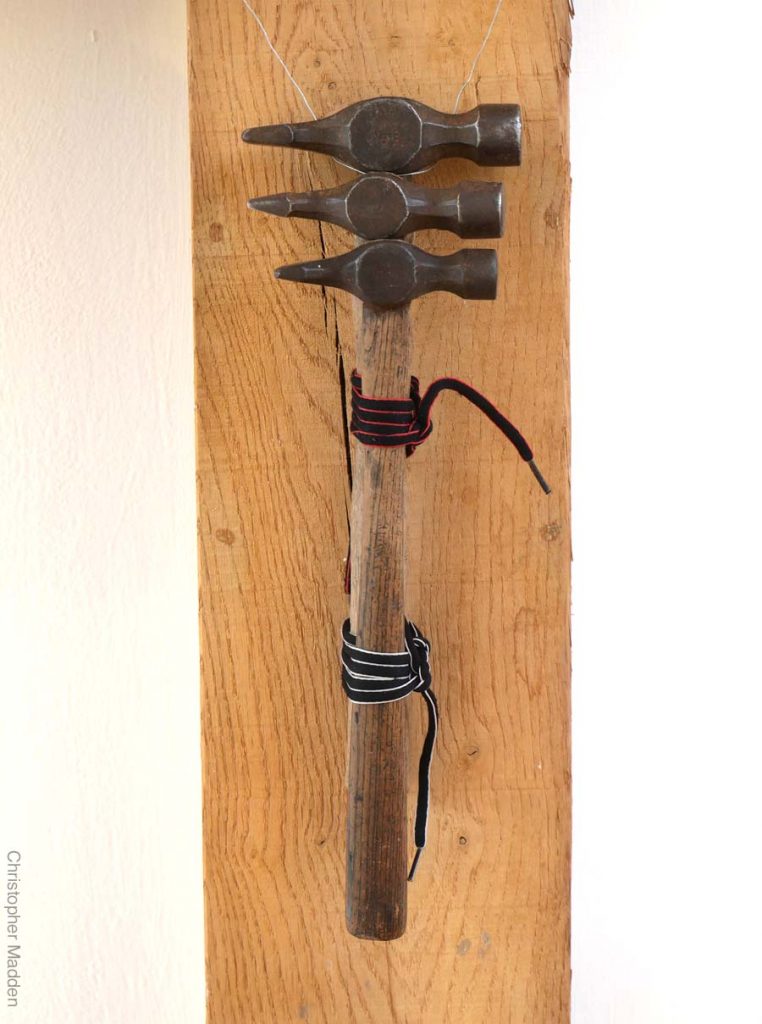
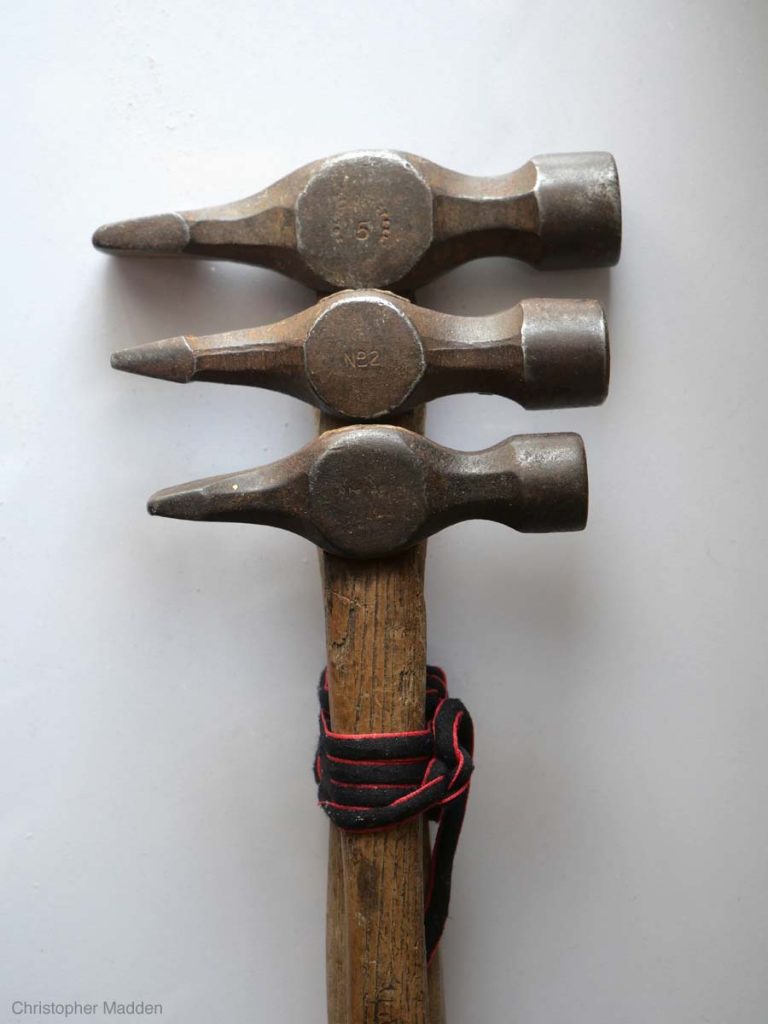
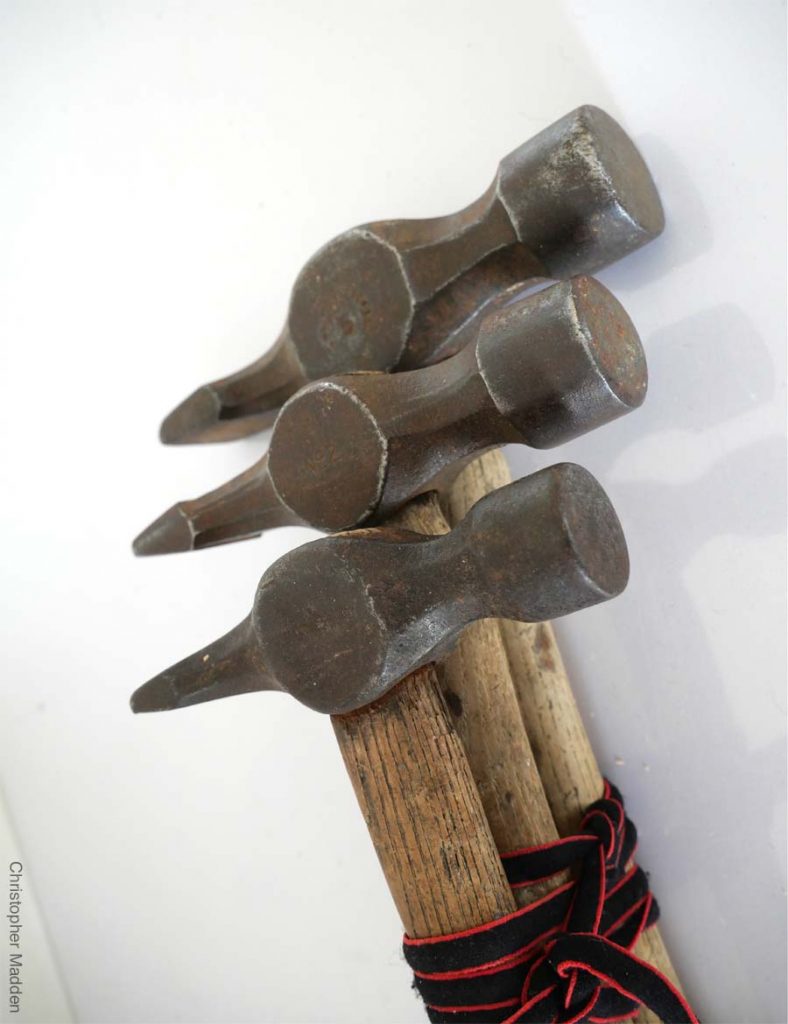
Three hammers bound together with shoe laces. The hammers are different sizes, creating a dynamic visual effect and implying a differential power status between the hammers.
The fact that the hammers are bound together renders them useless as hammers, making them impotent. However, maybe they’re not bound together to reduce their power – maybe they are bound together to create unity. Maybe the price of unity is a reduction in individual power. But is the price of unit a reduction in group power?
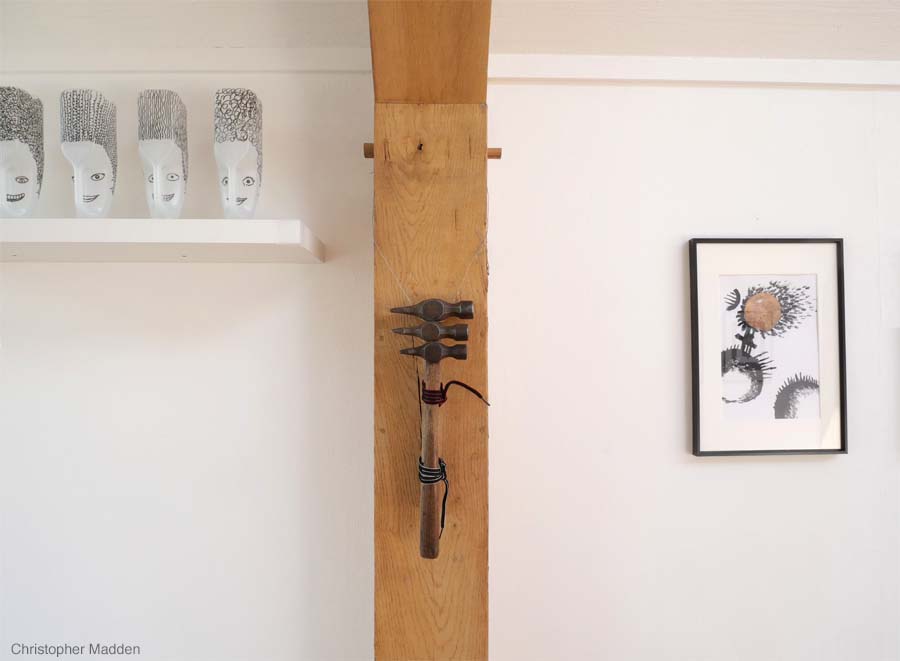
The hammers exhibited in my solo show at Tremenheere Sculpture Gardens, Cornwall, 2022.
The work is a study of power, restraint and impotence. It’s also a nice composition. The inspiration came in my studio when I placed one hammer directly on top of another one (By chance or deliberately? I don’t know).
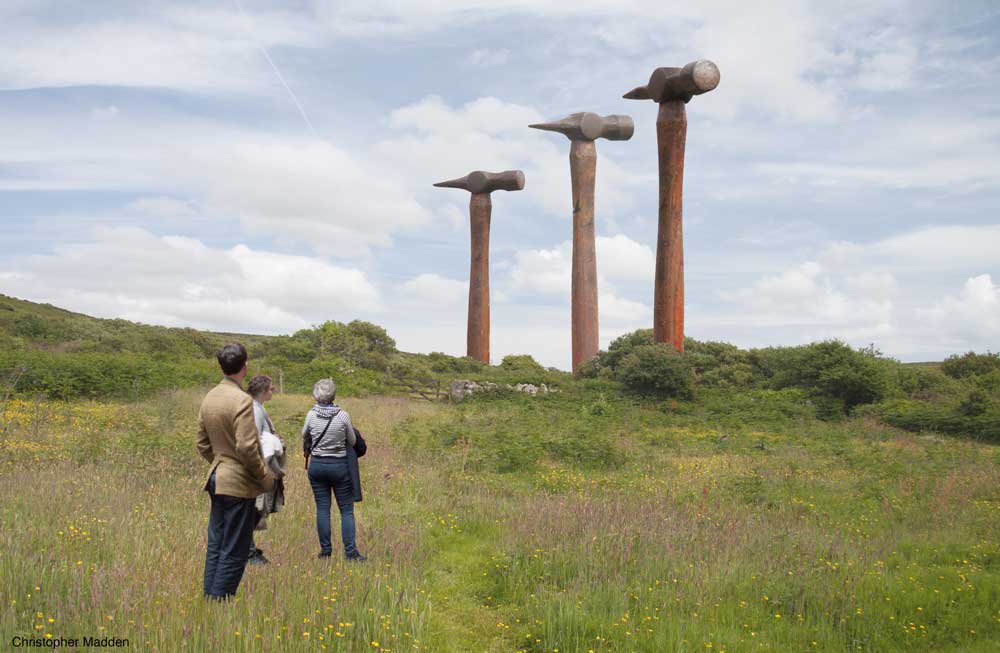
A visualisation of a concept for a sculpture in the landscape. The landscape in the photograph is the Penwith peninsula in west Cornwall. The hammers are meant to project a sense of overbearing force, the fact that there are several of them possibly implying organised force (such as military force). Hammers, to me, have a certain anthropomorphic quality to them, suggesting a degree of human identity – a long thin body with a head at the top. The blank facelessness of the heads of the hammers in this image suggest a mindless power (I’ve done other works in which hammers have faces).