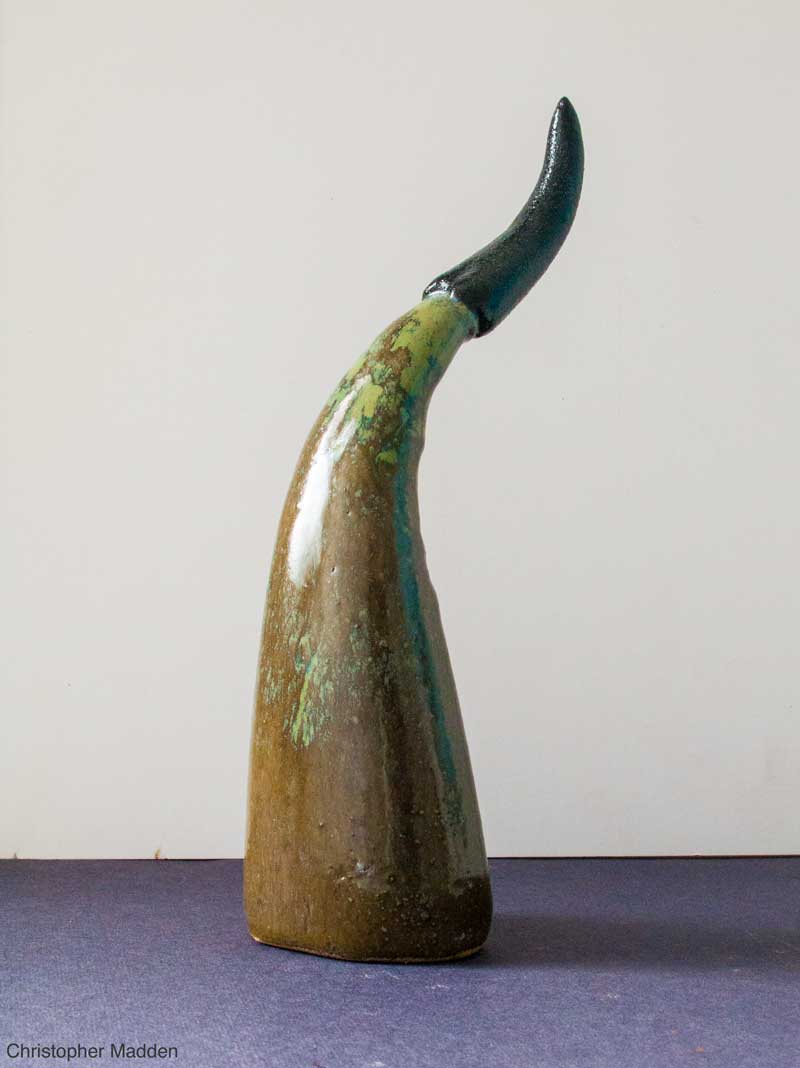
A ceramic sculpture that is slightly suggestive of a fungus such as a stinkhorn, although the work was conceived as a purely abstract sculpture.
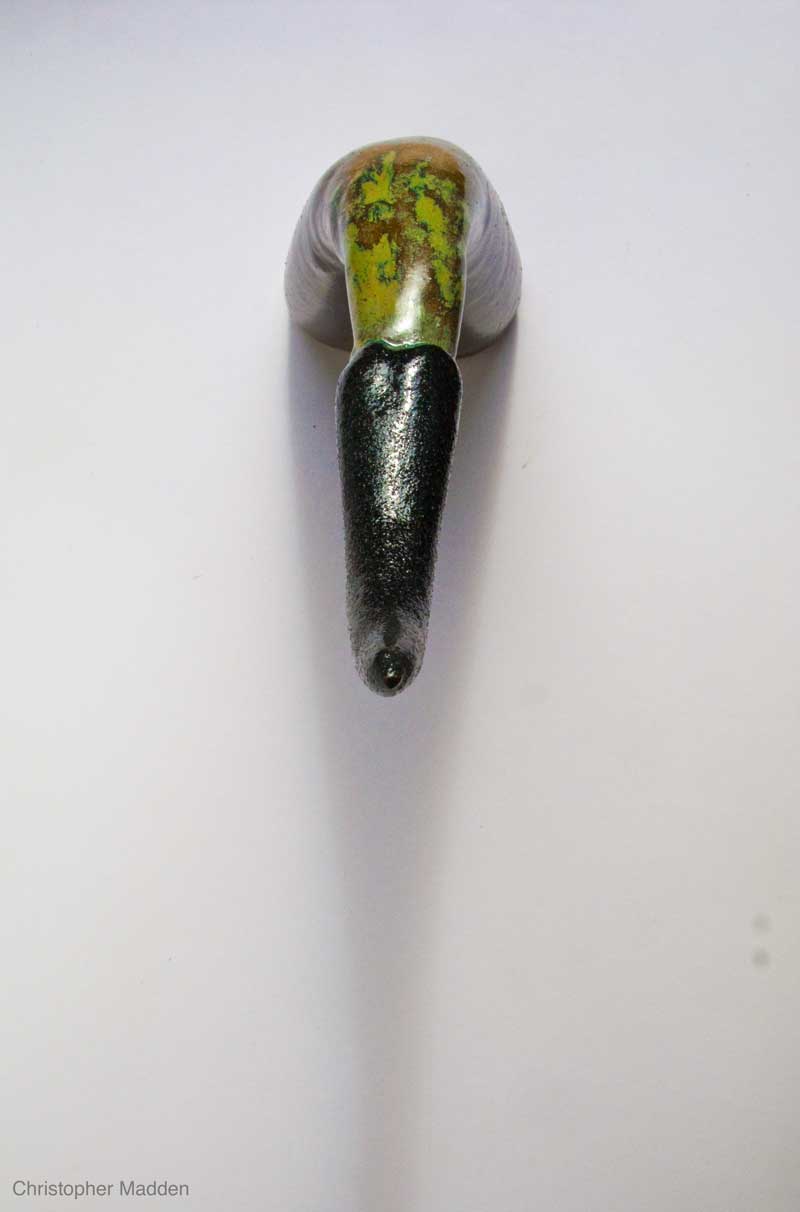
Below is a view of the sculpture from above, in directional lighting. This view shows well the dramatic differences that differing viewpoints can make when viewing three dimensional artwork (or anything else for that matter). .
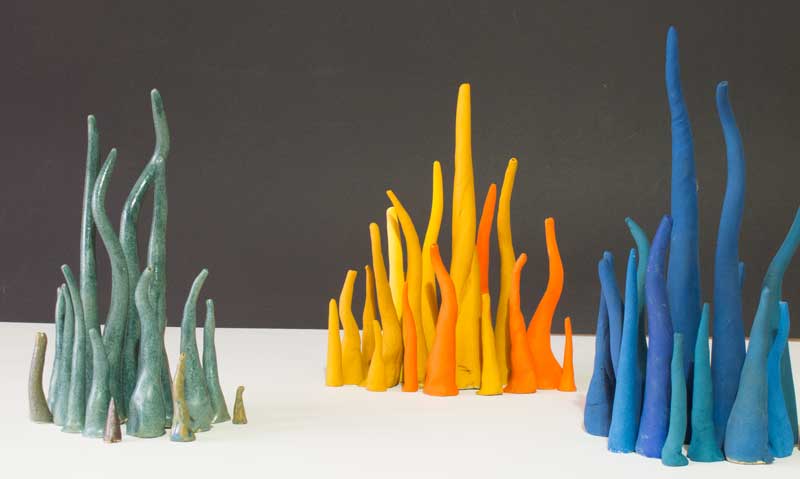
A group of works composed of clusters of coloured ceramic cone-like forms. The forms are individually rolled by hand as cones and are then distorted to create a sinuous waving effect. The forms were conceived as purely abstract, however they have an organic feel to them with something of the suggestion of marine or aquatic organisms. They could be worm-like creatures emerging from the sea bed and waving in the ocean currents.
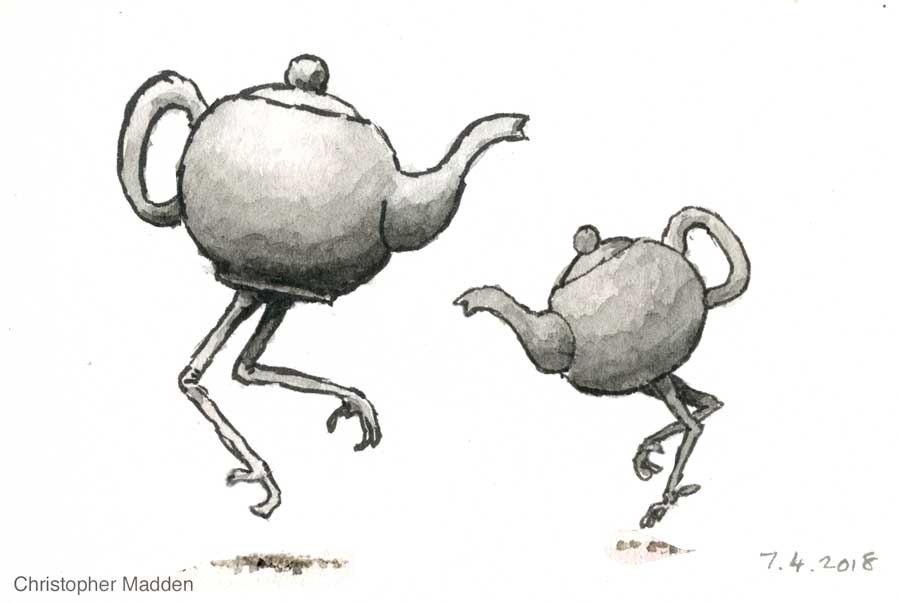
I like to sit down with a sketchbook every so often and draw whatever comes into my head. Surreal objects with bird-like features are a recurring theme. These slightly surreal dancing teapots are a good example.
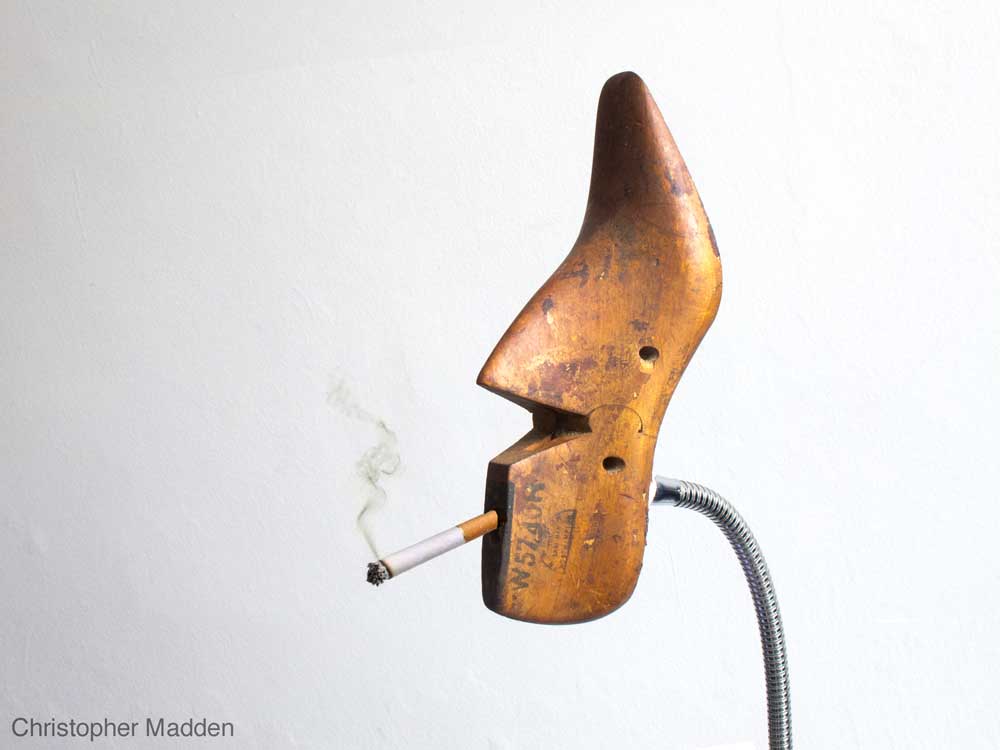
A surreal or dada found object sculpture made from a cobbler’s shoe last with a cigarette inserted into the circular hole in the last that is designed to accommodate a handle. The last is mounted on a lamp stand.
The sculpture utilises the human sensory condition known as pareidolia, the interpretation of shapes as human faces, to create a surreal head. Pareidolia is essential for the interpretation of a lot of art, especially art in which faces are merely suggested by, say, a few strokes of a paintbrush. In some art pareidolia is actually a curse though – think of the number of abstract images that are ruined when you see an unintentional face in them. The sculpture’s title, Last Cigarette, utilises the human tendency to reinterpret words to create puns – in this case the word ‘last’ referring to the wooden cobbler’s last, meaning that the cigarette is the last’s last cigarette.
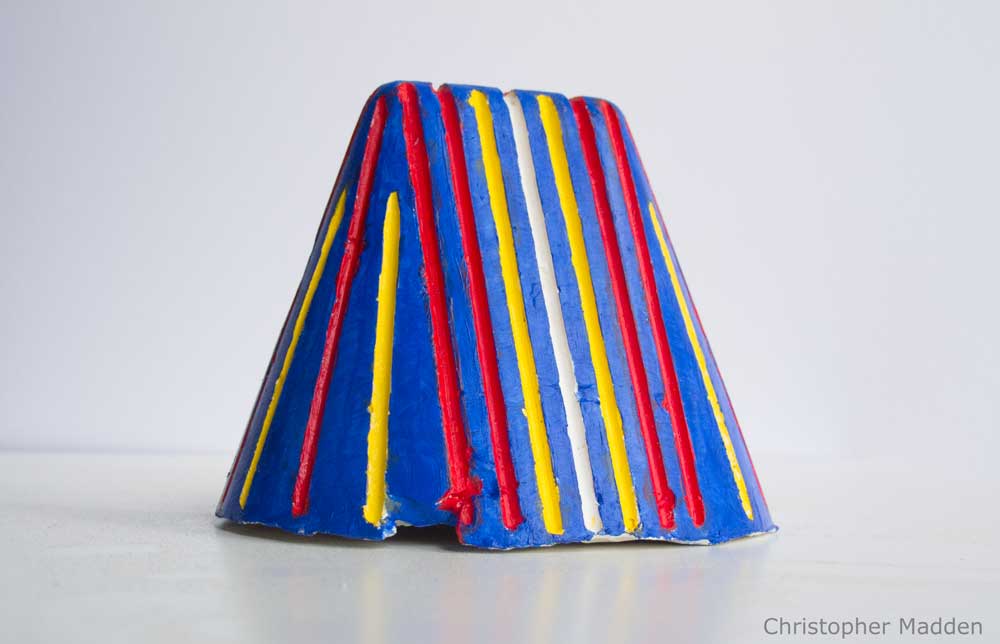
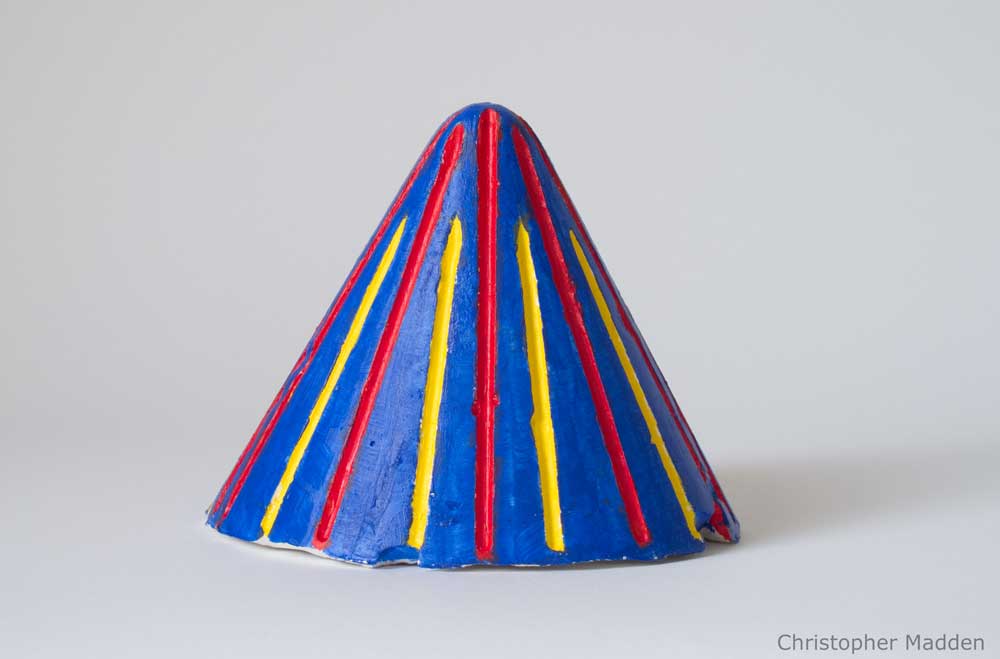
A small abstract contemporary sculpture created by casting the interior of a coffee filter cone. The work is deliberately created in a slightly crude style (notice the imperfections in the base).
The sculpture is painted in bright colourful primary colours, with the main surface of the sculpture painted blue while. he grooves in the sculpture (created by the ridges in the coffee filter cone) are in red or yellow (with a couple of white ones too).
The sculpture has an overall positive feel to it, caused partly by the bright colours and partly by the simple conical shape with its grooves.
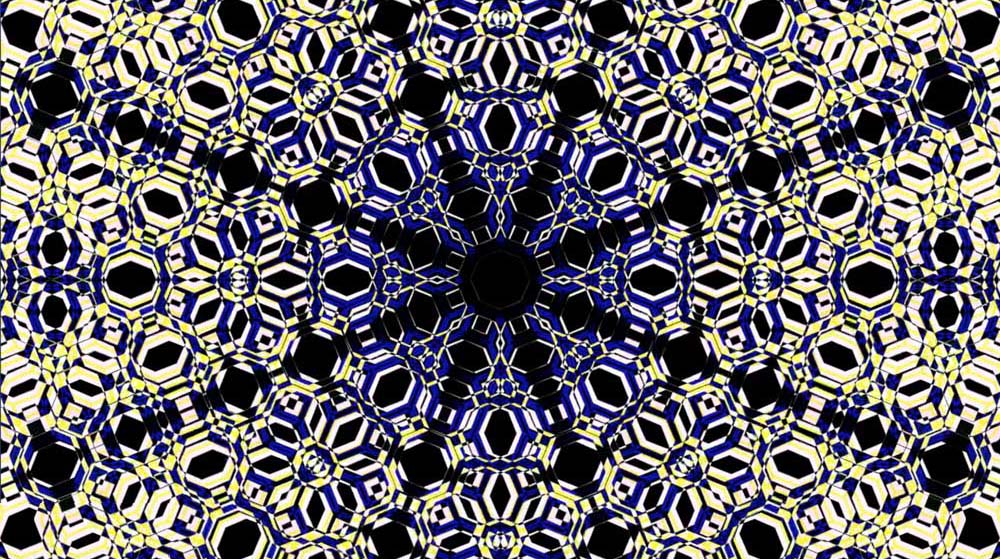
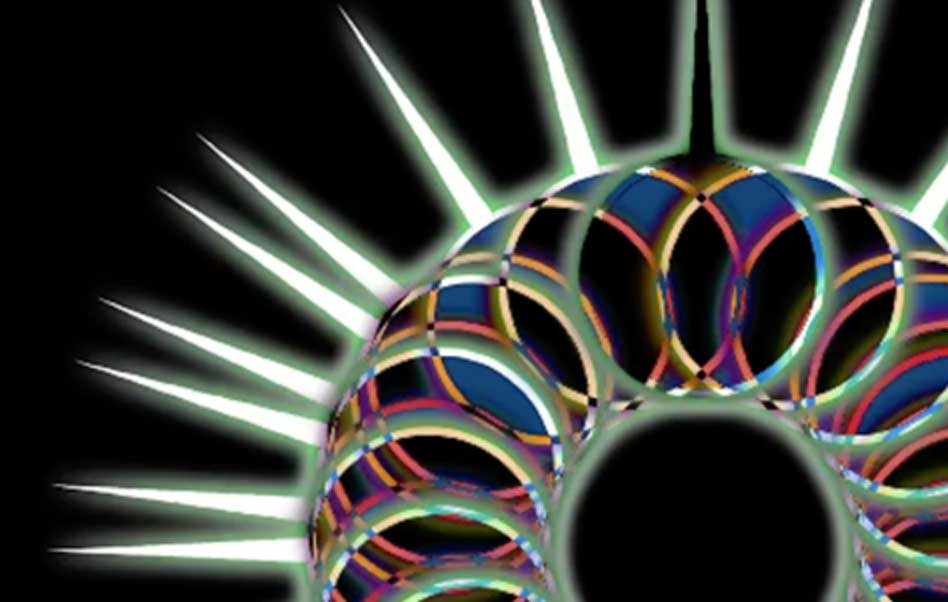
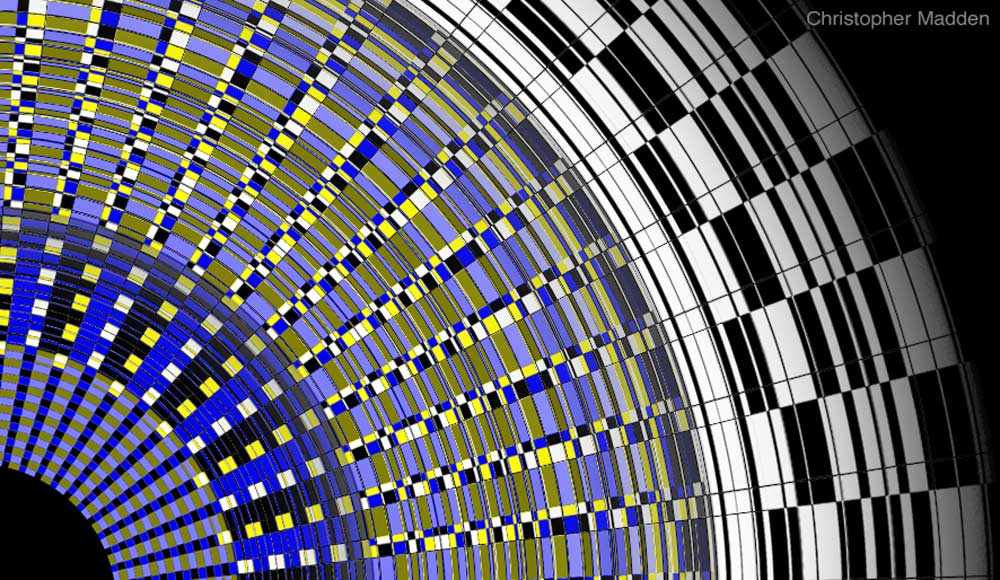
The image above is a detail from an abstract moving image work from a series in which multiple copies of a single geometrical shape are animated to interact with each other using simple computer algorithms, creating extremely complex shapes. See the video below for the full animation.
The animation is an attempt to link contemporary art and science by showing the way in which complex forms are generated from simple forms, which is one of the fundemental underlying principles of the structure of the universe (where the component parts of atoms such as electrons and protons are composed of even simpler entities, which themselves are composed of even simpler entities, which in turn…).
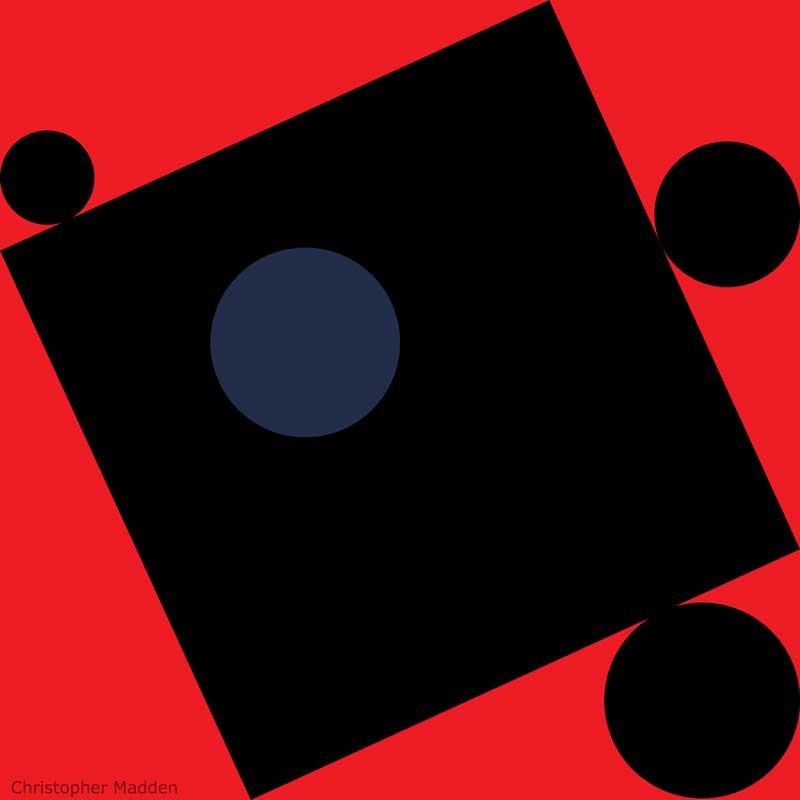
Abstract composition of circles and squares in red, black and blue
Abstract geometrical digital composition. 2012.
This abstract composition is a study in confinement, with the geometrical forms in the composition seemingly squeezed into the space within the composition. The angled square in the composition touches each side of the frame, which itself is a square. This adds to the composition’s sense of confinement as the image has no specific top and bottom and can be viewed in any orientation, giving the impression of ‘no way out’. Not only that, but the square format suggests that the enclosed square and its accompanying circles can almost possess a degree of freedom of movement by being able to rotate within the frame – a form of movement that in reality possesses no more freedom than does the movement of a hamster in a wheel. The limited colour palette of red, black and blue gives the composition a certain amount of tranquility, while the combination of colours also gives the work a dynamic quality.
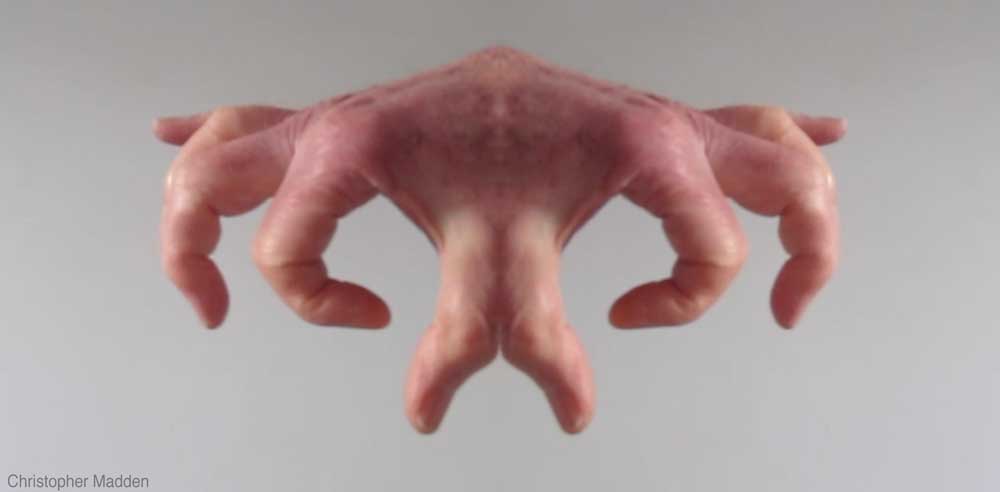
This video shows the way in which familiar objects can become disconcertedly unfamiliar and alien by removing them from their normal context.
It shows a video of a hand in which the video is split and flipped as a mirror image in order to create a strikingly bizarre image resembling an unsettling and disturbing alien creature. The video is an attempt to highlight the way that even the things that we treat as totally normal and mundane are in fact full of strangeness and wonder. By using the very simple mirror image technique I’ve made something that’s as ridiculously familiar to us as our hands look ridiculously alien and disconcerting. Who’d have thought that you had such strange alien things stuck on the ends of your arms?
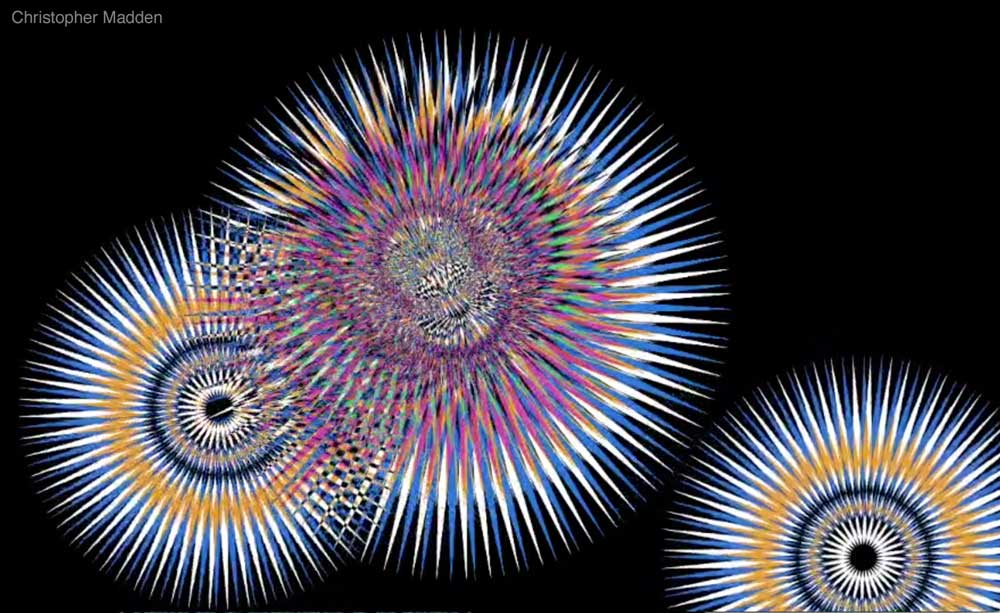
A piece of abstract digital animation that uses my technique of overlaying multiple copies of the same image made to move relative to each other in simple ways and to interact with each other so that, for instance, the colour displayed in the resulting image changes. This “starburst” animation is composed of multiple overlaid copied of a 36 pointed star. A key motive behind these video animations is the linking of art and science through the exploration of the creation of complex forms from the interaction of simple forms, with particular reference to the creation of the incredible complexity of the universe from its incredibly simple building blocks. There’s more about this here: Complexity from simplicity: contemporary artworks.
A detail from an abstract moving image work from a series in which multiple copies of a single shape move and interact using simple computer algorithms, creating complex shapes. The series is inspired by my interests in art, sciennce and philosophy In this work each individual ‘entity’ is composed of multiple versions of a very simple star shape that is modified in size and colour to create a complex star form. Smaller clones of this star form are then ejected from the original star form, in an action that suggests the birth of new stars, the creation of matter in the universe or the evolution of self-replicating life-forms (hence the link between art and science).
To see higher resolution videos and more information about this series click here.
Study of the motion of water ejected from a hose spray head
Video. 11 seconds
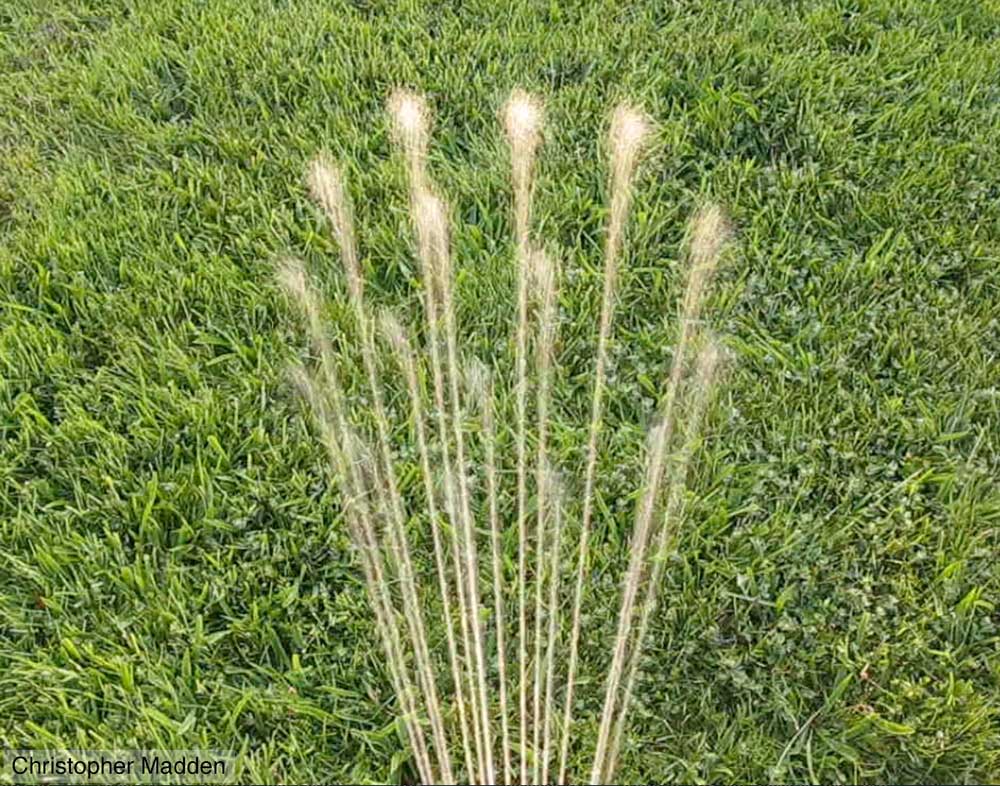
A very short video capturing the motion of water as it is ejected in pulses from a conventional garden hose spray nozzle with the head set to different spray modes. The brevity of the water pulses makes it possible to see patterns in the spray that are normally concealed or are absent when the water is ejected as a constant flow.
A still from the video, showing the pattern created as a result of the pulsing effect
This phenomenon is possibly a good starting point for a fountain or other water-based art installation.
This video, titled Spyk, was exhibited in the London Group open exhibition, 7th November to 1st December 2017.
Spyk
Abstract moving image. 2017
The video is from my series of videos in which multiple copies of relatively simple forms are rotated at different rates to each other, thus generating complex forms. There are more of them here.
The video was displayed at the London Group Open in 2017. London Group was founded in 1913 by a group of artists including Lucien Pissarro, Henri Gaudier Brzeska, Jacob Epstein, Walter Sickert, Duncan Grant and Wyndham Lewis. Its aim was to be an artist-based group that could act as a counter-balance to establishment institutions such as the Royal Academy. Current members include artists such as Frank Bowling RA, Anthony Eyton RA and Dame Paula Rego.
To see higher resolution videos and more information about this series click here.
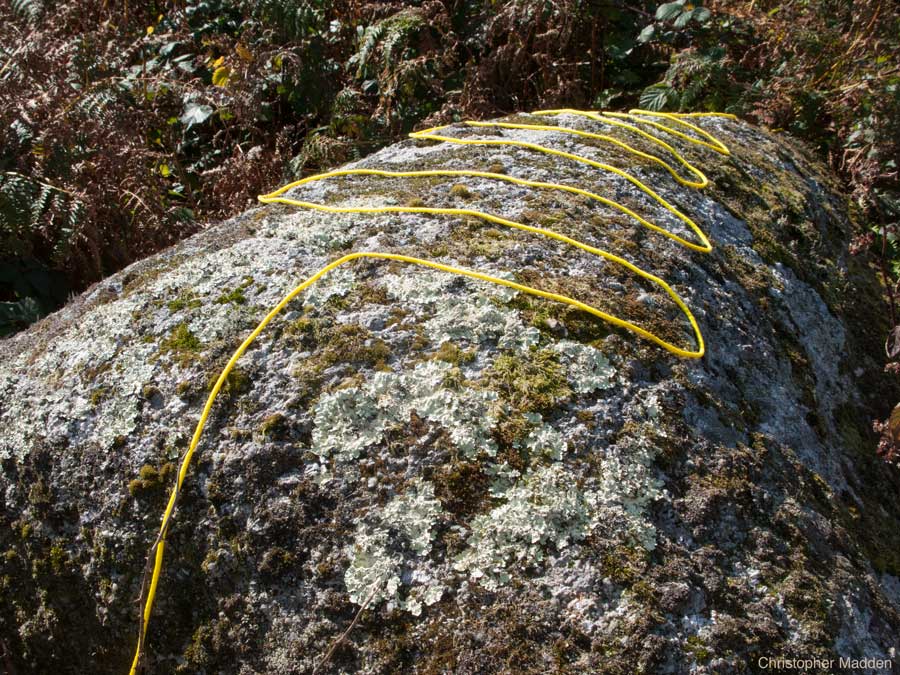
Coloured cord on a granite boulder, Zennor, Cornwall. 2017
I’ve been producing art dealing with environmental concerns since the 1970s.
The simplicity of construction of this piece is important. The observer will hopefully notice the almost total lack of endeavour required to create the work, while also noticing the (hopefully) relatively high aesthetic payoff as a result of that endeavour.
A lot of land art and other art in the environment strive to use only natural ingredients in the composition of the art, good examples being the work of Richard Long and Andy Goldsworthy. This work however consciously uses artificial material in the form of nylon paracord.
In the work the placing of brightly coloured plastic into the environment refers partly to humanity’s imposition of artificiality onto the natural world. This is partly a message about the despoiling of the environment by our endeavours. The fact that the nylon cord has been simply laid on the boulder (which took the effort of a whole three minutes) helps to reinforce this message, as the cord acquires qualities associated with the detritus of our instant gratification throw-away consumer culture. The fact that the cord is plastic reinforces this further. However, the brightly coloured plastic actually looks quite pleasing on the rock, so the work is also saying that humanity’s imposition of artificiality onto the environment may have a positive side to it, at least to us (but also that just because something looks nice doesn’t necessarily mean that it is).
In fact, where would we be without the artificiality that we impose on the environment? Hence some of the ambiguity in this piece.
The rock is on low heathland behind my house at Rosemorran, Zennor, near St Ives, Cornwall.
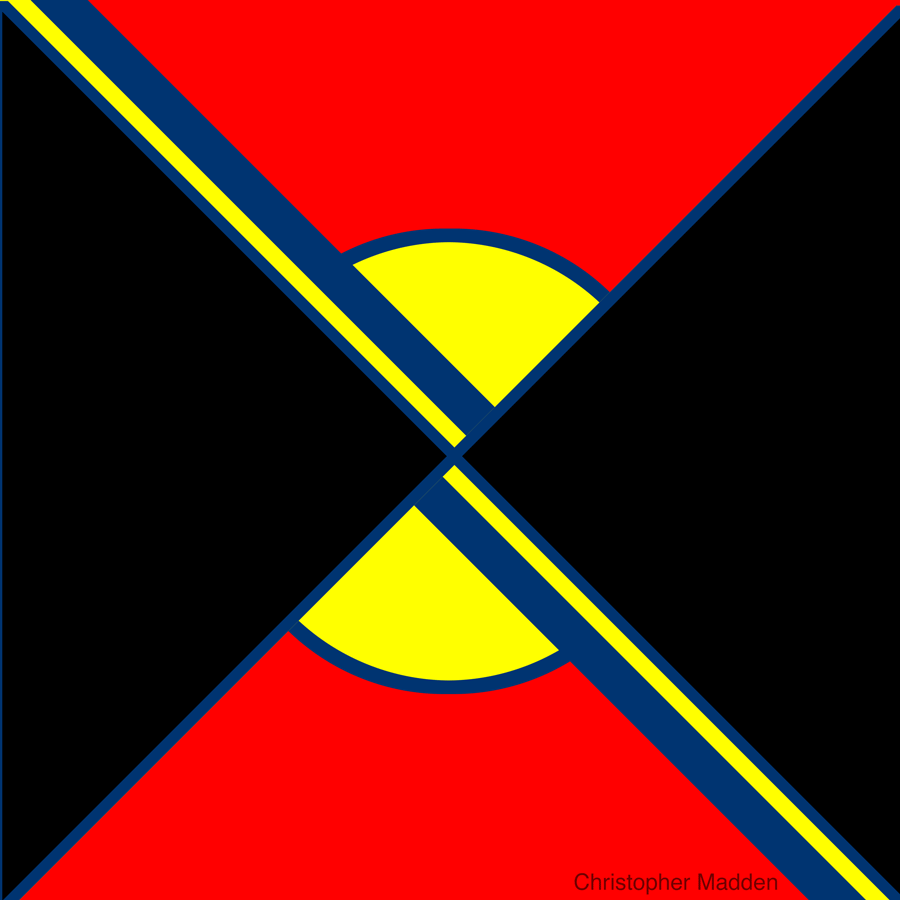
A digitally created geometric abstract work consisting of diagonals and circles. In this work I was chiefly concerned with the effect of creating discontinuous diagonals. The circle helps to focus the attention onto the centre of the image, where all of the action is taking place, as well as adding a degree of three-dimensionality and formal variation to the image.
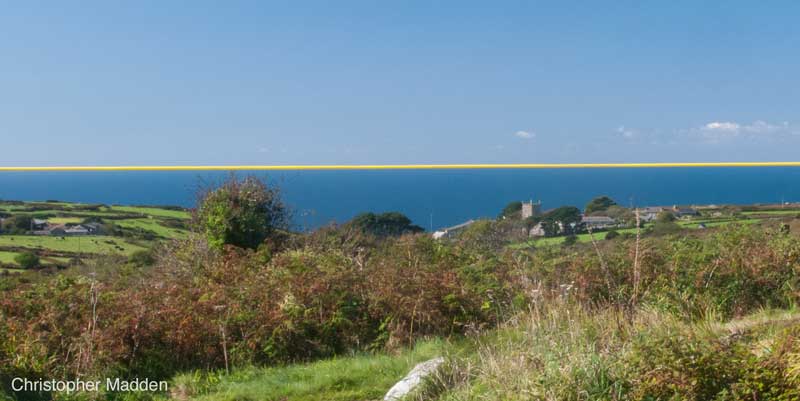
Unmanipulated photograph. Cord stretched along the horizon: Zennor, Cornwall, UK Plastic cord, landscape. September 2017
A photograph of a length of brightly coloured plastic cord stretched horizontally so that it coincides exactly with the horizon. This is an unmanipulated photograph. The work is partly about the all pervasive presence of plastic in our lives and the environment, with the piece of plastic cord se. he horizon created by the sea links the cord with the plastic pollution that is present in vast quantities in the oceans. As well being a metaphor for the plastic pollution in the oceans, the cord also signifies that plastic is in many ways a very useful and pleasing substance (without which our modern world wouldn’t be able to function). This is indicated by the fact that the cord creates a very pleasing aesthetic effect. The major problem with plastics is the complex molecular structures that are created during the creation of the plastic that mean that they decompose very slowly. If this problem is solved the plastic problem will be greatly reduced (although of course it will still be a problem, along with all of the other problems based on consumerism that we are inflicting on the planet).
The work also exists at a purely aesthetic level, with an appeal generated solely through the juxtaposition of the horizon and the plastic cord.
The work was created overlooking Zennor, Cornwall, UK.
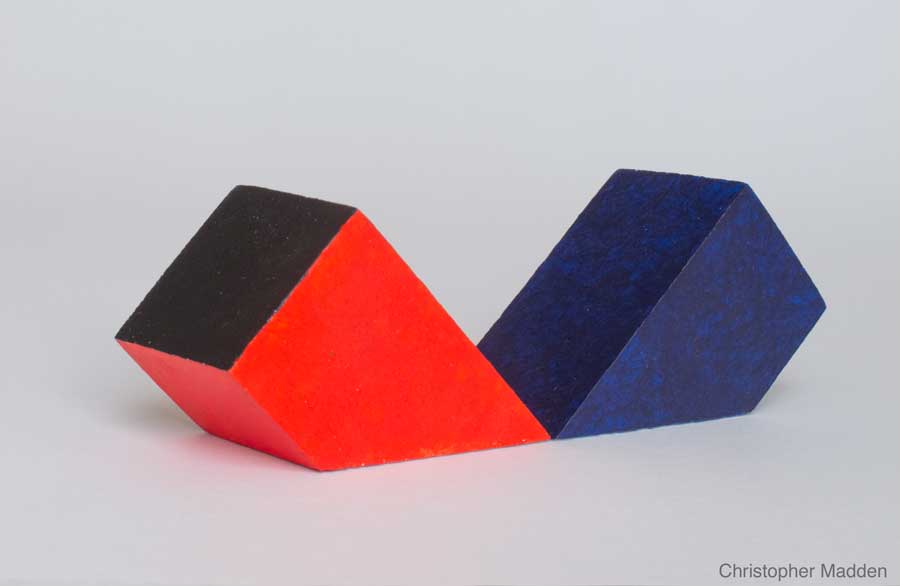
It’s hard to tell how big this sculpture is from this photograph.
It could be a couple of metres tall. In fact it’s closer to five centimetres, as the piece is created from lengths of 2×2 wood (two inches by two inches). The work has a strange relationship with scale. It’s small, but it could be big.
At it’s actual size this sculpture looks as though it’s happy at the size that it is, while somehow containing the spirit of a larger sculpture within itself. In some ways it gives the impression of being a large object that is somehow being perceived as being small, as though viewed through the wrong end of a telescope.
As I mentioned, this work is composed of two pieces of two by two wood. This is a common size of wood sold in long lengths in timber yards for use in general construction projects. This sculpture came about when I picked up two short offcuts of wood from a different project, that each had been cut at 45 degrees at one end, and placed them on a work surface on their angled faces. They instantly acquired a dynamic and vital presence. Due to the manner in which they rested at an angle each piece looked as though it was embedded in the surface with part of its form submerged.
One of the things I like about this work is that it is made from extremely simple components – two pieces of wood from a builders’ merchants and a bit of red and blue acrylic paint. Yet it doesn’t look like a work created in the spirit of found objects or ‘detritus art’ in which the work is often deliberately engineered to emphasise its origins in the flotsam and jetsam of contemporary consumer culture (Artists such as Philidda Barlow, whose work I like greatly, and Abraham Cruzvillegas come to mind as good exponents of this genre). The bright red and blue primary colours of the sculpture help, as found object sculpture is often the colour of rubbish. In fact this sculpture could almost be mistaken for a tiny example of the highly engineered works that are quite common in modernist sculpture.
An abstract moving image work from a series in which multiple copies of a single shape (usually a relatively simple geometrical form) move, overlap and interact using simple computer algorithms to create complex shapes. This work was exhibited in the London Group Open, 2017.
Spyk: Abstract moving image: August 2017
To see higher resolution videos and more information about this series click here.
Wood, ceramic, acrylic paint Height 12cm August 2017
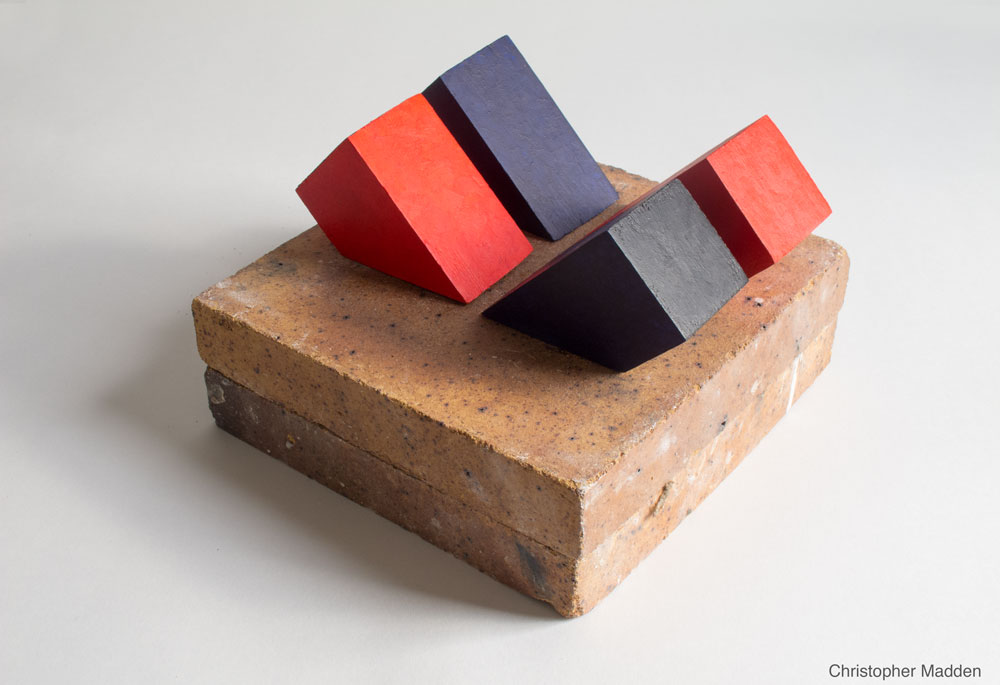
A sculpture composed of four identically shaped, differently coloured blocks of wood mounted on two ceramic tiles. The wood blocks are set at an angle to the vertical to give the impression that they may be partly concealed within the base on which they stand. The work is deliberately made from mundane material at a small scale which gives the work a surprising intimacy.
The piece is composed of scrap material that has been recycled or upcycled to create the artwork. It is no doubt influenced by the Arte Povera movement which used discarded artefacts to construct artworks. It is also influenced by the current awareness of environmental issues and the problems posed by consumer waste.
I was interested to see during a visit to an Apple Store in London today (in April, 2017) that the current ‘branding animation’ that is running on all of the Apple computers on show had something of the look and feel of some of my own animations from several years ago (shown below). This is probably a coincidence. I can’t imagine that the designers in Apple’s branding department were trawling the internet and happened to come across my work, and then even more improbably chose to adopt some of its style. The Apple animation, which I can’t find on the internet, and therefore can’t point you towards, features the leaf on the Apple logo detaching itself and replicating itself to form a rotating circle composed of multiple copies of itself, changing size and colour but always retaining a degree of graphic simplicity. The animation sequence to me had something of the feel of mine. Of course it may only be me who sees any resemblance, due to my heightened sensitivity towards the design factors of the work I created. My work uses circles rather than leaf-shaped lozenges, my circles interact where they overlay while Apple’s simply overlay, and mine are different colours, but that’s not much of a difference in my book. Assuming that there IS a resemblance of some sort I’m not sure whether to be pleased that a company of Apple’s status is using a similar style to mine, and thus validating it, or be annoyed that a company of Apple’s status is using a similar style to mine, as people would inevitably say “Your animation’s inspired by Apple’s, isn’t it?”.
A longer version of this animation, with more variation in the movement, can be seen here: Animation
A detail from an abstract moving image work from a series in which multiple copies of a single shape move and interact using simple computer algorithms, creating complex shapes. The series combines my interest in art and science.
Daedim: abstract moving image
Animation. July 2017
To see higher resolution videos and more information about this series click here.